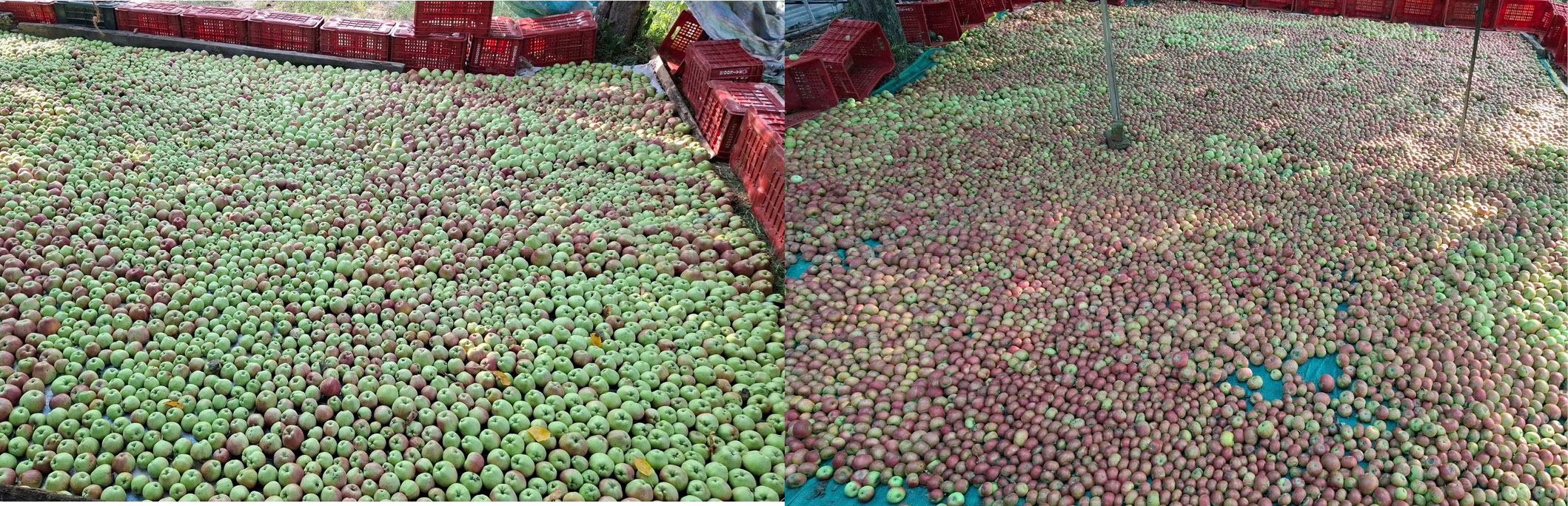
Baramulla: At first glance, the scene resembles a courtyard where paddy has been spread out to dry under the autumn sun. But there are no sheaves of paddy here.
These are thousands of recently harvested apples allegedly being sprayed with synthetic colour and spread out in the open courtyard of a farmer.
This practice of spraying synthetic colour on apples has triggered fresh concerns over the safety and credibility of Kashmir’s prized horticulture industry, raising questions about consumer deception, premature harvesting and the unchecked use of chemicals in orchards.
This correspondent saw large quantities of American and other commercial varieties of apples spread across a courtyard, with some fruit appearing green or inadequately coloured while others have a conspicuously bright reddish appearance.
An elderly woman informed that the apples were allegedly sprayed with synthetic colour before being spread out in the open and broad daylight in her neighbourhood.
Photographs with this newspaper show huge quantities of apples spread over large polythene sheets in an open courtyard, with crates arranged around them. Interestingly there is apparent contrast between green, immature-looking apples and apples displaying a reddish cum pink colour, with the fruit reportedly being kept exposed to sunlight after the alleged colour treatment.
Concerns have been raised over the alleged use of artificial colouring and other treatments on apples to make unripe or inadequately coloured fruit appear ripe and more attractive to consumers.
According to the people associated with the apple trade and farming, some apples are allegedly being subjected to artificial colour treatment before reaching markets. The practice deceives consumers into believing that the fruit has naturally attained the desired colour and maturity.
“When an apple has been artificially coloured, the consumer cannot identify the chemical simply by looking at it. If pesticide residues exceed permissible limits, the colour of the apple will not reveal that either. And it is the consumer who will bear the brunt and pay the price,” said Nazia Nabi, a social activist.
The issue assumes significance in Kashmir, where apple cultivation is a major component of the horticulture economy and the quality and appearance of the fruit have a direct bearing on farmers’ returns.
“How can a practice involving a food commodity of such economic importance take place openly without effective inspection? Kashmir’s apple industry is one of the pillars of the rural economy. Its reputation depends on consumer confidence. Anything that compromises that confidence threatens not only consumers but millions whose livelihoods are connected with the crop,” said president Fruit Growers and Dealers Association, Fruit Mandi Sopore.
Sources familiar with the issue have urged the Agriculture and Horticulture authorities to conduct inspections of orchards, fruit sheds and collection centres, storage facilities and fruit markets to ascertain whether any unauthorised colouring or chemical treatment is being used on apples.
Experts point out that there is a difference between approved horticultural treatments used scientifically to improve fruit colour and maturity and the unauthorised application of synthetic colours or chemicals after harvest to make fruit appear ripe.
In May 2025, FSSAI specifically directed States and Union Territories to intensify inspections against illegal fruit-ripening agents, synthetic colouring and non-permitted coatings on fruits. The food regulator called for inspections of fruit markets, godowns and storage facilities suspected of using prohibited substances.
The alleged colouring of apples therefore warrants a proper scientific investigation. Samples from markets and storage facilities could be collected and sent for laboratory testing to determine whether any unauthorised synthetic colour, prohibited ripening agent or non-permitted coating has been used.
Fruit growers and traders have also been urged to follow approved agricultural and food-safety practices, while consumers have been advised to remain cautious about unusually bright or artificially uniform-looking fruit.
If the allegations are established through laboratory testing, strict action should follow against those responsible. At the same time, genuine apple growers and traders should not be unfairly blamed without scientific evidence.
“The agriculture and horticulture departments and food-safety authorities need to jointly examine the matter so that consumers are protected and the reputation of Kashmir’s apple industry is not compromised by a few unscrupulous practices,” Ghulam Nabi Baba,a research scholar.
These are questions for the system, not simply for the individual farmer. The matter, therefore, warrants investigation rather than dismissal.
The debate over artificially coloured apples comes at a time when Kashmir is already confronting disturbing questions about long-term chemical exposure in its orchards.
For decades, pesticides, insecticides and fungicides have become an integral part of commercial apple production.
The reason is understandable: growers are fighting pests, diseases and changing climatic conditions while trying to protect their livelihood.
But the scientific evidence supplied to this newspaper points towards another side of the story—the possible health consequences of prolonged occupational exposure to agricultural chemicals.
A study conducted at the Sher-i-Kashmir Institute of Medical Sciences (SKIMS) examined 432 patients with primary malignant brain tumours admitted between January 2005 and December 2008. “Of the 432 brain-tumour patients studied, 389—or 90.04 percent—were orchard farm workers, orchard residents or children playing in orchards who had been exposed to multiple neurotoxic and potentially carcinogenic chemicals for periods ranging from 10 to 20 years,” the study report revealed.
The chemicals identified in the study included chlorpyriphos, dimethoate, mancozeb and captan.
The researchers concluded that the findings pointed towards suspicion of a link between pesticide exposure and malignant brain tumours.