Bireswar Sen occupies a distinctive and refined place in the history of modern Indian art. Known for his subtle, meditative landscapes, Sen brought together elements of Indian tradition and modern artistic sensibility to create a style that was both deeply personal and culturally rooted. His work stands as a quiet yet powerful response to the changing artistic currents of early twentieth-century India.
Born in 1897 in Bengal, Sen did not initially pursue art as a career. He studied science and completed a degree in the subject, but his inclination toward artistic expression gradually drew him into the world of painting. This shift proved to be significant, not only for his own life but also for the broader development of Indian modern art. At a time when artists were seeking alternatives to Western academic realism, Sen found inspiration in indigenous traditions and nature.
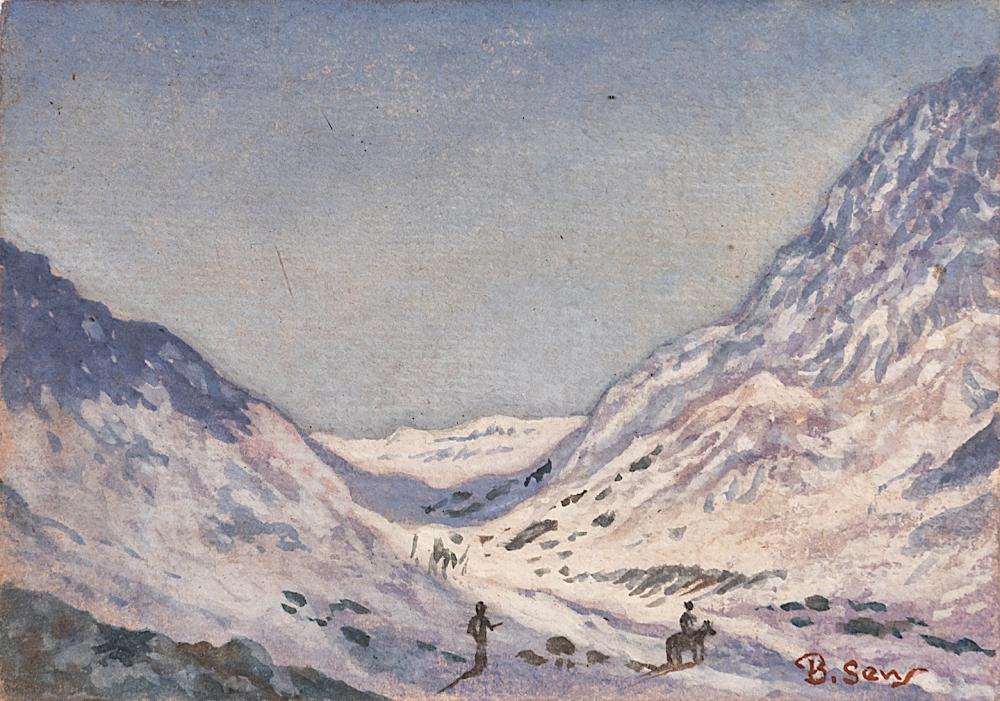
Sen is best known for his miniature landscapes, often executed on a very small scale yet carrying immense depth and emotional resonance. His works frequently depict the Himalayan region, including areas such as Kashmir, Kullu, and Garhwal. However, these are not mere topographical representations. Instead, they are poetic interpretations of nature, where mountains, valleys, and skies dissolve into misty, dreamlike atmospheres.
Drawing inspiration from Mughal and Pahari miniature traditions, as well as East Asian art, Sen developed a language that was both traditional and modern. He avoided grandeur and dramatic realism, choosing instead to express vastness through minimalism. His ability to suggest infinity within limitation is one of his most remarkable achievements.
Sen experimented with extremely small surfaces. He is known to have painted on unconventional formats such as postage stamp-sized papers and even matchbox-sized surfaces. These tiny works were not mere curiosities; rather, they reflected his mastery over detail and his belief that scale does not limit expression. Even within such confined spaces, he was able to create a sense of vast mountains, distant horizons, and atmospheric depth—demonstrating extraordinary control and sensitivity.
Apart from his artistic practice, Sen also made significant contributions as an educator. He was associated with the Lucknow College of Arts and Crafts, where he eventually served as principal. Through his teaching, he influenced a generation of artists and helped shape a more Indian-oriented approach to art education. His contribution was recognized by the Government of India when he was awarded the Padma Shri in 1954.
Unlike Nandalal Bose and Abanindranath Tagore, who largely focused on culture, tradition, mythology, and the revival of classical Indian themes, Bireswar Sen developed a deep and sustained interest in nature as his primary subject. While his style remained rooted in traditional miniature techniques, his artistic vision moved toward a more introspective and atmospheric expression. Instead of narrative or cultural symbolism, Sen emphasized mood, silence, and the spiritual essence of landscapes. His paintings are less about storytelling and more about evoking a meditative experience, where nature becomes a means of inner reflection.