Few artists in history have explored the human face with as much honesty and insight as Rembrandt. His portraits are admired not only for their technical brilliance but also for their remarkable ability to reveal the inner life of the sitter. Rather than idealizing his subjects, Rembrandt painted them with all their strengths, flaws, and emotions, transforming portraiture into a profound study of humanity.
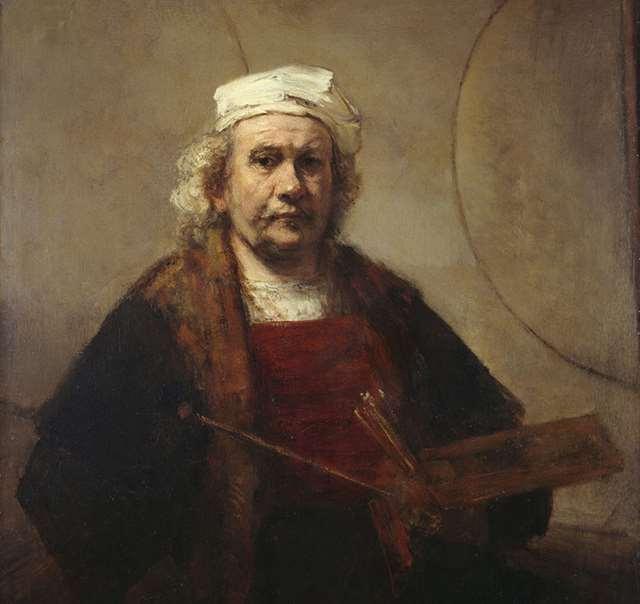
A striking example of his mastery is Self-Portrait with Two Circles, painted during the final years of his artist’s life. Standing before a plain wall marked by two enigmatic circles, Rembrandt presents himself as an aging painter holding his tools. Wrinkles, sagging skin, and tired eyes are rendered without disguise, yet the portrait radiates dignity and confidence. The direct gaze suggests a man who has endured hardship but remains steadfast in his craft.
The painting offers valuable insight into Rembrandt’s working process. He likely began with a toned canvas and a loose sketch, establishing the broad arrangement of forms. Rather than focusing on outlines, he built the image through areas of light and shadow. Strong illumination on the face emerges from a dark background, creating the dramatic effect for which he is celebrated.
Working in layers, Rembrandt gradually developed the portrait with rich, textured brushstrokes. Thick applications of paint, particularly on the highlights of the forehead, nose, and cheeks, give the surface a sculptural quality. Seen up close, the painting appears almost abstract; from a distance, these strokes merge into a convincing likeness filled with life and character.
What makes this portrait exceptional is its psychological depth. The face records not only age but experience. Every wrinkle and shadow becomes a mark of a life lived, turning a simple self-portrait into a meditation on time, resilience, and artistic identity.
More than three centuries later, Rembrandts portraits especially Self-Portrait with Two Circles remains one of the greatest achievements in portrait painting. It reminds us that the power of a portrait lies not merely in capturing appearance, but in revealing the person within.