We all know Jim Carrey as an enthusiastic actor and an amazing comedian. Well, he is an award-winning actor who has been honored for both his dramatic and comedic work. He has starred in dozens of films including “Ace Ventura: Pet Detective,” “Dumb and Dumber,” “Liar Liar,” “The Mask,” “Eternal Sunshine of the Spotless Mind,” and “The Truman Show.” Carrey also starred in the hit television series “In Living Color.” Despite his blooming career as an actor, Jim Carrey nonetheless found himself dripped in paint in order to find a more expressive form of art to communicate with people and to convey his views. Carrey released a documentary short, “I Needed Color.” For six years, he had quietly devoted himself to a studio practice, painting and sculpting as a way of mending his personal frustration and dissatisfaction with Trump administration.
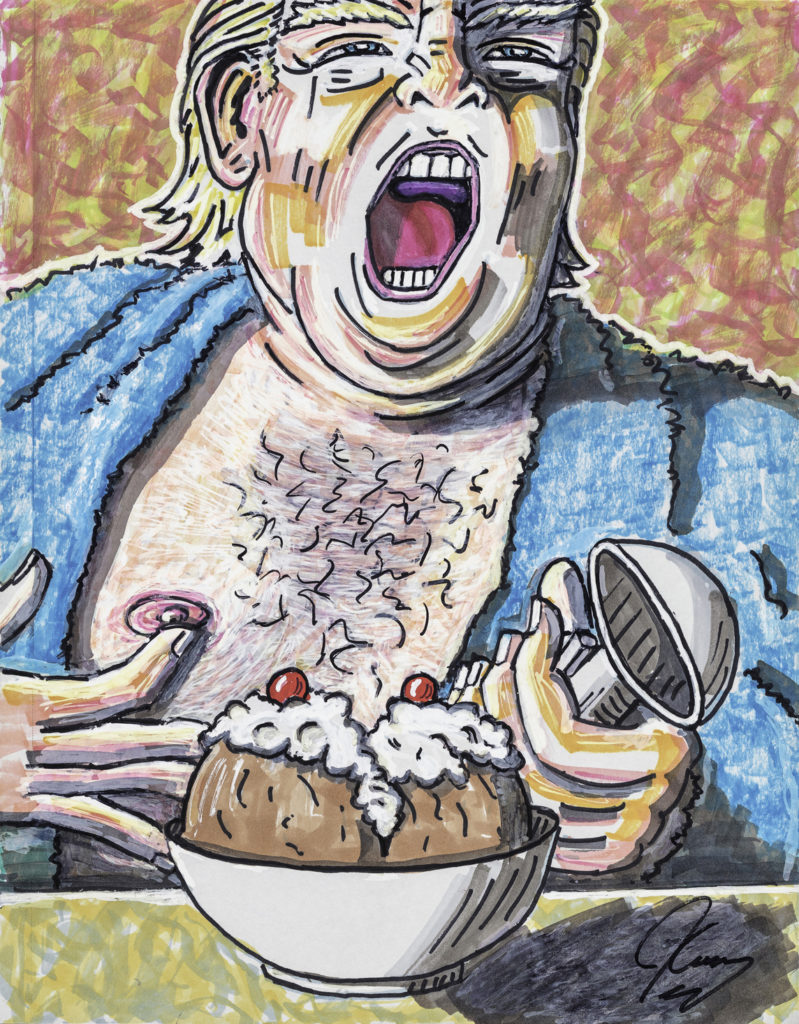
Jim Carrey as an artist is as expressive and enthusiastic as he is as an actor. One can say that as an artist he seems more emotional and innocently honest. Even though in his political cartoons he is not afraid to openly take aim at the Trump administration.
At the New Yorker Festival, Jim Carrey spoke about his painting, his political cartoons, and the Trump administration this is what he said,
“I get to a certain point where people go, ‘Oh, my God, you’re really great. That’s what you are.’ And I go, ‘Nope. I’m something different,’” Carrey told Colin Stokes, associate cartoon editor of the New Yorker, at this weekend’s New Yorker Festival. “I want to constantly be fashioning the limbs to this avatar and I want to constantly be growing, so what happens is I get a lull in popularity a little bit, and I kind of go away and I learn a new thing.”
Although Jim Carrey frequently published his work on social media with definitive commentaries, his political cartoons were shown in a Gallery at Maccarone in Los Angeles as “IndigNation” : Political Cartoons by Jim Carrey, 2016–2018,”
Jim Carrey has been very vibrant in criticizing the Trump administration, and has made numerous headlines with his political cartoons. In an interview he said, “I think that people are underestimating the danger involved in having this—such a lack of power over a president like this,” Carrey added. “If we ever do get back into power, we need to revisit presidential powers. I don’t think the founding fathers had a traitor in mind being at such a high office. They didn’t count on that one.”
When asked about his controversial drawing of White House press secretary Sarah Huckabee Sanders he said, “This is as flattering a portrait as I could do “And I got a little bit of flak from it…when they said, ‘Oh, jeez, it’s not nice to do an ugly portrait of this person,’ I went, ‘Ugly is on the inside, man. And, yes, in some people, you know, it manifests outwardly.’”
Carrey has been extremely vocal, both in his art and his commentaries. In another cartoon more controversial cartoon Donald Trump is shown in a straightjacket, hanging upside-down above the city streets. As Carrey had described it as a piece showing “the escape artist that is Donald Trump, being mocked by the Twitter bird, using the American flag as a prop, and losing what little hair he has left.”
According to Carrey “All pain becomes art. That’s the rule,”. “Some horrible thing happens in your life. For me, I end up at the art studio.”
Landscape painting
In the past as we know, the subject matter of paintings was largely taken for granted and the majority of the older pictures mostly represented religious subjects. Artists rarely stepped away from pre meditated themes and rarely painted a scene from a romance or an episode of contemporary history. It was only in the late 18th century that artists began to experiment and ignoring the shackles of old customs. Artists like Copley, Jaques Louis David and the great Spanish painter Francisco Goya, were among the first artists who consciously freed themselves from the bonds of tradition and managed to transform the meaning of art. This transformation gave artists more freedom to experience and more freedom to express themselves.
Even though the mentality of art world was transformed and artists enjoyed new freedom in their choice of subject matter, landscape painting was still looked upon as a minor branch of art. But, this attitude changed, with great artists who raised this type of painting to a new level. The two main artists who uplifted the dignity of landscape painting were, ‘William Turner and John Constable.
Turner is often lauded as the 19th century’s greatest landscape painter. Turner’s depictions of storms, waves, and fire capture the terror and tranquility of the natural world. Known as the “painter of light,” Turner’s unique ability to combine the intensity of Romanticism and the beauty of nature solidified his place as one of history’s foremost Romantic artists.
He was a very successful artist whose paintings were very much admired by Royal Academy. His fantastic landscapes were splendid with beauty and movement. His paintings were crowded by each and every effect which could make them more striking and dramatic to shock the audiance. The enthusiasm and perfection with which Turner worked gave his paintings a conception of grandeur of nature at its most romantic and sublime.
John Constable was another artist along with Turner who uplifted the respect for landscape painting. Unlike Turner he had no wish to shock people by daring innovations; he was more faithful to his own vision. He used to make sketches from nature and elaborate them in his studio. His paintings were not immediately accepted to be shown in a gallery but, his persistence made him one of the greatest landscape painters ever lived.
Along with Turner and John Constable another artist who revolutionized landscape painting was the German painter Casper David Friedrich. Friedrich’s paintings reflect the mood of the Romantic lyrical poetry of his time. In our contemporary art world, there is no disconnection of landscape painting from other forms of art., thanks to artists like William Turner, John Constable and others that Landscape painting is as important branch of art as any other form.