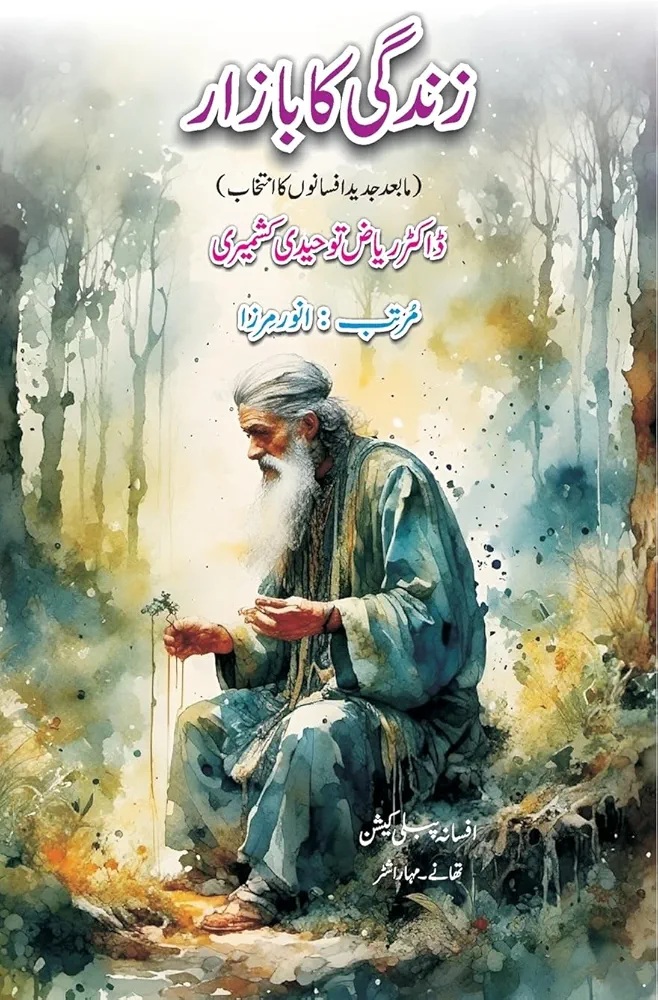
Among the writers from Kashmir valley who have rendered selfless services to literature earning not only recognition for themselves but also carving a distinct identity in the world of Urdu literature the name of Dr. Riyaz Tawhidi deserves to be written in golden letters. Born in Wadi Pora, Handwara, in the border district of Kupwara, this literary son of the soil has so far presented several short story collections to Urdu literature, notable among them Kalay Pedon Ka Jangal (The Forest of Black Trees) and Kalay Dīvon Ka Saaya (The Shadow of Black Demons). Recently, his latest short story collection, Zindagi Ka Bazaar (The Marketplace of Life), has come into public view. This collection has been compiled by Anwar Mirza and published by Educational Publishing House, New Delhi. Comprising 220 pages, the book has an attractive and well-designed cover. Dr. Tawhidi has dedicated this collection to the new generation of Urdu readers.
Izhar Khizr, hailing from Patna, Bihar, has written a brief yet comprehensive note on this collection. According to him, Dr. Riyaz Tawhidi is not only a fine critic of fiction but also a capable and successful creative writer of Urdu short stories. Prof Qudus Javed has contributed a long and detailed article on Dr. Tawhidi’s short story writing and his critical abilities. In his view, Dr. Tawhidi’s stories are not confined merely to local themes, rather, the canvas of many of his stories extends to global issues as well. In this article, Prof Qudus Javed has presented a detailed review of dozens of Dr. Tawhidi’s short stories.
Expressing his happiness, Dr. Riyaz Tawhidi himself states that the stories included in this collection are selected pieces from his first two published collections as well as from a third collection that is currently under compilation. This collection contains a total of forty-one short stories. The Secret of White Light is the opening story of the book. It is based on a philosophical dialogue and successfully attempts to explain the clear distinctions between light, illumination, the original, and the copy, and how a philosopher can make the most complex ideas understandable to an ordinary person.
David Planet is a science-fiction story included in this collection. It revolves around David, a twenty-year-old young scientist. He succeeds in creating a man-made world established on a distant planet far away from Earth, where life is comfortable and equipped with every luxury. They even defeat death and establish a realm of eternal life. However, just when they are engrossed in celebrating their success, the entire system collapses in an instant. Cosmic rays spread everywhere and robots begin to melt. Through this fiction, the negative consequences of unnatural human interference in the natural system are presented as a powerful reaction.
Global Lie is a resistance story that narrates, in a complete and forceful manner, the misdeeds of powerful beasts of the present age who, in the name of democracy, are strangling weak and helpless nations. Stone-Pelter portrays what violence truly means and how countless people continue to suffer oppression and brutality for years because of it. The story becomes even more shocking when innocent and blameless individuals are subjected to cruelty and torture under the cover of lies.
The Lost Capital is one of the most painful and heart-rending stories of the collection. It deals with the insensitivity and disobedience of children toward their parents in the contemporary era. Ghafar Khan lies alone in a hospital and is abandoned even in his final moments of life, despite the fact that his son whom he had raised with great care and affection had become a renowned surgeon abroad. Yet, in spite of all this, the son chose to remain indifferent to his father.
Depression exposes the animalistic traits of a driver and a conductor who, for decades, have subjected passengers traveling in a dilapidated and rusted bus to cruelty and violence, even sending many of them into eternal sleep. Homeland vividly depicts the situation in valley when, during the 1990s, circumstances took a drastic turn. The once pleasant and joyful atmosphere was poisoned, and the age-old heritage of Hindu-Muslim-Sikh unity was uprooted. The story also gives voice to astonishing revelations based on truth and ground realities.
Thorns of the Babool Tree is a story that powerfully reflects flawed political attitudes and the misuse of authority by political leaders. Often, despite everything being fair and transparent, influential individuals subject honest and sincere people to various forms of torment. This bitter reality emerges prominently in the story.
Never Say Goodbye is a romantic tale, and any amount of praise for it would be insufficient. Written in a simple and lucid language, the story leaves a deep impact on the reader by showing how undue parental interference separates a couple forever, and how, later in life, their inability to adjust leaves them in perpetual sorrow.
The Forest of Black Trees, the title story of Dr. Riyaz Tawhidi’s first collection, depicts how the forest of black trees made human lives unbearable. As evening fell, anyone who thought of stepping outside would hesitate a thousand times, because for decades the settlement had been subjected to night raids of fire and destruction. This suffering was portrayed as a punishment for no crime but old age.
The Lost Graveyard is crafted in such a way that it brings before the reader’s eyes that era of valley when, due to violence, youths, elderly people, children, and even women were targeted and put to eternal sleep. As a result, thousands of women were widowed and millions of children were forced to live lives of orphanhood.
Flowers of Mercy is another poignant story that highlights an important social issue. Often, people today feel unhappy at the birth of daughters, yet later it is daughters who, more than sons, bring joy to their parents’ hearts through their achievements a reality beautifully portrayed in this story.
The Throat-Cutter reflects how cursing honest and simple traders and the inhuman selfishness of doctors have become a norm in today’s society. The story deeply affects the reader by portraying how the butcher respected doctors, and how, in return, the doctors treated him revealing a heart-shaking tale.
Dr. Riyaz Tawhidi is richly endowed with creative abilities, and he presents his ideas in his stories with maturity and refined expression. His style is unique and graceful, something that readers can clearly experience through his narratives. May God grant him the strength to continue serving Urdu literature further. I humbly request readers to read this short story collection and honor the author with their valuable and golden opinions.
Writer is a columnist based in Qazigund Kashmir