
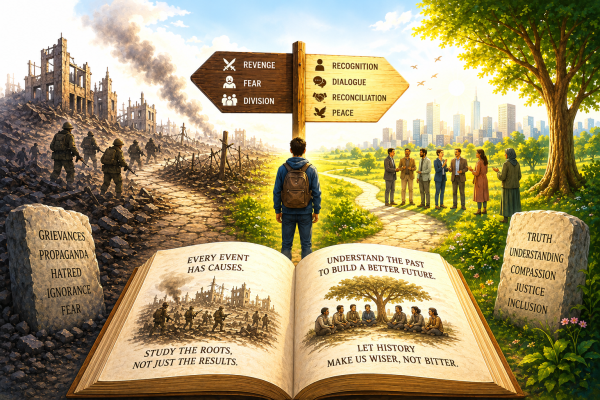
History is often described as humanity’s greatest teacher. Yet one uncomfortable question remains: does history truly teach us to avoid repeating past mistakes, or does it sometimes become a source of fear, insecurity, and revenge?
The answer depends less on history itself and more on how we choose to remember and teach it.
The famous saying, “Those who cannot remember the past are condemned to repeat it,” reminds us that history should be a guide for building a better future. But history can also become a weapon. Selective memories, incomplete narratives, and inherited grievances can transform historical events into powerful political tools that divide societies rather than unite them.
One of the strongest human emotions is the desire for revenge or to avenge perceived wrongs. Whether experienced by an individual, a community, or an entire nation, the feeling of historical injustice can endure for generations. It is precisely this emotion that makes wounded societies vulnerable to exploitation. Political leaders, extremist movements, foreign powers, and ideological groups often revive historical grievances to mobilize support, justify violence, or consolidate power.
The twentieth and twenty-first centuries provide numerous examples.
The genocide in Rwanda in 1994 did not emerge overnight. Decades of colonial policies had institutionalized ethnic divisions between Hutu and Tutsi populations, creating inequalities that were later manipulated by political leaders. Historical grievances, fear, and propaganda culminated in one of history’s worst genocides, claiming around 800,000 lives in approximately one hundred days.
The breakup of Yugoslavia during the 1990s similarly demonstrated how centuries-old memories of conquest, religion, and ethnic conflict were revived by nationalist politicians. Historical narratives became instruments of fear, contributing to wars that killed over 100,000 people and displaced millions.
In Northern Ireland, decades of violence known as the Troubles were sustained not only by contemporary political disagreements but also by generations of historical mistrust between Protestant unionists and Catholic nationalists. The conflict eventually began to ease only after sustained political dialogue, recognition of grievances, and the 1998 Good Friday Agreement established mechanisms for peaceful coexistence.
The Holocaust remains one of history’s darkest reminders of where hatred and dehumanization can lead. Its lessons have shaped international human rights law and the global commitment to preventing genocide. Yet even today, anti-Semitism, racism, and xenophobia continue to resurface whenever societies forget the broader lessons of history.
In South Africa, however, history offers a different example. After apartheid ended, the country did not pursue widespread retaliation against former oppressors. Instead, the Truth and Reconciliation Commission, chaired by Archbishop Desmond Tutu under the leadership of Nelson Mandela, created a process that allowed victims to be heard while encouraging perpetrators to acknowledge their actions. The process was imperfect, but it demonstrated that recognition and reconciliation can become stronger foundations for peace than revenge.
These examples reveal an important truth: where historical wounds run deep, punishment alone rarely heals societies. Genuine healing begins with conversation, acknowledgment of suffering, recognition of injustice, and reconciliation. None of these require forgetting history. Instead, they require understanding it honestly.
Every historical event has both causes and consequences. Wars do not simply begin with invasions. Revolutions do not arise without long-standing grievances. Genocides do not occur without years of discrimination, propaganda, and institutional failure. Economic collapses are rarely caused by a single decision. Every major event is the culmination of many social, political, economic, and cultural factors.
Yet history is often taught as a sequence of isolated events rather than as interconnected processes. Students frequently learn when a war started or ended, who won, and who lost, without fully understanding why the conflict emerged in the first place. This narrow approach risks creating simplistic heroes and villains while ignoring the complex chain of decisions, fears, ambitions, and failures that produced the outcome.
Such selective teaching creates fertile ground for bias. It allows competing groups to construct their own versions of history, each emphasizing their suffering while overlooking the suffering of others. Over time, these competing memories become barriers to mutual understanding.
To prevent history from repeating itself, societies must study not only what happened but also why it happened. If the underlying causes remain unaddressed, inequality, discrimination, exclusion, authoritarianism, economic despair, or misinformation, the same conditions can produce similar outcomes under different circumstances.
History should therefore not be treated as a catalogue of victories and defeats, nor as a permanent justification for resentment. It should be understood as an ongoing study of human choices and their consequences. The purpose of remembering is not to inherit anger but to inherit wisdom.
A mature society does not erase painful chapters from its past, nor does it become imprisoned by them. Instead, it confronts them honestly, examines the causes, recognizes every victim, accepts uncomfortable truths, and builds institutions that reduce the likelihood of repetition.
The ultimate lesson of history is not that conflict is inevitable. It is that human beings always possess the ability to choose differently. Whether history becomes a bridge to understanding or a prison of revenge depends entirely on how we teach it, how we remember it, and how willing we are to learn from it.
History should not simply tell us where we came from. It should help us decide where we want to go.