
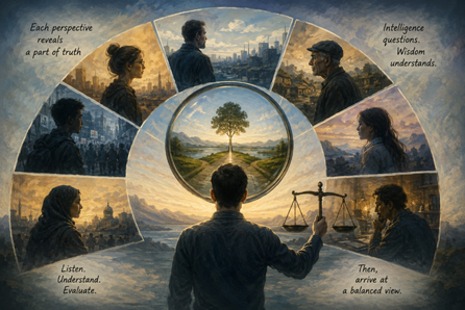
Human beings rarely see the world as it is. We see it as we are. Our experiences, upbringing, education, culture, beliefs, fears, ambitions, and emotions all shape how we interpret reality. Two people can witness the same event and come out with completely different conclusions—not because one is necessarily lying, but because each is viewing the event through a different psychological lens.
This is why the ability to consider multiple perspectives is one of the most valuable forms of intelligence. It is not simply about listening to opposing opinions; it is about recognizing that every perspective reveals a part of reality while concealing another. The challenge is to assemble these fragments into a more complete picture.
From a psychological standpoint, the human brain is not naturally wired for balanced thinking. It evolved to make quick judgments rather than perfect ones. Our ancestors survived by rapidly distinguishing friend from foe, safe from dangerous, familiar from unfamiliar. These mental shortcuts, known as heuristics, remain with us today. They help us make fast decisions but also leave us vulnerable to biases.
One of the strongest of these is confirmation bias—our tendency to seek information that confirms what we already believe while dismissing evidence that challenges our views. Another is motivated reasoning, where our conclusions are guided less by facts and more by our desire to protect our identity, beliefs, or social group. Once we become emotionally invested in an idea, our intelligence often works not to discover the truth but to defend the position we already hold.
This explains why highly intelligent people are not necessarily more objective. Intelligence can become a sophisticated tool for rationalizing existing beliefs rather than questioning them. Knowledge without intellectual humility can reinforce certainty instead of wisdom.
Viewing multiple perspectives requires a different kind of intelligence—one rooted in curiosity rather than certainty. It demands the willingness to ask uncomfortable questions:
- What if I am mistaken?
- Why does someone else see this differently?
- What experiences shaped their view?
- What evidence contradicts my own assumptions?
These questions shift the mind from defending beliefs to exploring reality.
Psychologists also distinguish between cognitive empathy and emotional empathy. Emotional empathy is feeling another person’s emotions. Cognitive empathy is understanding how another person thinks, even if we disagree with them. The latter is essential for balanced judgment. One does not need to agree with another viewpoint to understand why it exists.
History repeatedly demonstrates the danger of one-dimensional thinking. Ideologies, nationalism, religious extremism, political polarization, and even financial bubbles often emerge when societies become convinced that only one narrative is correct. When dissent disappears, mistakes become invisible. Diverse perspectives act as a safeguard against collective blind spots.
Science itself progresses through this principle. Every scientific theory remains open to challenge because truth is strengthened by scrutiny rather than weakened by it. In contrast, dogmatic thinking seeks certainty before investigation. One asks questions; the other suppresses them.
Modern technology complicates this further. Social media algorithms reward engagement, not balance. They often expose people to information that aligns with their existing preferences, creating echo chambers where familiar ideas are constantly reinforced. Over time, repeated exposure creates the illusion that one perspective represents the whole truth, making opposing viewpoints appear irrational or even threatening.
Balanced thinking does not mean assuming every opinion carries equal merit. Some claims are supported by overwhelming evidence while others are based on misinformation or prejudice. Balance is not the absence of judgment; it is the discipline of delaying judgment until evidence has been examined from multiple angles. It means weighing facts, questioning assumptions, recognizing uncertainty, and remaining willing to revise one’s conclusions when new evidence emerges.
This process reflects what psychologists describe as integrative complexity—the capacity to recognize that competing ideas may each contain elements of truth and to integrate them into a broader understanding. Research has associated higher integrative complexity with better decision-making, more effective conflict resolution, and greater resilience in dealing with uncertainty.
Ultimately, wisdom lies not in collecting more opinions but in learning how to evaluate them. Intelligence provides the capacity to analyze information; humility provides the willingness to question oneself; and perspective provides the context necessary to understand others. Together, they form the foundation of balanced judgment.
Perhaps the greatest mark of an intelligent mind is not how firmly it holds its beliefs, but how confidently it can examine beliefs that differ from its own without fear. In a world increasingly divided by certainty, the ability to view reality through many lenses may be one of humanity’s most important intellectual and moral strengths.