In an age where images are consumed in seconds and judged almost instantly, we often ask what a painting means. Rarely do we ask what remains beyond it. The following is not an essay on aesthetics but a conversation between two artists reflecting on truth, expression, and the invisible burden every work of art carries.
Artist A: What is the purpose of art?
Artist B: Perhaps it is not to explain life but to remain in dialogue with it. We often believe art is an act of communication, yet every artist eventually discovers that no painting can completely contain what gave birth to it.
Artist A: Then every artwork is incomplete.
Artist B: Every expression is partial. Truth is always greater than its expression. A painting is not truth itself; it is merely one of its reflections.
Artist A: We usually think that whatever is absent from an artwork has been intentionally omitted.
Artist B: Not always. Some things remain absent because the artist cannot withstand the pressure of their presence. There are experiences whose weight exceeds language, exceeds paint, and sometimes exceeds the artist.
Silence, then, is not emptiness. It is compressed meaning.
Artist A: Yet there is another kind of silence. Sometimes an artist chooses not to reveal everything because expression has consequences. Human emotions are never fixed. Anger may later become regret. Certainty may become doubt. Which emotion deserves to be painted?
Artist B: Perhaps all of them. Human truth is rarely a single moment. It unfolds over time.
Artist A: sometimes our work gets sold, what does the buyer actually possess?
Artist B: We often assume that buying a painting means possessing it. In reality, the collector acquires the object, not the journey.
The artist alone remembers the uncertainty before the first brushstroke, the abandoned compositions, the sleepless nights, the private griefs, the invisible conversations, and the countless decisions that never reached the canvas. None of these can be framed or sold.
At first, every artist longs to be understood.
Recognition feels like the highest reward. There is an expectation that someone, somewhere, will finally see exactly what the artist intended.
Time changes that expectation.
Gradually the artist realizes that complete understanding is impossible. Every viewer arrives carrying their own memories, beliefs, and emotions. A painting is not a transfer of consciousness; it is an encounter between two consciousnesses.
Eventually another realization emerges.
The artist no longer wishes to be fully understood.
Not because of secrecy.
Not because of pride.
But because something must remain unspoken—not hidden, but preserved.
The unexpressed becomes the spark that ignites the next journey.
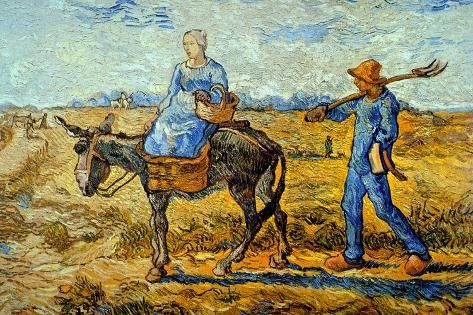
During this conversation, we paused before one of Vincent van Gogh’s quieter paintings depicting a donkey carrying a woman while a man walks beside them.
The discussion soon moved beyond Van Gogh himself.
The woman and the man will eventually reach home. They will speak of their journey, their hardships, and their memories.
The donkey will not.
It continues carrying without language.
Few will wonder what it witnessed.
Fewer will imagine that it, too, possesses an interior life.
One artist remarked, “Perhaps the donkey is the artist.”
The comparison was unexpected.
Artists often carry experiences that cannot be fully translated into words. Viewers may admire the work, critics may interpret it, collectors may purchase it, yet only the artist knows what the work demanded before it entered the world.
Why, then, do artists continue creating if every expression remains incomplete?
Perhaps because expression is not entirely a matter of choice.
Birds sing.
Spiders weave.
Whales call across oceans.
Human beings, too, seem compelled by forces they cannot entirely explain.
The difference may not be that humans express while animals do not. The difference may be that humans pause and ask why.
The greatest works of art rarely provide answers.
Instead, they preserve questions.
Perhaps that is their true generosity.
They do not imprison truth within explanation. They allow it to remain larger than language.
For every painting that reaches the wall, another remains unfinished within the artist.
And perhaps it is that unseen work—the one that can never be completed—that quietly calls the artist back to the canvas.