
Mir Syed Ali Hamdani, often known as Shah-i-Hamdan, is seen as one of the greatest personalities in the history of Kashmir. The impact of his existence during the 14th century on the valley can be witnessed even today in terms of spirituality, economy and art of the region. Born in Hamadan in Persia, he grew up in an environment of scholarship, spirituality, and disciplined learning. Over time, he became known as a Sufi saint, thinker, and reformer who travelled widely across regions including Afghanistan, Uzbekistan, Syria, Turkestan, China, and Kashmir.
His journey was deeply connected to the spread of spiritual wisdom along with morals. Each time he travelled to a new area, his primary purpose was to teach people about being honest and compassionate in life. Upon reaching Kashmir, he found that social and cultural changes were underway. His arrival was the beginning of organized spiritualism along with social guidance.
Here in Kashmir, his teaching was no longer restricted to rites and worship alone. He talked about justice among men, duties among leaders, compassion towards the poor, and equality in daily transactions. Slowly but surely, he laid down the basis for morality within society. Eventually, his teachings affected even commoners and rulers alike.
Along with spiritual teachings, he is also associated with a major cultural transformation in Kashmir. History shows how he invited highly skilled artists from Persia who possessed a very advanced understanding of craftsmanship, weaving, design, and architectural beauty. This influx of artists led to a sustained cultural interaction between Persia and Kashmir.
One of the areas that showed considerable influence was in the field of craftsmanship. Weaving, embroidery, woodwork, papier-mâché, and textile designs started to change during this time period due to these interactions. Artisans from this area started to learn about these techniques and adapt them to Kashmir’s conditions. It was not just imitation; rather, it was the creation of a new style.
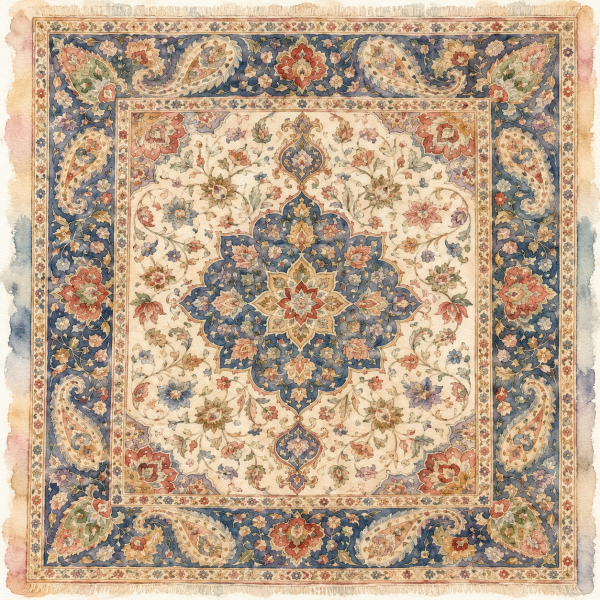
One of the most significant results of such an interaction was the development of carpet weaving. The Persians had very sophisticated methods of weaving carpets with knots of various types, floral designs, and natural dyeing. Gardens, vineyards, medallions, and symmetry were among the themes for the designs. Such ideas seemed to find their soil in Kashmir, as they were improved on by the Kashmiri weavers.
Iranian carpets gained strong recognition in Kashmir and surrounding regions due to their artistic depth and durability. The art of making carpets was carried on in Kashmir, where the craft took its own distinctive shape, although with Persian elements. More intricate craftsmanship and delicate texture design were created by the makers, resulting in carpets made from both silk and wool.
Carpets have great significance in the lives of people from Kashmir, for they are used in all sorts of places in their houses, such as the living room, the guest room, and the sitting room, creating a more elegant ambience. During weddings, religious gatherings, family functions, and special occasions, carpets are placed prominently as part of a traditional presentation. They are associated with respect toward guests and a sense of dignity in social gatherings. This practice continues across generations and remains an important cultural tradition.
Similarly, the influence of Shah-i-Hamdan is greatly related to , located in Srinagar. It can be noted that this is one of the most revered religious sites in the region. Khanqah-e-Moula, which is situated along the banks of the river Jhelum, bears testimony to the devotion and learning that have been taking place for centuries.
Besides spiritual leadership, he was also a scholar and writer. The book named Zakhiratul Muluk is all about governance, ethics, and social responsibility. It tells the rulers how to conduct themselves with righteousness, how to treat the people justly, and how leadership should always be driven by ethical considerations and not selfish motives. The text reflects a vision of society where authority is balanced with responsibility and where ethical conduct forms the foundation of governance.
Over time, the crafts and systems introduced or influenced during his era developed into a major part of Kashmir’s economy. Such traditions were practiced by all the families in the valley and became sources of income as well as artistry. In fact, such craftsmanship has even survived to the present day, and the artisans continue to contribute not only economically but also culturally through their art.
It is important to understand this legacy. Indeed, the arts and culture that were practiced several centuries ago continue even today in modern Kashmir, not only as relics of the past, but also as vibrant traditions. Carpet making continues in much the same way as it did centuries ago, following similar techniques and design styles.
The contribution of Shah-i-Hamdan does not limit itself to one single person but signifies a relationship of spirituality, culture, and economy that made Kashmir unique in terms of arts and moral values. The significance of Shah-i-Hamdan is visible in households, craft bazaars, and in the social structure of Kashmiri society.
About the Author: Shoiab Mohmmad Bhat is a writer, social educator and researcher from Baramulla, holds a master’s in Gender Studies and a BED. He writes on social issues, education, and gender perspectives, promoting awareness and positive change.