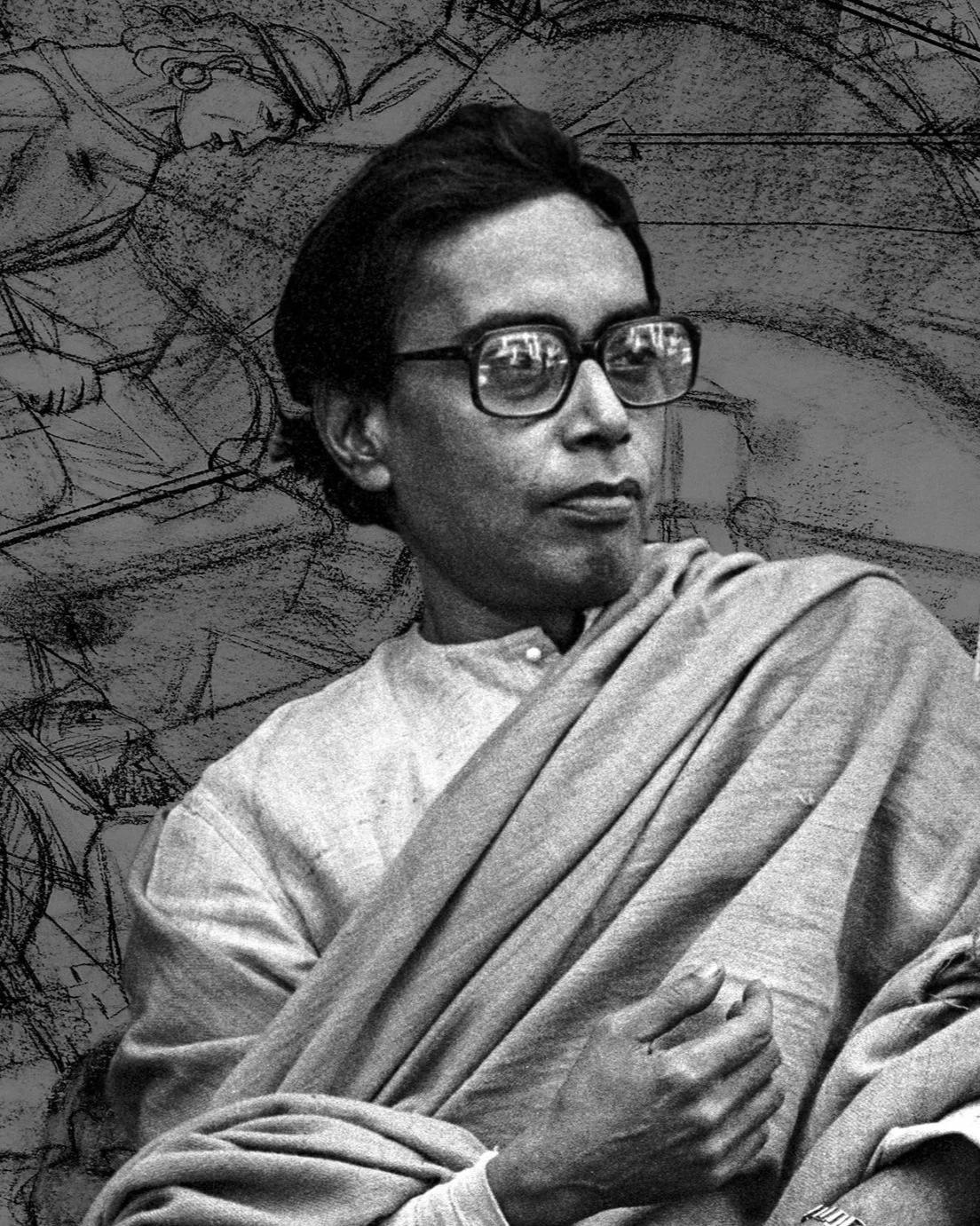
The recent sale of Ganesh Pyne’s The Fisherman at Christie’s London marks one of the defining moments in the history of Indian modern art. The painting shattered the artist’s previous auction record and firmly established Pyne among the most sought-after Indian painters in the international art market. The sale was remarkable not merely because of the price, but because it reaffirmed the enduring relevance of an artist who spent his entire career avoiding publicity, painting slowly, and speaking through silence rather than spectacle.
Born in Kolkata on 11 June 1937, Ganesh Pyne belonged to a generation of artists that inherited both the cultural richness and the emotional scars of twentieth-century Bengal. The death of his father during childhood and the traumatic memories of the 1946 Calcutta riots left a permanent imprint on his imagination. Unlike many modernists who celebrated industrial progress or urban life, Pyne turned inward. His paintings became meditations on memory, mortality, folklore and dreams, creating an intensely personal visual language that has often been described as “poetic surrealism.”
Although he studied at the Government College of Art and Craft in Kolkata, Pyne resisted academic conventions. He admired European cinema, Bengali literature, medieval manuscripts and traditional miniature painting as much as he admired modern art. These diverse influences merged into an unmistakable style that belongs entirely to him. His work is neither surrealism in the Western sense nor a continuation of the Bengal School. Instead, it occupies a unique territory where myth, memory and psychological experience coexist.
One of the most fascinating aspects of Pyne’s practice was his choice of medium. At a time when oil painting dominated contemporary art, he devoted himself to tempera—a technique that had largely disappeared from modern practice. Tempera requires the artist to build countless thin, translucent layers of pigment, demanding extraordinary patience and technical precision. Every surface glows from within, creating a jewel-like luminosity that cannot be achieved through hurried brushwork. Pyne often spent months, sometimes years, completing a single painting.
His palette was equally distinctive. Midnight blues, smoky blacks, earthy browns and muted reds dominate his compositions. Rather than depicting daylight, Pyne painted the world of twilight, memory and dreams. His figures emerge from darkness as if illuminated by an unseen inner light. Horses, birds, skeletons, puppets, musicians, monks, fishermen and mythical beings appear repeatedly throughout his career, not as narrative illustrations but as symbolic characters inhabiting an emotional landscape.
Death was perhaps the most misunderstood subject in Pyne’s work. His skeletal figures were never intended to frighten viewers. Instead, they represented the fragile boundary between life and memory. The influence of Bengali folklore, ghost stories narrated by his grandmother, and the violence witnessed during childhood all found expression in these haunting yet profoundly humane images.
Unlike many successful artists, Pyne remained famously reclusive. He disliked commercial success, rarely socialised within the art market and produced very few paintings each year. His exhibitions were often modest, sometimes displaying only three or four works at a time. This deliberate pace contributed to the rarity of his paintings, a factor that today significantly influences their market value.
Among contemporary artists, Pyne enjoyed enormous respect. M. F. Husain once described him as India’s finest painter, an extraordinary compliment considering the remarkable generation to which both artists belonged. Critics admired his ability to combine impeccable craftsmanship with philosophical depth, while younger painters found inspiration in his commitment to authenticity rather than fashion.
The extraordinary success of The Fisherman is therefore much more than an auction headline. Painted in 1977–79 in Pyne’s mature style, the tempera work depicts a solitary fisherman transformed into an almost mythical presence. The figure appears suspended between reality and dream, embodying endurance, isolation and the quiet dignity of labour. The composition demonstrates Pyne’s remarkable command over atmosphere, where darkness is never merely absence of light but a living emotional space.
When the painting appeared at Christie’s London in June 2026, it carried a pre-sale estimate of only £250,000–350,000. What followed surprised even seasoned auction specialists. After nearly seven minutes of competitive bidding, The Fisherman realised £3.832 million (approximately $5.13 million or ₹44 crore including buyer’s premium)—more than ten times its upper estimate. The result more than doubled Pyne’s previous auction record and made the work the most expensive painting ever sold by the artist. Remarkably, the sale occurred on what would have been Pyne’s eighty-ninth birthday, lending the event an added symbolic resonance. The work had last appeared at auction in 1997, when it sold for less than £7,000, illustrating the extraordinary transformation in the global appreciation of Indian modern art over the past three decades.
The record sale also reflects a broader shift in international collecting. For many years, the market for Indian modern art was dominated by the Progressive Artists’ Group, particularly F. N. Souza, M. F. Husain, S. H. Raza and Tyeb Mehta. Today, collectors increasingly recognise artists who developed deeply individual vocabularies outside dominant movements. Pyne’s work, with its extraordinary technical refinement and psychological complexity, perfectly fits this renewed appreciation.
Beyond auction figures, however, Ganesh Pyne’s greatest legacy lies in his artistic vision. He demonstrated that modern Indian art need not imitate international trends to achieve universal significance. By drawing upon Bengali folklore, mythology, personal memory and the emotional landscape of post-independence India, he created paintings that transcend geography while remaining deeply rooted in their cultural origins.
Looking at a Ganesh Pyne painting is unlike viewing most contemporary works. They do not reveal themselves immediately. Their meanings unfold slowly through repeated encounters. The silence within them is deliberate. Their mystery resists easy explanation. Every figure, shadow and symbolic object invites contemplation rather than instant recognition.
The spectacular success of The Fisherman is therefore not merely a financial milestone but a long-overdue acknowledgement of one of India’s most profound visual poets. It confirms that the quiet, introspective world created by Ganesh Pyne continues to speak powerfully across generations and cultures. In an age increasingly driven by spectacle and speed, his paintings remind us that true artistic greatness often resides in patience, craftsmanship and the courage to explore the deepest recesses of the human imagination.