Watercolor is often regarded as one of the most challenging painting mediums. Its transparency, fluidity, and unpredictability demand both technical skill and creative confidence. Yet these very qualities have attracted generations of artists who have used watercolor to create works of remarkable freshness and luminosity.
The foundation of every watercolor painting begins with a few essential tools. Quality watercolor paper is perhaps the most important. Unlike ordinary paper, watercolor paper is designed to absorb water without warping. Artists generally prefer papers made from cotton, which allow pigments to flow naturally and produce beautiful washes. Brushes vary in shape and size, but round brushes are the most versatile, capable of producing both broad strokes and delicate details. Watercolor paints are available in tubes and pans, each offering unique advantages depending on the artist’s working method.
One of the most fundamental watercolor techniques is the wash. A wash involves spreading diluted pigment evenly across the paper to create skies, water, or large areas of color. British master J. M. W. Turner used luminous washes to capture atmospheric effects in his landscapes and seascapes. His paintings demonstrate how transparent layers can create a sense of light impossible to achieve with opaque mediums.
Another important technique is wet-on-wet, where paint is applied onto damp paper. Colors blend naturally, producing soft edges and subtle transitions. This method is ideal for clouds, mist, and distant mountains. The American watercolorist Winslow Homer employed wet-on-wet passages to evoke the movement of water and changing weather conditions.
In contrast, the wet-on-dry technique involves applying paint to dry paper. This produces sharper edges and greater control, making it suitable for architectural details, foliage, and defined forms. Many contemporary watercolor artists combine wet-on-wet and wet-on-dry methods within the same painting to achieve both atmosphere and structure.
Glazing is another valuable technique. Here, transparent layers of color are applied over dried washes. Each layer modifies the one beneath it, creating depth and richness without sacrificing transparency. Through careful glazing, artists can build complex color relationships while preserving the freshness characteristic of watercolor.
Watercolor artists often rely on the white of the paper rather than white paint. By leaving selected areas untouched, they create sparkling highlights and a sense of luminosity. This approach is evident in the work of John Singer Sargent, whose watercolor paintings display extraordinary economy of brushwork and brilliant use of preserved whites.
The technique of dry brush offers yet another expressive possibility. Using a brush with minimal moisture, artists drag pigment across the paper’s textured surface, producing broken marks and interesting textures. Dry brush is particularly effective for depicting rocks, tree bark, and weathered surfaces.
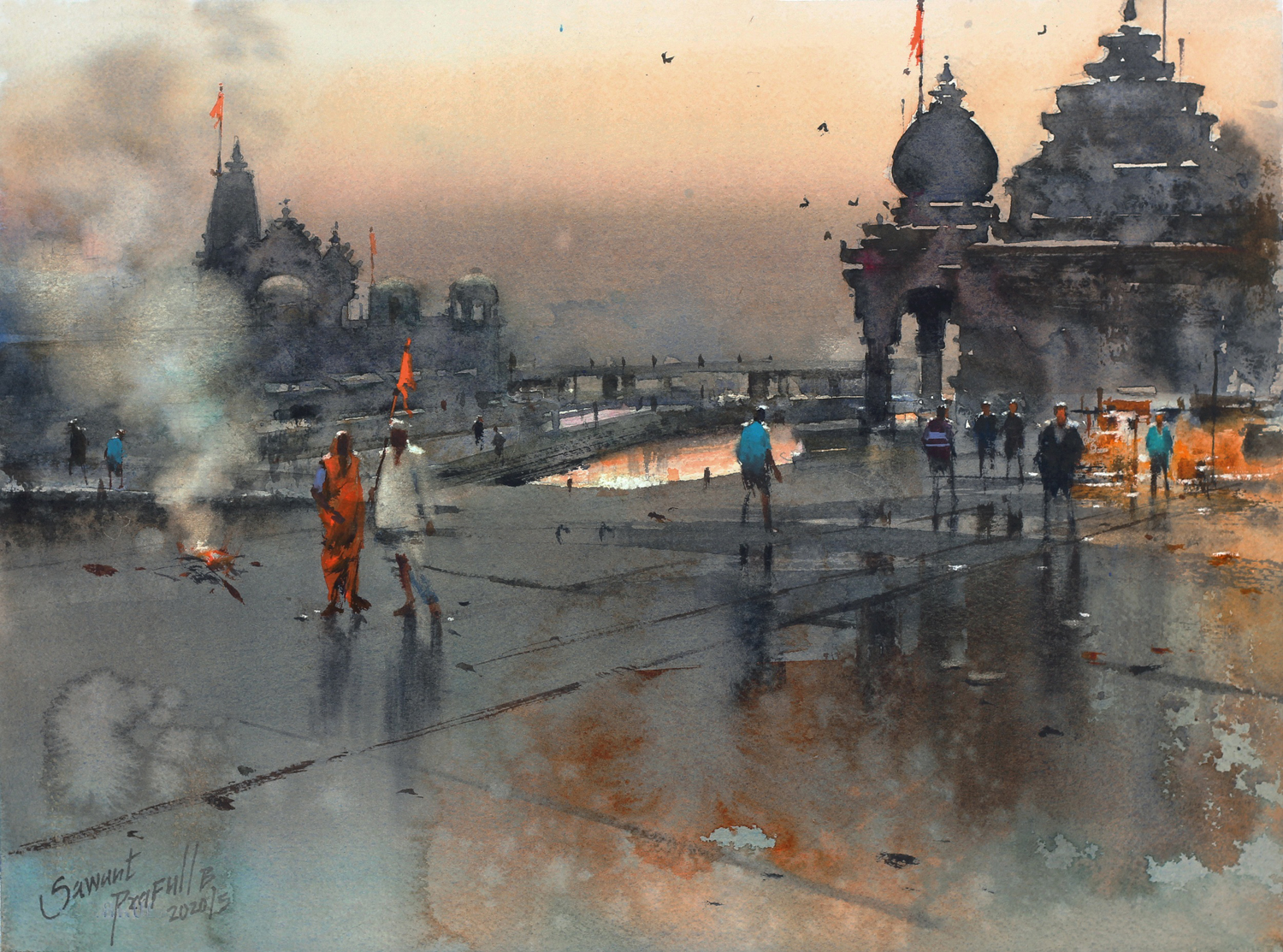
Among Indian contemporary watercolor masters, Praful Sawant, Rajkumar Sthabathy and popular Milind Mulick are widely admired for their atmospheric landscapes, confident brushwork, and ability to simplify complex scenes into powerful visual statements. Even though each artist uses different approach but the immense control they have on the medium is inspiring. Their work demonstrates the importance of value relationships, selective detail, and bold composition. Rather than rendering every object, water they mostly focus on capturing the mood and essence of a place.
The true beauty of watercolor lies in its balance between control and spontaneity. While technical knowledge provides a strong foundation, successful watercolor painting also requires a willingness to embrace unexpected effects. The greatest watercolorists—from Turner and Sargent to Homer and Abanindranath Tagore, Nandlal Bose to Praful Sawant and Milind Mullick—have shown that mastery comes not from controlling every drop of paint, but from learning to work with the medium’s unique character.
For aspiring artists, the best approach is simple: practice washes, study light and shadow, observe nature carefully, and learn from the masters. Watercolor rewards patience, observation, and courage, offering endless possibilities for creative expression.