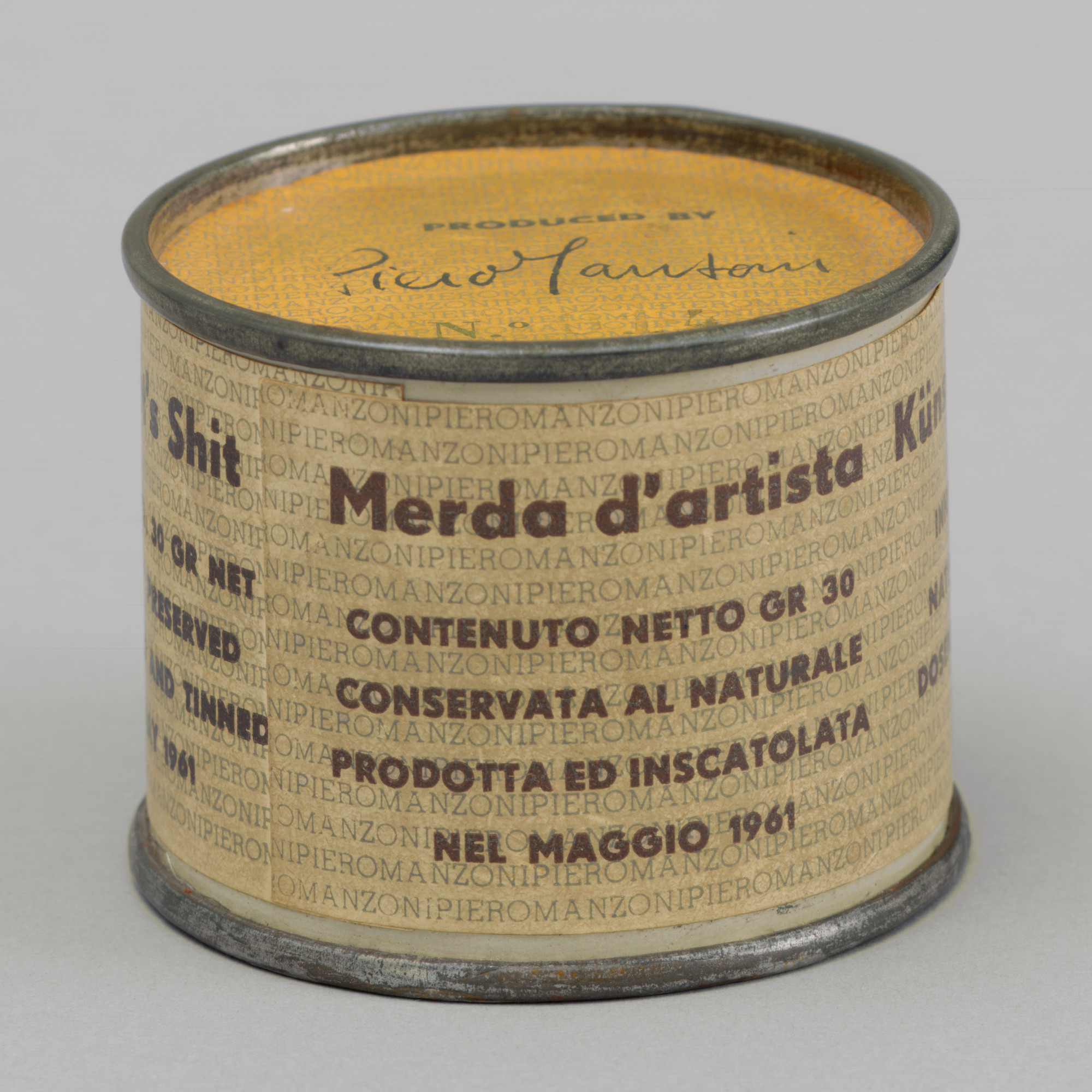
Art has always challenged society, but few works have done so with the audacity of Piero Manzoni’s Merda d’Artista (Artist’s Shit). Created in 1961, the work consisted of ninety small metal cans, each labeled as containing thirty grams of the artist’s own excrement. More than six decades later, these sealed cans continue to provoke debate, fascination, laughter, and disbelief. Yet beneath the absurdity lies one of the most incisive critiques of the modern art world ever conceived.
At first, the work appears to be nothing more than a prank. Many viewers react with amusement or irritation, wondering how such an object could be considered art. However, this reaction is precisely what gives the work its power. Manzoni understood that art is not merely about aesthetics; it is also about value, belief, and the systems that determine what society considers important.
By placing a provocative label on an ordinary can and signing it with his reputation, Manzoni exposed a central paradox of the art market. If collectors are willing to pay enormous sums simply because an object is associated with a recognized artist, where does the value truly reside? Is it in the physical object itself, or in the ideas and prestige attached to it?
The irony of Artist’s Shit has only deepened with time. What was initially intended as a satirical commentary on commercialization has become a highly sought-after collector’s item. Several cans have sold for hundreds of thousands of dollars at auction. Every increase in their market value seems to reinforce the very criticism Manzoni intended to make. The artwork functions like a trap: by purchasing it, collectors inadvertently participate in the joke.
Manzoni was not alone in questioning traditional definitions of art. Earlier in the twentieth century, Marcel Duchamp shocked audiences by presenting everyday objects as artworks, most famously with his readymade urinal titled Fountain. Duchamp demonstrated that artistic meaning could emerge from context and intention rather than craftsmanship alone. Manzoni extended this idea to an extreme conclusion. If a urinal could become art through the artist’s declaration, why not a sealed can allegedly containing waste?
The significance of the work extends beyond the art market. It invites broader questions about how society creates value. Brands, celebrities, luxury goods, and even political symbols often derive their worth from collective belief rather than intrinsic qualities. In this sense, Manzoni’s cans are not merely about art; they are about human psychology and the mechanisms of modern culture.
Critics continue to disagree about the work’s merit. Some view it as a profound conceptual achievement, while others dismiss it as an elaborate hoax. Yet the persistence of these arguments demonstrates the artwork’s success. More than sixty years after its creation, people are still debating its meaning, still questioning their assumptions, and still arguing about what art can be.
Perhaps that is the ultimate measure of its achievement. Great artworks do not simply decorate walls; they alter the way we think. Manzoni transformed a crude joke into a philosophical challenge that remains relevant today. Whether one admires or despises the work is ultimately secondary. The important fact is that it continues to force viewers to confront uncomfortable questions about value, authenticity, and the nature of art itself.
In the end, Artist’s Shit may be remembered not for what was supposedly inside the cans, but for what it revealed about the people looking at them.