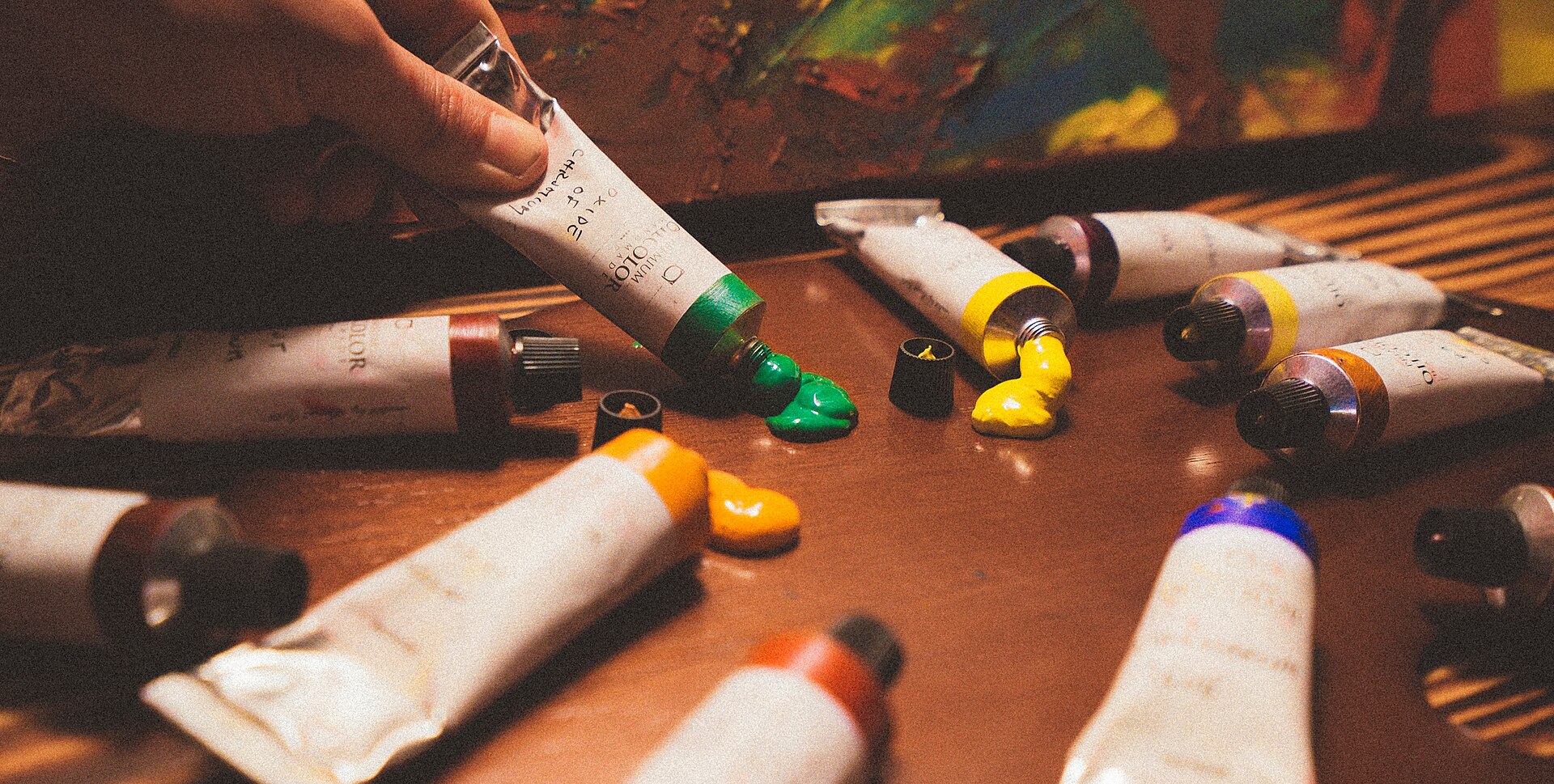
When we think about revolutions in art, we often imagine great painters, bold movements, or dramatic shifts in style. Rarely do we think about something as ordinary as a paint container. Yet, one of the most important turning points in the history of art came not from a canvas or a brush, but from a simple invention—the collapsible paint tube.
Before the 19th century, painting was not the free-flowing, expressive activity we imagine today. It was a laborious and highly controlled process. Artists had to prepare their own paints by grinding pigments and mixing them with oils. These mixtures were then stored in crude containers such as pig bladders or small jars. The problem was obvious: these makeshift storage methods were unreliable. Paint would dry out, leak, or spoil quickly. As a result, artists were largely confined to their studios, where they could control their materials and environment.
This limitation shaped the very nature of art itself. Paintings were often carefully planned, composed, and executed indoors. Nature was observed, sketched, and then recreated later from memory or preliminary drawings. The idea of spontaneously capturing a fleeting moment of light or atmosphere was, in practical terms, almost impossible.
Everything changed in 1841, when an American painter named John Goffe Rand introduced the collapsible metal paint tube. At first glance, the invention might seem modest. But its impact was profound. For the first time, paint could be stored in an airtight, portable, and resealable container. Artists no longer had to worry about their colors drying out or being wasted. They could carry multiple pigments with them, use small amounts as needed, and preserve the rest for later use.
With paint now easily portable, artists began to venture outdoors, painting directly from life. This practice, known as plein air painting, allowed them to observe and capture natural light, weather conditions, and changing environments in real time. Instead of constructing scenes from memory, they could respond instantly to what they saw.
This shift gave rise to one of the most important movements in art history: Impressionism. Artists like Claude Monet, Pierre-Auguste Renoir, and Camille Pissarro embraced this new freedom. Their works moved away from rigid detail and instead focused on light, color, and movement. Brushstrokes became looser, compositions more spontaneous, and subjects more immediate. Paintings were no longer about perfect representation—they were about perception and experience.
It is important to understand that this transformation was not driven by theory alone. It was made possible by a practical innovation. Without the paint tube, the Impressionists’ approach would have been far more difficult, if not impossible, to achieve.
The invention also had a broader social impact. As manufactured paints became more widely available, art materials became more accessible. Painting was no longer limited to highly trained professionals with the resources to prepare their own supplies. Amateurs and hobbyists could now participate more easily, contributing to a wider culture of artistic expression.
In many ways, the paint tube represents a larger truth about creativity. Artistic revolutions are not always born from grand ideas; sometimes, they emerge from simple improvements in tools and processes. By removing constraints, these innovations allow artists to explore new possibilities and redefine their craft.
Today, when we see an artist painting outdoors or quickly capturing a scene, it feels natural, even inevitable. But this freedom was not always there. It had to be enabled. And it was enabled by an invention so small and unassuming that it often goes unnoticed.
The next time we admire a landscape painted in shifting light or a canvas alive with spontaneous color, it is worth remembering that behind that moment of artistic brilliance lies a quiet revolution—one that began with a tube of paint.