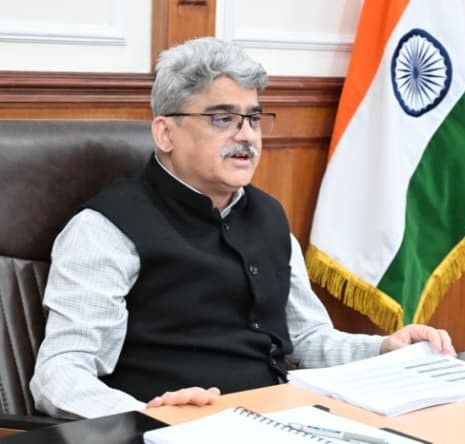
Srinagar: Jammu and Kashmir Chief Secretary Atal Dulloo on Friday launched 162 new district-level online citizen services on the eUNNAT portal, taking the total number of Government-to-Citizen (G2C) services available on the platform from 1,548 to 1,710.
The services, developed by the Information Technology Department for 18 districts, include permissions for fairs and exhibitions, cultural programmes, political and religious gatherings, processions, drone operations and other district-level public services. Citizens can now apply online, track applications and receive digitally signed approvals without visiting government offices.
The services were launched during a review meeting with Administrative Secretaries to assess Jammu and Kashmir’s performance under the National e-Governance Service Delivery Assessment (NeSDA) and review progress in expanding the Union Territory’s digital governance ecosystem.
During the meeting, Dulloo directed all departments to ensure compliance with mandatory NeSDA parameters and work with the Information Technology Department to digitise additional public services.
He also asked the Information Technology Department, in coordination with the Law Department, to review all online citizen services and identify those that have become redundant following policy and legislative reforms.
Referring to the government’s Ease of Doing Business (EoDB) and Reducing Compliance Burden (RCB) initiatives, the Chief Secretary said several certificates, permissions and No Objection Certificates (NOCs) had already been abolished and should no longer remain active on digital platforms. He directed that such services, after legal validation, be categorised as “No Longer Required” on the eUNNAT portal.
Dulloo said digital governance should simplify public services by eliminating outdated compliances rather than merely shifting services online. He added that citizens should not be required to apply for permissions or certificates that are no longer mandated under the existing policy framework.
To improve accessibility, the Chief Secretary instructed the IT Department to identify at least 100 high-volume citizen services for integration with WhatsApp and the Single Sign-On (SSO) platform, with priority to services frequently used by farmers, tribal communities, women, children and other vulnerable groups.
He also called for the future integration of emerging digital public assets, including AgriStack-enabled digital land records and SVAMITVA Property Cards, once operationalised by the concerned departments.
Additional Chief Secretary, Finance, Shailendra Kumar, said the success of digital governance should be measured by the value it delivers to citizens rather than the number of services available online, stressing the need to prioritise frequently used and high-impact services.
Commissioner Secretary, Information Technology, Saurabh Bhagat, said the latest expansion of digital services had helped Jammu and Kashmir secure the third position nationally in the National e-Governance Service Delivery Assessment (NeSDA).
He said 159 services developed by BISAG across departments, including JK e-SEHAT, JK Samadhan, JKCIP, the Holistic Agriculture Development Programme (HADP) and the Public Works Department, had already been integrated with the eUNNAT platform.
Bhagat said nine additional services are undergoing User Acceptance Testing, while five more services related to the Revenue Department, Housing and Urban Development Department and Gulmarg Development Authority are under development. Once integrated, the total number of services on the eUNNAT portal will increase to 1,724.
The meeting also reviewed plans to incorporate technologies such as Artificial Intelligence, multilingual interfaces, WhatsApp-based service delivery, Single Sign-On, face authentication, Aadhaar-enabled authentication and e-Sign solutions to improve citizen access to government services.
The Chief Secretary directed departments to expedite the digitisation of high-volume citizen services, strengthen compliance with NeSDA parameters and sustain the Union Territory’s performance in digital governance.