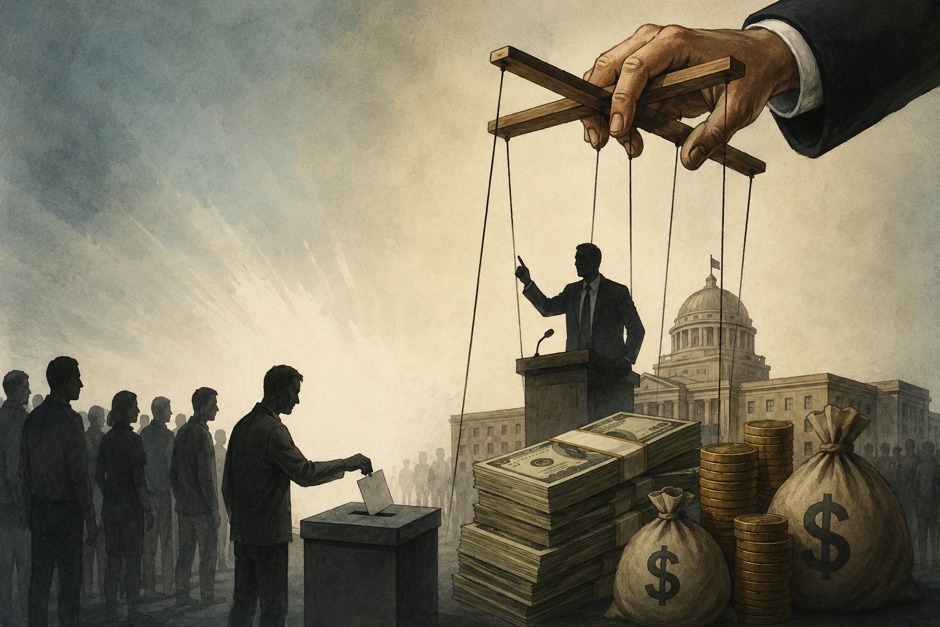
Modern democracy is often described as the rule of the people. Citizens vote, elect representatives, and shape the future of their nations through collective choice. Yet beneath the public rallies, campaign slogans, debates, and promises lies another powerful force that silently shapes political outcomes: money. In many ways, modern elections have become a meeting point between people’s power and capitalism, where democratic ideals compete with financial realities.
Election campaigns today are no longer simple gatherings where candidates speak directly to local communities. They have evolved into highly sophisticated operations requiring enormous financial resources. Political consultants, data analysts, media strategists, image builders, social media teams, advertising agencies, and survey companies all play central roles in shaping public perception. Campaigns now depend heavily on technology, psychological profiling, and continuous voter sentiment analysis. Every speech, slogan, gesture, and advertisement is carefully designed to influence emotions and public opinion.
This machinery is expensive. Political parties and candidates must raise massive amounts of money simply to remain competitive. Television advertisements, digital campaigns, rallies, transportation, volunteers, online influencers, and twenty-four-hour media management all require funding. In many countries, election spending has reached unprecedented levels, making fundraising not merely an advantage but a necessity for survival.
Legally, most democracies permit fundraising through donations from individuals, corporations, interest groups, or political action committees. On paper, these contributions are often presented as support for ideas or policies. However, in reality, large donors rarely invest money without expectations. Politics increasingly resembles a marketplace where funders place bets on candidates, much like investors back businesses. The expectation is simple: when the chosen candidate gains power, policies favourable to those donors may follow.
This influence does not always appear openly. It may emerge through tax policies, government contracts, deregulation, privatisation, subsidies, land access, resource control, or favourable economic reforms. While ordinary voters may believe they are choosing leaders, wealthy interests often gain privileged access to decision-making once elections are over. The public may elect the visible face, but the invisible network behind the campaign can become equally influential.
The relationship between money and political influence can be seen across the world in different forms. In the United States, for example, election campaigns frequently involve billions of dollars. Political action committees and wealthy donors play enormous roles in financing campaigns, lobbying, and influencing legislation. In several developing democracies, wealthy business groups often finance multiple political parties simultaneously, ensuring influence regardless of who wins. In some nations, media ownership itself becomes politically significant, where large corporate networks shape narratives favourable to specific candidates or ideologies.
The problem becomes even more visible during coalition politics or elections that produce no clear majority. In such situations, “horse trading” often emerges, political bargaining in which elected representatives switch loyalties, negotiate positions, or form opportunistic alliances to secure power. Here, the original mandate of the voters can become secondary. Instead of public expectations guiding governance, the immediate objective becomes acquiring or preserving political power. Deals are made behind closed doors, alliances shift rapidly, and ideology often gives way to political arithmetic.
This creates a dangerous contradiction within democracy. The system claims to represent the will of the people, yet economic power can heavily influence political outcomes before and after elections. Citizens possess voting rights, but unequal financial influence means not all voices carry the same weight. A wealthy donor funding nationwide campaigns may indirectly shape public policy far more than millions of ordinary citizens combined.
Capitalism itself is not inherently anti-democratic. Free markets have generated innovation, economic growth, technological progress, and higher living standards in many societies. Businesses and industries naturally seek stability and policies that support economic expansion. However, when capitalism enters politics without sufficient safeguards, economic inequality can slowly transform into political inequality. Wealth begins to purchase influence, and influence begins to protect wealth. Over time, the line between public service and private interest becomes blurred.
Yet the situation is not entirely hopeless. Democracies still possess mechanisms to resist excessive concentration of political and financial power. Independent journalism, transparent campaign finance laws, public funding of elections, strong institutions, judicial oversight, civil society activism, and informed voters can all help reduce the dominance of money in politics. Digital transparency tools and investigative reporting have also exposed hidden funding networks and unethical political practices in many countries.
Ultimately, the central question is not whether money should exist in politics, because modern political systems cannot function without financial resources. The real question is whether democracy can ensure that money serves the political system without controlling it. If elections become entirely dependent on capital, then democracy risks becoming less about the people and more about those capable of financing power.
The challenge facing modern societies is therefore profound: how to preserve genuine people’s power in an age where political influence increasingly follows economic strength. Democracy survives not merely when people can vote, but when their voices remain more powerful than the money spent trying to shape them.