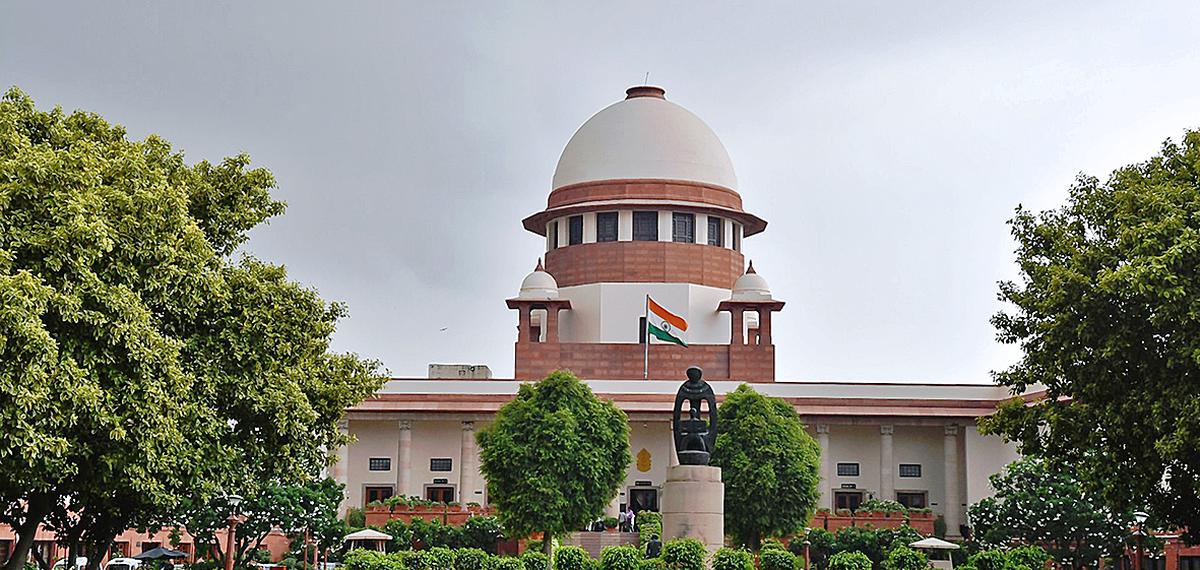
New Delhi: The Supreme Court on Monday flagged low conviction rates under the Unlawful Activities (Prevention) Act and said that more than 90 percent of such trials culminate in acquittals.
A bench of Justices B V Nagarathna and Ujjal Bhuyan made the observations while granting bail to a Jammu and Kashmir resident, Syed Iftikhar Andrabi, accused in a narco-terrorism case.
The top court referred to data compiled by the National Crime Records Bureau (NCRB) and said that the country-wide percentage of convictions under the Unlawful Activities (Prevention) Act (UAPA) for the five years from 2019-23 hovers between 2 percent and 6 percent.
“In other words, there is a 94 percent to 98 percent possibility of acquittal in such cases in the country. When it comes to the Union territory of Jammu and Kashmir, the percentage of conviction is abysmal, to say the least.
“For the aforesaid period, the annual rate of conviction is always less than 1 percent. It means that at the end of the trial, there is a 99 percent possibility of acquittal in such cases. With such statistics staring at our face, the question is, should we continue the detention of the appellant or defer the consideration to a later stage, simply because the charges are serious?” the bench said.
The top court also said that, on due consideration, it believed that Andrabi has made out a case for the grant of bail during the pendency of the trial, as there is no recovery of cash or contraband from the person of the appellant or from the premises used by the appellant, either as his residence or place of work.
“All statements implicating the appellant have been made before the police, including the confessions allegedly made by the appellant himself, which, prima facie, are self-incriminating and hit by Section 25 of the Evidence Act, 1872.
“The appellant has no prior antecedents of being connected with the narcotic trade or in terrorist activities. At least, no such material has been placed on record.
“On the contrary, it is stated that the appellant is an ardent advocate of the constitutional, federal and democratic set-up of India. He is a supporter of the Jammu and Kashmir People’s Conference, a registered mainstream political party,” the bench noted.
Andrabi had challenged an order passed by the High Court of Jammu and Kashmir and Ladakh, which dismissed his bail plea, saying the scrutiny of cellphone records indicated that “he had been in touch with terror operatives across the border”.
Narrating the sequence of events leading to the apprehension of the accused, the NIA had said that on June 11, 2020, police intercepted a car belonging to Abdul Momin Peer at Kairo Bridge, Handwara. During a search, Rs 20.01 lakh in cash and 2 kg of heroin were seized, and Peer was arrested.
Later, on his disclosure, the police arrested Andrabi and Islam-Ul-Haq Peer.
Investigation revealed that the accused were allegedly involved in cross-border smuggling and supply of heroin in Jammu and Kashmir and other parts of the country after procuring the same from their associates in Pakistan, the chargesheet said.
“Andrabi and Abdul Momin Peer had visited Pakistan several times during 2016-17 to meet the operatives of terrorist organisations, including Lashkar-e-Taiba and Hizbul Mujahideen,” it said, adding that the “amount generated from the sale of heroin was used by the accused to further the terrorist activities of Lashkar-e-Taiba.”