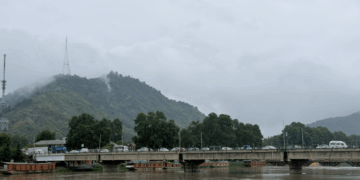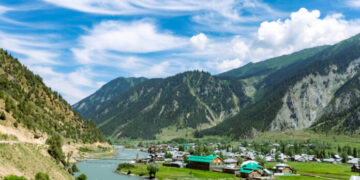

The Detailed Project Report (DPR) for the Khanabal–Baltal 2/4-laning road corridor already exits and it had been submitted to National Highways and Infrastructure Development Corporation Limited (NHIDCL) in January 2024. In planning terms, that document did more than propose a wider road – it formally acknowledged an old truth: south Kashmir already has a defined mobility spine running from Bijbehara and Anantnag into the Lidder valley and onward toward the Amarnath axis.
Yet when the discussion around rail connectivity to Pahalgam surfaced, the debate quickly assumed that a railway would have to carve out an entirely new route through orchards and fields. No one bothered to check the truth, alignment, and route, and the public conversation became a choice between apples and infrastructure. It never had to be.
Across the world, mountain regions faced with the same dilemma rarely open a fresh scar across the landscape. Instead, they follow a far simpler principle: place road and rail in the same corridor so the valley is disturbed only once.
The Bijbehara–Pahalgam road is not untouched countryside. Over decades it has seen widening, slope cutting, drainage channels, shop lines, bridges, culverts and traffic expansion. In environmental language, it is already a modified zone – a human transport corridor that nature has learned to live beside.
Building a railway within this same strip would therefore not mean invading a new landscape; it would mean using land already committed to mobility. The argument shifts from where to cut orchards to how to fit engineering carefully inside an existing band of disturbance.
This approach has a name in modern planning: corridor integration. It is not experimental. It is how mountain regions protect themselves.
How the World Builds in Fragile Valleys
| Country | Corridor | What Runs Together | Terrain Type | Why Aligned Together | Approx. Shared Length |
| Switzerland | Gotthard Corridor | Motorway + railway | High Alps | Avoid multiple mountain cuts | 90 km |
| Austria | Inn Valley | Autobahn + rail | Alpine river valley | Single disturbance zone | 130 km |
| Norway | Oslo–Bergen | Highway + railway | Fjord & mountain valleys | Reduce ecological fragmentation | 300 km |
| Japan | Tokaido | Shinkansen + highway | Coastal foothills | Shared transport spine | 515 km |
| France | Rhône Valley | Autoroute + rail | Agricultural valley | Protect vineyards | 250 km |
| Germany | Rhine Valley | Highway + rail | Narrow gorge | Limited buildable land | 185 km |
| Italy | Brenner Pass | Motorway + railway | Alpine pass | Historic corridor reuse | 110 km |
| China | Sichuan–Tibet valleys | Expressway + railway | Himalayan terrain | Landslide risk reduction | 400 km |
| Canada | Fraser Canyon | Highway + rail | Steep canyon | Only viable route | 150 km |
| New Zealand | Southern Alps | State highway + rail | Glacial valleys | Tourism corridor | 160 km |
The pattern is clear. Where land is scarce and ecology fragile, planners do not scatter infrastructure across the valley – they concentrate it.
Seen through this lens, the question changes completely. The railway would not be a line searching for land. It would be a line adapting to land already altered by movement.
Engineers would design within the corridor using tools already common elsewhere like short viaduct sections where space narrows, retaining structures shared with the road embankment, covered cuts near settlements, and joint drainage and slope-stabilisation systems. Instead of orchards defining the route, the existing route would protect the orchards.
It may sound counter-intuitive, but combining transport modes actually reduces damage. Wildlife crossings serve both road and rail. Drainage is controlled in one place. Landslide protection is strengthened instead of duplicated. And traffic pressure drops when people shift from thousands of individual vehicles to fewer shared journeys.
In orchard belts, the impact becomes localised and manageable. Trees are not split into unusable patches. Irrigation channels remain continuous. Cultivation continues alongside movement –just as it does in mountain valleys across Europe and Asia.
Much of the tension around infrastructure comes from repetition: widen a road today, propose a railway tomorrow, dig utilities the year after – reopening the same arguments every time. Corridor planning avoids this cycle. It sets aside one carefully engineered strip for long-term movement and leaves the rest of the landscape undisturbed.
The Khanabal–Baltal DPR had already recognised the transport spine. Extending the idea toward Pahalgam through a shared rail-road corridor would not have meant more development – only better coordinated development.
The choice was never between apples and access. It was between cutting the valley again and again, or learning from places that build carefully once and live with it for generations. The choice vests in Kashmiris – either be for development or be against. The choice is clear – either to resist every bridge and track today – and complain about isolation tomorrow. Or to ride the bandwagon of progress and prosperity.