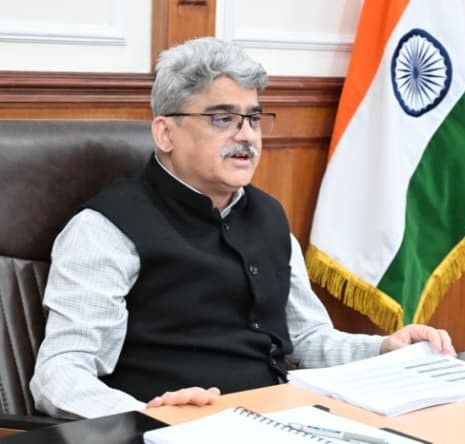
SRINAGAR: Chief Secretary Atal Dulloo on Saturday reviewed the progress of the Swachh Bharat Mission-Urban (SBM-U) 2.0 and Atal Mission for Rejuvenation and Urban Transformation (AMRUT) 2.0 and directed officials to ensure timely completion of ongoing projects across Jammu and Kashmir.
Chairing a meeting of the Housing and Urban Development Department (H&UDD), Dulloo stressed that the success of SBM-U should be reflected in cleaner neighbourhoods, efficient waste management and improved public health outcomes. He also called for greater community participation in maintaining urban cleanliness and ensuring effective use of the infrastructure created under the mission.
According to officials, J&K has made significant progress in waste management and urban infrastructure development under the two centrally sponsored schemes.
Commissioner Jammu Municipal Corporation and Managing Director, SBM (Urban) and AMRUT, Devansh Yadav informed the meeting that against a Phase-II allocation of ₹692.12 crore under SBM-U 2.0, expenditure of ₹96.97 crore has been incurred so far, while ₹57.95 crore remains available for ongoing works during the current financial year.
The meeting was informed that 62 of the 78 targeted Urban Local Bodies (ULBs) have completed Material Recovery Facilities (MRFs), with the remaining 16 expected to be completed by December 2026.
Officials said the 225-tonne-per-day compressed biogas plant being developed by Jammu Municipal Corporation has achieved 50 per cent physical progress, while the proposed 300-tonne-per-day plant for Srinagar Municipal Corporation is under an extended bidding process.
In the construction and demolition waste management sector, the 65-tonne-per-day facility in Jammu has been completed and is undergoing trial runs, while the 125-tonne-per-day Srinagar facility has achieved 95 per cent progress and is expected to be completed this year.
The meeting was informed that 13.29 lakh metric tonnes of legacy waste have been bio-remediated against a target of 26.29 lakh metric tonnes. Jammu Municipal Corporation is expected to clear its remaining waste by October 2026, while complete remediation in Kashmir division is targeted by December 2026.
Officials also reported that treated wastewater from the Mehdi Kadal and Pahalgam sewage treatment plants is being reused for irrigation purposes.
Reviewing progress under AMRUT 2.0, the meeting was informed that J&K has secured central assistance of ₹867 crore, with works worth ₹852.90 crore already allotted. During the current financial year, ₹113.51 crore has been utilised out of ₹150 crore released so far.
All 22 approved water-body rejuvenation projects under the mission have been completed, officials said. Of the 65 approved water supply schemes, seven have been completed, 30 are scheduled for completion by December 2026 and another 18 by March 2027.
Under the ‘Jal Hi Amrit’ initiative, five sewage treatment plant projects have been completed out of 14 approved works. The projects incorporate Supervisory Control and Data Acquisition (SCADA) and Online Continuous Effluent Monitoring Systems (OCEMS).
The meeting also reviewed progress on GIS-based master plans for Class-II towns being prepared in collaboration with the Survey of India. Drone mapping has been completed in 14 towns, while mapping of all 18 identified towns is expected to be completed by October 2026.
Officials said five self-help groups engaged under the AMRUT Mitra initiative have completed 78,000 water-quality tests, while 11 other groups have planted 798 trees around water bodies and waste disposal sites.
The meeting was also informed that 7,422 sanitation workers have been profiled, 713 specialised personal protective equipment kits distributed and 627 workers covered under Ayushman Bharat health insurance. The National Sanitation Helpline (14420) is operational across the Union Territory.
Dulloo also reviewed projects under the Clean Himalayan and Hill Cities Initiative, under which ₹22.37 crore is being spent on waste management and sanitation projects in tourist destinations, including Katra, Pahalgam, Patnitop, Gulmarg and Bhadarwah.
The Chief Secretary directed officials to maintain strict monitoring of ongoing works, adhere to project timelines and ensure effective utilisation of available resources so that the benefits of the schemes reach people across the Union Territory.