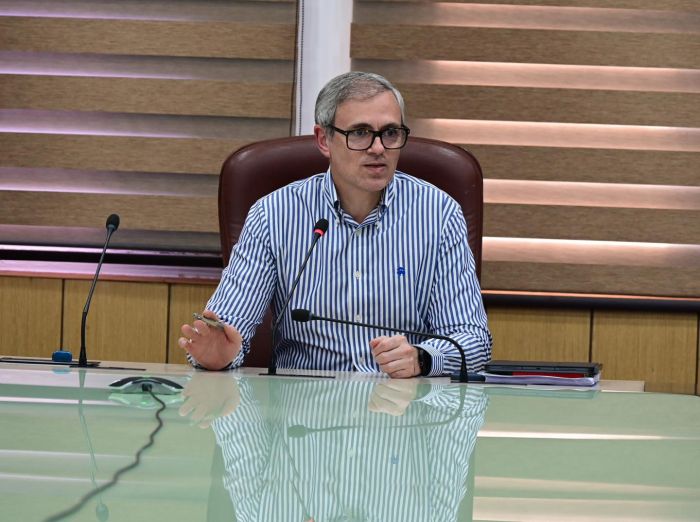
Bengaluru: Chief Minister Omar Abdullah on Saturday questioned claims of advantage for BJP in West Bengal, alleging manipulation in voter rolls and raising concerns over SIR.
Assembly elections are underway in West Bengal in two phases. While the first phase got over on April 23, the second will be conducted on April 29. The first phase recorded over 92 percent polling.
Speaking to reporters here, Abdullah said the focus on voting percentage was misleading and did not reflect the ground reality of voter participation.
“Those saying advantage to the BJP quote either from the press notes sent by the saffron party or who have not gone deeply into the data,” he claimed.
He further claimed that the total number of voters in West Bengal had decreased compared to the previous election, even as the percentage turnout appeared higher.
“The percentage has increased because you (ECI) have reduced the number of voters. Due to the SIR (Special Intensive Revision of electoral roll), so many voters have been removed. Compared to the previous election, the total number of voters has gone down this time, even though the percentage has gone up,” he said.
Alleging large-scale deletions from electoral rolls, Abdullah, who is also the National Conference leader, said, “In Mamata Banerjee’s own constituency, 25 percent of voters have been removed. In West Bengal, there are 70 seats where the number of voters removed from the list is more than the BJP’s margin of defeat in the last election. That means in 70 seats, the margin itself has been wiped out. If this is not a weapon, then what is?”
Trinamool Congress president and Chief Minister Mamata Banerjee is pitted against the BJP’s Suvendu Adhikari in her long-held bastion — Bhabanipur in West Bengal.
Abdullah said that concerns over electoral integrity extended beyond voting machines.
“We are not as worried about tampering with machines. I am less worried about machines and more about what they do in pre-election management — through delimitation and manipulation of voter lists,” he said.
He expressed “disappointment” that courts had deferred hearing the issue until the elections are over.
Referring to reports of MPs raising concerns about the Election Commission, Abdullah said, “If so many MPs have complained, then the EC should look at its shortcomings and functioning. This is the first time I have seen something like this.”
He added that from the time the poll body was made independent, including during the tenure of T N Seshan (former CEC), such a situation had not arisen.
On AAP Rajya Sabha MPs led by Raghav Chadha shifting towards the BJP, Abdullah said the phenomenon was not new.
“When has this ‘Aya Ram Gaya Ram’ culture not existed? This is not the first time,” he said.
‘Aaya Ram Gaya Ram’ was an expression used widely in politics in the 1990s referring to the frequent floor-crossing and switching of parties.
The J&K CM observed that such defections would have limited electoral impact. “I don’t think even one of them can bring 10 votes to BJP on the ground,” he remarked.
Asked about possible implications for Punjab politics, Adbullah said, “If they (AAP RS members) were that strong, they would have been MLAs or Lok Sabha members. I don’t think even one of them can bring 10 votes to BJP on the ground.”
He said that allegations and counter-allegations were a routine part of electoral politics and referred to the ideological contest between the Congress and the RSS.
Abdullah expressed concern over the ongoing conflict involving Iran.
“We hope and pray that this war ends soon. There is no basis or justification for this war,” he said, questioning the rationale behind the attack and its consequences.
“The whole world is suffering — oil prices are rising, supply is shrinking, and essential goods are becoming scarce,” he said.
Abdullah asserted that Iran deserved compensation for the losses suffered in the conflict.
On ceasefire efforts, Abdullah said, “We can only hope and pray. Our only concern should be that the war ends soon and peace is restored.”