For a long time, wars have been justified with the argument that collateral damage is unavoidable. Military strategists and political leaders often describe it as a small and unfortunate side effect of a larger battle between armed forces. However, recent conflicts across the world have exposed a painful truth: collateral damage is no longer small or incidental, it has become the main story of war. The greatest victims today are not soldiers on battlefields, but ordinary, innocent human beings caught in the fire.
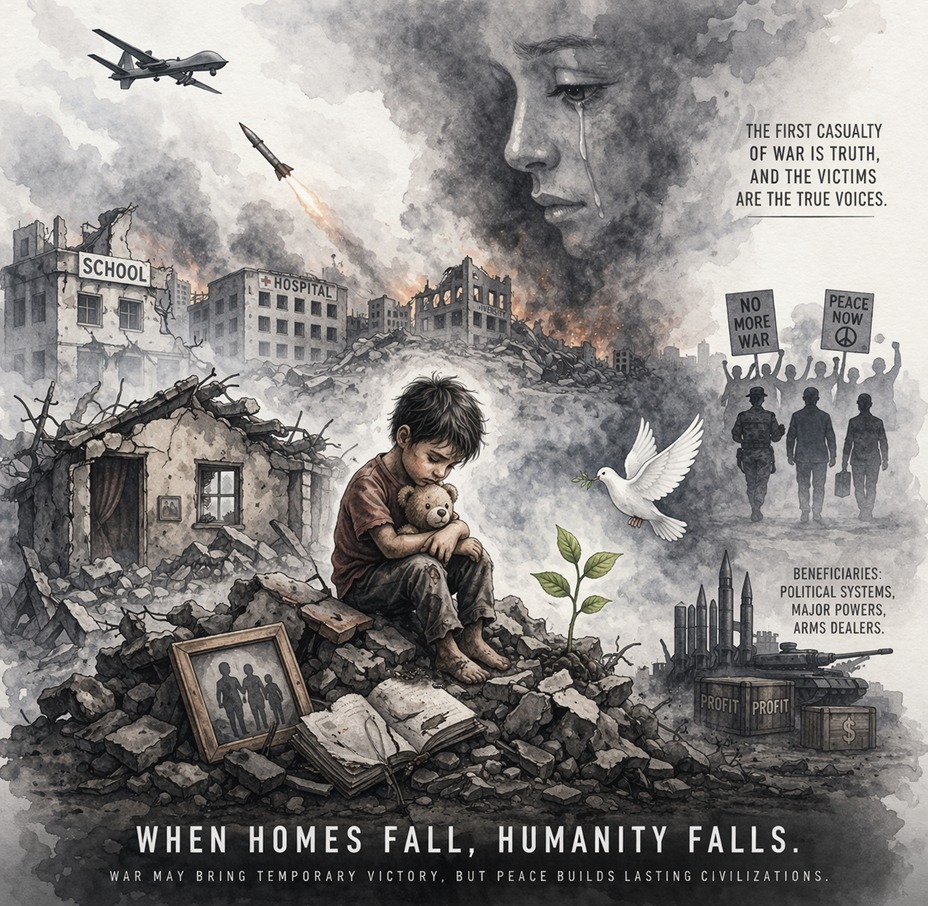
In modern warfare, the common civilian has become the biggest casualty. Homes built over decades of sweat and sacrifice are destroyed in a matter of seconds by drones, missiles, or airstrikes guided by advanced technology and artificial intelligence. A house is not just a building; it is a lifetime of savings, dreams, memories, and security for a family. When a home is destroyed, it wipes out more than walls and furniture, it destroys the future of children, the stability of families, and the dignity of human life. In recent conflicts in regions like Ukraine, Gaza, Syria, and Yemen, entire neighbourhoods have been reduced to rubble, leaving thousands of families homeless overnight. Children who once dreamed of becoming doctors, engineers, or teachers now struggle just to survive.
Another major casualty of war is the destruction of institutions that build civilized societies. Schools and universities, which shape the future of nations, are often damaged or turned into shelters or military positions. Hospitals and medical research centers, which exist to save lives, become targets or are forced to shut down due to lack of resources and safety. When hospitals are bombed or rendered non-functional, the consequences are devastating. Patients cannot receive treatment, surgeries are delayed, and basic medical care becomes impossible. During several recent conflicts, doctors have been forced to perform surgeries without electricity, medicine, or proper equipment. The destruction of such institutions pushes societies back by decades, leaving deep scars that take generations to heal.
Perhaps the most painful damage is not physical but moral, the damage to the spirit of humanity itself. War slowly erodes compassion and empathy. Images of destruction and death become routine on television screens and social media. People begin to see suffering as statistics rather than human tragedy. This normalization of violence weakens the basic human instinct to care for others. When humanity loses its sensitivity to suffering, it loses its moral foundation. The real danger of war is not only the destruction of cities but the destruction of conscience.
It is often said that the first casualty of war is truth. In times of conflict, information becomes a weapon. Narratives are shaped, facts are twisted, and propaganda replaces honest reporting. Journalists and independent voices who try to present the truth face threats, censorship, or even death. The real stories of suffering civilians, destroyed homes, and broken families often remain buried under political narratives of victory and nationalism. Truth becomes uncomfortable, and those who speak it become targets.
Meanwhile, there are beneficiaries of war. Political systems often use conflicts to distract their citizens from internal problems such as unemployment, inflation, corruption, or social inequality. War creates a sense of fear and urgency, pushing people to unite under the national flag and ignore domestic issues. Differences between nations are sometimes deliberately kept alive, fuelling tension that can be used during elections to mobilize voters and strengthen political power. Sustained long-standing conflicts among communities and nations often serve major powers to exercise dominance over regions, allowing them to influence political decisions, control strategic resources, and maintain geopolitical leverage without direct involvement. Nationalism, when used responsibly, can unite people; but when used as a tool of political gain, it becomes a dangerous weapon that prolongs conflicts and deepens divisions.
Another clear beneficiary of war is the arms industry. Weapons manufacturers and dealers thrive on conflict. The more unstable the world becomes, the higher the demand for weapons. It is deeply troubling that battlefields sometimes become testing grounds for new weapons and technologies. Drones, missiles, surveillance systems, and advanced military equipment are often showcased in real conflicts to demonstrate their effectiveness to potential buyers. War, in such cases, becomes not only a tragedy but also a marketplace, where human lives are the price paid for profit and technological advancement.
However, even in these dark times, there are signs of hope. In recent wars, voices of dissent and humanity have emerged from within the very nations involved in conflict. Citizens have taken to the streets to protest against violence and demand peace. Students, activists, and ordinary people have raised their voices against destruction and loss of innocent lives. In some cases, senior military commanders and government officials have resigned from their high positions in protest, choosing conscience over power and humanity over career. Such actions remind us that moral courage still exists and that humanity has not completely lost its voice.
These protests and resignations send a powerful message: war is not always supported by the people it claims to protect. Many citizens understand that the true cost of war is paid by families, children, and future generations. Their courage to speak out shows that even in times of conflict, the human spirit continues to resist injustice and destruction.
War has always been part of human history, but the scale and nature of collateral damage today demand serious reflection. If innocent civilians, homes, schools, hospitals, truth, and humanity itself are the biggest casualties, then the idea of collateral damage being “small and unavoidable” no longer holds true. The world must rethink how conflicts are approached and resolved. Dialogue, diplomacy, and cooperation must take precedence over destruction and dominance.
The real strength of nations lies not in the number of weapons they possess, but in the value they place on human life. When homes are protected, schools are open, hospitals function, and truth is respected, societies grow stronger and more stable. War may bring temporary victory, but peace builds lasting civilizations.
In the end, the question before humanity is simple yet profound: if collateral damage becomes the main damage, can war ever be justified?