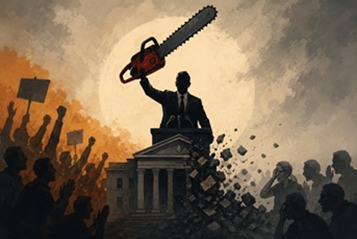
In recent elections around the world, political campaigns have become increasingly theatrical, aggressive, and emotionally charged. Among the most striking symbols to emerge in recent years has been the chainsaw waved dramatically at political rallies as a promise to “cut down” the system. What once might have seemed absurd or symbolic exaggeration has now become part of mainstream political imagery.
The most internationally recognised example came from Javier Milei during Argentina’s presidential campaign, where he wielded a chainsaw to represent his promise to slash government spending, dismantle bureaucracy, and confront what he called the corrupt political establishment. The image spread rapidly across global media and social platforms because it captured a growing mood of public anger and frustration.
The chainsaw is not an ordinary political symbol. It is loud, forceful, destructive, and impossible to ignore. Unlike symbols associated with construction, dialogue, or reform, the chainsaw represents tearing things apart quickly and aggressively. In political campaigns, it becomes a metaphor for radical disruption, the idea that the existing system is beyond repair and must be cut down entirely.
This symbolism appeals strongly during periods of economic hardship, inflation, unemployment, corruption scandals, or deep public distrust in institutions. Many frustrated voters no longer want cautious politicians promising gradual reform. They want leaders who appear willing to confront the system aggressively and dramatically. The chainsaw, therefore, becomes more than a prop; it becomes an emotional promise of revenge against political elites, bureaucracy, and institutional failure.
Modern media culture amplifies such symbolism even further. In the age of social media, dramatic visuals travel faster than detailed policy discussions. A politician holding a chainsaw generates instant headlines, memes, emotional reactions, and viral videos. Aggressive imagery cuts through the noise of modern information overload far more effectively than long speeches or complex policy proposals.
However, while such symbolism may energise voters, it also carries serious long-term consequences for democratic culture.
The growing use of aggressive imagery in politics risks normalising hostility and confrontation in public life. Democracy depends on persuasion, negotiation, compromise, and coexistence between people with differing opinions. Symbols like chainsaws shift the psychological tone of politics from cooperation toward combat. Political opponents are no longer viewed as fellow citizens with different ideas, but increasingly as enemies or obstacles to be eliminated.
This trend also oversimplifies complex societal problems. Economic crises, healthcare systems, migration, inequality, climate policy, and institutional reform require careful planning and long-term solutions. Yet aggressive campaign symbolism reduces these complicated issues into emotional slogans such as “destroy the system” or “cut everything down.” A chainsaw may symbolise speed and decisiveness, but it does not symbolise precision, patience, or thoughtful reconstruction.
Another dangerous consequence is the deepening of political polarisation. Aggressive political campaigns often divide society into rigid camps: “the people” versus “the elites,” “patriots” versus “traitors,” or “real citizens” versus “enemies of the nation.” Such narratives intensify social divisions and make democratic compromise appear like weakness or betrayal.
History repeatedly shows that societies consumed by permanent political anger eventually weaken their own institutions. When destruction becomes more politically attractive than reform, public trust in parliaments, courts, media, universities, and democratic norms gradually erodes. Citizens begin to see institutions not as imperfect systems to improve, but as obstacles to attack and dismantle.
There is also a deeper psychological concern. Repeated exposure to aggressive political symbolism can desensitise societies to hostility and intimidation. Over time, increasingly extreme rhetoric becomes normal. Public discourse becomes harsher, political behaviour more confrontational, and democratic debate more emotionally volatile.
Not every campaign using dramatic symbolism leads to authoritarianism or instability. Political theatre has always existed. Yet symbols matter because they shape collective imagination and public psychology. A society that increasingly glorifies destruction in politics may eventually struggle to preserve the patience, tolerance, and mutual respect required for democracy itself.
The rise of “chainsaw politics” reflects a broader global frustration with economic hardship, institutional failure, and political stagnation. Citizens understandably demand change and accountability. But the challenge for modern democracies is ensuring that the desire for reform does not evolve into a celebration of permanent anger and destruction.
A chainsaw can cut things down quickly. Building a stable, just, and democratic society, however, requires far more difficult tools: wisdom, restraint, dialogue, and the ability to reform institutions without destroying the foundations that hold societies together.