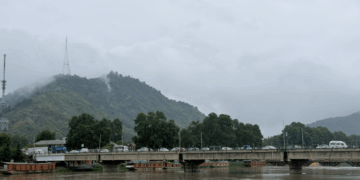

As Kashmir received an incessant spell of rainfall in June weekend, the flood scare loomed large over the region for the second time since September-2014 disastrous flood that had thrown life out of gear for more than one month in the valley. The last time when the flood scare loomed in Kashmir was in April 2, 2015 and April 7, 2017 but the government in particular and the people in general are yet to learn any lesson from these instances of near disasters.
Following the September-2014 flood that had marooned half of the population in the Srinagar city and elsewhere, besides leaving a trail of destruction in its awake, the government started the dredging of river Jehlum which continued for months – in order to increase its capacity – but the river Jehlum has once given the indication of its water carrying capacity which is seemingly not sufficient to channel a few inches of precipitation that form in last few days. Given the reports of river Jehlum breaching its banks at Pampore, PanthaChowk and Athwajan on Saturday, it is certain now that in case of a cloudburst, the people will find it very difficult to sandbag these breaches which was quite manageable this time and now people need to do some serious thinking about it.
Every time it rains heavily in Kashmir, particularly in South Kashmir, the water-level in river Jehlum tends to flow above danger level mark and thereby raising the apprehensions of flood among the people. These apprehensions continue to be there because the flood control engineering department in Kashmir has failed to come up with a long term plan for a flood related eventuality in Kashmir. By reviewing the situation and setting up helplines, the government has exhibited the swiftness with regard to its “rescue management” in view of imminent flood threat in the Srinagar city and other parts of the valley — which is substantial at its face value but the vital strategies with regard to “flood management” which may include; — to the best of my knowledge — flood risk assessments, flood risk management planning, hydrological modelling, surface water drainage strategies, flood evacuation plans., have never been discussed, let alone its implementation.
The people of Kashmir have also failed to consider the underside of the looming flood threats in Kashmir which is largely their own making; be it through encroachment in and around water bodies and channels, rapid urbanization, water pollution, waste dumping and other long list of environment hazardous activities.
The environment is the last thing that people want to hear in Kashmir which is a catastrophe in the making. Much of the construction in the new parts of the Srinagar city has been done on the erstwhile farmlands, water bodies and those who bear witness to it are still alive. Nevertheless, people are not ready to come to terms with this reality which may anytime soon bring harsh consequences. The people have witnessed it during the September-2014 floods as how emergency responses, like those currently being devised, work in a place like Kashmir. We never can predict the gravity of the prospective floods in Kashmir and the government can never guarantee that its rescue management plans would be implemented during such serious times.
There is a widely held belief about our region that it is the war that will wipe out life from here but before we reach that point, we need to ask ourselves this question: how do we survive the natural disasters in the offing?
The bottom line of my article is that we cannot be just worried and working about our political future when the future of our environment is appearing bleak. What I have written may not seem relevant to many of you reading this but the world is facing a major climate change, and our part of the world is not an exception to its consequences.
The author is a meliorist and peacenik. He can be reached at akeelsofi@gmail.com