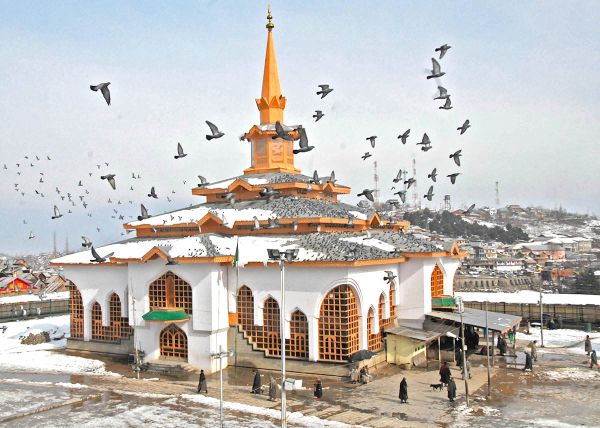
Long before expressions such as climate change, ecological degradation and sustainability entered public discourse, Sheikh Noor-ud-Din Noorani (RA), known as Sheikh ul Alam or Nund Rishi, was speaking about humanity’s relationship with the natural world. His short, powerful shruks were not environmental treatises, yet they carried ideas of interdependence, restraint and compassion that remain strikingly relevant today.
As Kashmir confronts mounting pressure on its forests, water resources, wetlands, farmland and biodiversity, his words deserve to be heard not as spiritual poetry from a distant past, but as a challenge to the way we relate to the land on which our lives depend. The verse most widely remembered is :
“Ann poshi teli, yeli wan poshi.”
Food will last only as long as the forests endure.
The simplicity of the verse conceals a profound understanding of dependence. Forests and food appear to belong to separate worlds, yet forests influence water, soil, local climate and the stability of slopes and these in turn support agriculture and human life. What modern science explains through complex systems, he expressed in a few words that became part of Kashmir’s collective memory. The verse is more than a warning against cutting trees. It is an observation about what happens when we disturb the ecological foundations on which life rests. When one part of a connected system is degraded, the consequences eventually surface elsewhere.
But Sheikh ul Alam’s significance goes deeper than any apparent anticipation of modern science. He did not merely explain what nature does for human beings. He cultivated a way of seeing nature. Policy can describe forests as ecosystem services. Hydrology can explain recharge and runoff. Ecology can demonstrate the consequences of habitat loss. Spiritual traditions offer something further- a moral reason for restraint even when exploitation looks economically attractive.
Traditions associated with him emphasise compassion towards living things and caution against unnecessary harm to plants, even the grass beneath one’s feet. One account says that after he cautioned people against trampling grass, his listeners pointed out that the ground they sat on was itself affected by their presence. He then reportedly chose a barren rock for meditation so that he would not suppress the grass beneath him. Whatever its precise origin, the principle it has preserved is clear, a person who asks others to respect life must be willing to practise that respect, even at personal inconvenience.
That is a powerful lesson for us. It is easy to speak about protecting nature. It is far harder to accept limits on ourselves for its sake. This brings us to one of the deeper ideas through which his teachings can be understood – the struggle with the nafs. In Islamic spiritual thought, the nafs broadly refers to the self and its desires, particularly when they become excessive or undisciplined. Read through an environmental lens, this offers a compelling way to think about a central problem of modern civilisation. Our ecological crisis is not caused by a lack of technology alone. It is also driven by excess – excessive consumption, extraction and expansion and the belief that every natural limit can somehow be overcome. A spring may replenish itself, but not indefinitely under increasing extraction. A forest may regenerate, but not if its integrity is repeatedly disturbed. A wetland can absorb and regulate water, but it disappears when treated as vacant land. Soil can sustain farming for generations, but its fertility declines when its biological foundations are neglected.
Nature has limits. Human desire often does not. His response was not a rejection of the material world but an emphasis on discipline within it. His life and teachings are associated with simplicity, humility and compassion. In that sense, the struggle with the nafs can be read as a warning against a culture that has forgotten the meaning of “enough”. Few issues illustrate this more clearly than water. Kashmir has long been perceived as a water-rich landscape, but abundance can create its own illusion.
Water security depends not only on how much water exists, but on whether the landscapes that store, recharge, filter and regulate it remain healthy. When a spring weakens, the problem is rarely confined to the point where the water emerges. Its recharge area may have been disturbed, vegetation may have changed, construction may have altered drainage, extraction may have increased, and shifting precipitation and snow patterns may be reducing recharge. The response must be scientific and practical.
Kashmir needs hydrological monitoring, aquifer mapping, protection of recharge areas, better land-use planning and efficient water management. But Sheikh ul Alam adds another dimension – restraint. How much do we take. How much do we waste. How much do we leave for those who come after us. These are environmental questions, but they are also moral ones. His relationship with agriculture offers a further insight.
In the traditions surrounding him, the farmer occupies a position of dignity. Sowing, cultivation and harvest are not presented merely as economic transactions but as part of a larger rhythm of existence. A farmer can prepare the land and sow the seed, but cannot command the rain, control the seasons or manufacture the fertility of the soil. Farming therefore carries an inherent lesson in humility – human effort is essential, but it operates within natural processes far larger than itself.
This is where the idea of “amanat” becomes useful. In the Islamic ethical tradition, amanat means something held in trust, something entrusted to us that we do not own and must return undamaged. Applied to land, water and forests, it turns the question of ownership into one of stewardship. We are not the makers of the springs, the soil or the mountains. We are their custodians, answerable to the generations that follow. It is an uncomfortable idea for a civilisation organised around consumption, yet the climate crisis is forcing us to confront it.
We are powerful enough to transform landscapes, but not independent of the systems that sustain us. We can extract water, but we cannot manufacture an aquifer. We can clear a forest, but we cannot recreate a mature ecosystem overnight. We can build over a wetland, but we cannot easily reproduce all the functions of a living one. The natural world is not a warehouse of resources. It is a network of relationships, and Sheikh ul Alam’s great contribution was to place the human being within that network. This is why “Ann poshi teli, yeli wan poshi” should not be reduced to a slogan for tree planting. Its deeper meaning lies in dependence and limits. Human prosperity rests on ecological foundations we did not create and cannot indefinitely replace. None of this replaces science or weakens modern governance.
Kashmir needs climate science to understand changing risks, ecological restoration to repair damaged landscapes and stronger environmental institutions. But it also needs something technology and regulation cannot supply – a culture of restraint. Laws can set boundaries, yet lasting responsibility depends on what society considers acceptable. If forests are seen only as timber, wetlands only as land, rivers only as water and mountains only as building sites, even the strongest policies will face pressure. In practice, that could begin with small things, communities guarding their springs and village woodlots, officials treating wetlands as protected systems rather than vacant land and every one of us asking what a project will cost the landscape before asking what it will earn.
Sheikh ul Alam does not offer a 14th-century blueprint for a 21st-century crisis. He offers something more fundamental, a way of looking at the world. A forest is not merely timber. A field is not merely production. A spring is not merely a source of water. A wetland is not vacant land. A blade of grass is not merely something beneath our feet. Each is part of a living creation within which we ourselves exist.
Perhaps, then, our environmental crisis is also a crisis of perception. We have become increasingly capable of measuring nature while becoming less capable of revering it. We calculate the cost of restoration after destruction rather than asking whether the destruction should have been permitted at all. His wisdom reverses that order. Before asking how much we can extract, it asks whether we should. Before celebrating our power to transform a landscape, it asks whether we have the humility to leave some places undisturbed. Kashmir is changing. Its climate, its landscapes and its relationship with natural resources are all changing. We cannot return to the 14th century, nor should we try. But we can recover an ethic that remains relevant – human prosperity cannot be separated from the health of the natural systems that sustain it, and desire must be tempered by responsibility.
The first step towards healing Kashmir’s wounded landscape is not only to restore its forests, wetlands, springs and rivers, but to restore the consciousness with which we see them.
Not merely to save nature. But to rediscover our place within it.