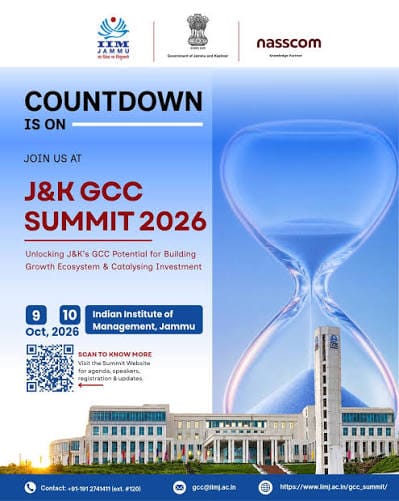
On 9 and 10 October 2026, something quite interesting is going to happen at IIM Jammu. The J&K GCC Summit 2026, being organised by IIM Jammu in collaboration with the Government of Jammu and Kashmir and in knowledge partnership with NASSCOM, will bring together some of the country’s leading Global Capability Centre (GCC) companies, policymakers, academics and industry leaders.
But I believe the significance of these two days goes well beyond a summit. For perhaps the first time, some of the senior-most administrative leaders of Jammu and Kashmir will sit across the table with leaders of India’s GCC industry in a series of candid, no-holds-barred conversations about a question that matters deeply to us: What will it take for Jammu and Kashmir to enter India’s growing GCC ecosystem, and to do so as a credible Tier-2 and Tier-3 destination?
That may sound like a familiar proposition at a business summit. It is not. Economic growth is ultimately driven by two sets of stakeholders—the government that creates the enabling environment and the businesses that take the risk of investing in it. Genuine growth begins when these two sides are willing to listen to each other, ask difficult questions and speak honestly about what works and what does not. That is precisely the spirit in which we are approaching the J&K GCC Summit.
Let me explain why.
In June 2025, a train crossed the Chenab on the world’s highest railway arch bridge, connecting the Kashmir Valley to the national rail network. The bridge was decades in the making. Its deeper value, however, can be expressed in one word that matters as much to an investor as it does to a traveller: predictability. A journey that once depended heavily on weather and a single highway can now be planned with greater certainty.
That is the journey we want to begin for J&K’s GCC ecosystem. Building a significant GCC destination will not happen overnight. It may take years. Perhaps decades. But the journey can be made predictable if we learn from those who have already travelled it. Be they leading GCC companies or States that have successfully attracted such investments.
That is why the Summit is bringing industry leaders together with representatives of States such as Gujarat, Bihar and Tamil Nadu, which have valuable lessons to share. We do not intend to reinvent the wheel. We want to understand what has worked elsewhere, what has not, and what can be adapted to J&K’s own circumstances.
The opportunity before us.
India already hosts more than 2,200 capability centres employing around 1.9 million professionals and generating close to USD 65 billion in annual exports. Importantly, more than 220 of these centres have already chosen Tier-2 and Tier-3 cities. The next phase of the GCC story is increasingly moving beyond the established metropolitan centres, with locations outside the metros expected to account for a substantial share of the sector’s future workforce.
This is where J&K must position itself. The question is not whether Jammu and Kashmir can replicate Bengaluru, Hyderabad, Chennai or Pune. We should not try to become another metro. Our opportunity lies in becoming a different kind of GCC destination.
Over the last decade, the case for J&K has changed significantly. Rail and road connectivity has been transformed and air connectivity has expanded. The Union Territory today has an institutional ecosystem that includes an IIM, an IIT and an AIIMS, alongside CSIR-IIIM, NIT Srinagar, the Islamic University of Science and Technology, Shri Mata Vaishno Devi University and the prestigious Universities of Jammu /Kashmir, among several other institutions offering new-age and specialised programmes.
In addition to that we also have something that every GCC ultimately needs—human resource. Jammu and Kashmir has a young, educated and increasingly aspirational population. Its universities and technical institutions are producing talent across disciplines. Office, talent and utility costs remain competitive compared to established metropolitan locations. And the security environment today provides a foundation for businesses to plan for the long term.
Yet a good proposition is not enough. An investor looking at a new location will ask some very practical questions. Who will take my decision? How long will my approvals take? Where will my people sit on the first day? And who will do the work? The answers to these questions can determine where a GCC chooses to locate, often more decisively than the headline value of an incentive.
We have to answer each of them.
The first is facilitation. The hardest part of entering a new region for an established business is often not the investment itself, but understanding whom to approach and how to navigate the system. In J&K, an investor should not have to make multiple rounds of enquiries across Departments. The investor should have one phone call or one email to make.
We therefore need a named facilitation officer, with the authority to convene Departments, resolve issues and remain accountable as a single point of contact for the prospective investor. If banks can provide relationship managers to their customers, there is no reason why government cannot provide the same degree of institutional ownership to an investor.
The second question is time.
Approvals relating to registration, premises, power, fire safety and labour compliance should carry clear and published timelines. These should be tracked through the single-window system and, importantly, measured against actual performance. An investor can plan around a known timeline. It is uncertainty that stalls a project. Strict adherence to prescribed timelines translates to confidence which is quintessential for attracting investments.
The third question is space and infrastructure.
J&K needs to identify and earmark ready-to-occupy office spaces in both Jammu and Srinagar, with floor plates, tenure and tariffs clearly stated in advance. A GCC that decides to come here should be able to occupy its premises within months, not years. The space has to exist before the decision is made.
There is also a unique advantage here that few locations can offer. Jammu and Srinagar are two major cities within one Union Territory, under one administration, one policy framework and one institutional point of contact. They draw upon different talent pools and can potentially serve as primary and continuity locations for the same GCC. A company should be able to scale across both cities without having to navigate two different administrations.
The fourth question is people.
Our commitment has to be simple: skilling must respond to actual employer demand. Here comes the role of Mission YUVA and our technical institutions. Mission YUVA, the Skill Development institutions, our universities and the ITI network being upgraded under PM-SETU must increasingly train people for specific roles, in specific numbers and within specific timelines. The Department of Labour and Employment, which is spearheading the organisation of the Summit, will have an important role in translating industry conversations into an actionable talent strategy. This is also where the GCC opportunity becomes much more than an investment proposition.
A GCC does not merely bring an office. It brings new skills, new career paths, new technologies and new aspirations. For a young person in Jammu or Srinagar, the arrival of a global company should mean that a world-class career no longer necessarily requires leaving home for Bengaluru, Hyderabad, Mumbai or Delhi. That is the human dividend we must keep at the centre of this conversation.
And then comes the most important question of all: Who will be the first?
The first GCC centre matters disproportionately. Every subsequent investor will ask: Who else is already here? The answer today has to change from zero.
An anchor GCC can do more than create direct employment. A centre employing 500 professionals can support a comparable ecosystem of opportunities in facilities, transport, hospitality, food services, professional services and other allied sectors.
Securing that first anchor tenant is therefore not just another investment target. It is the decisive step in establishing confidence. The administration will concentrate its efforts accordingly. This is why the J&K GCC Summit matters.
Every panel, every panellist, every question and every answer over these two days will be an opportunity for us to learn and, equally important, to allow industry to tell us what it needs from us.
We are not approaching the Summit merely to showcase J&K. We are approaching it to listen. If we want global capability centres to look beyond the metros, then we must demonstrate that a Tier-2 or Tier-3 location can offer something equally compelling: access to talent, competitive costs, quality institutions, reliable infrastructure, responsive governance and, above all, confidence that commitments made today will hold tomorrow.
Jammu and Kashmir has many of these ingredients. The task before us is to bring them together into an ecosystem that works.
Our entrepreneurial spirit is gathering momentum. Our young people are increasingly looking towards new-age sectors and new forms of enterprise. The GCC ecosystem can benefit from this talent and ambition, even as its presence here can accelerate the development of that very ecosystem.
The Path Forward
I do not believe J&K needs to become the biggest GCC destination in India. I believe it can become one of the most differentiated.
We have learnt something from building the Chenab Rail Bridge. Great journeys begin with an audacious idea, but they are completed through engineering, patience, persistence and thousands of smaller decisions made correctly along the way.
The GCC journey will be no different. We have the ambition. We have the foundations. We have a growing pool of talent. What we now need is execution, industry partnership and the patience to build for the long term.
The first J&K GCC Summit is therefore not the culmination of a journey. It is the beginning of one. And if we get the beginning right, I believe the destination is within reach. A GCC ecosystem that proves that the next generation of India’s growth need not come only from its largest cities, but can also emerge from its most promising Tier-2 and Tier-3 centres.
Jammu and Kashmir is ready to make that journey. The promise is not that it will happen overnight. The promise is that we are ready to make it happen.
(The writer is Chief Secretary, Government of Jammu and Kashmir)