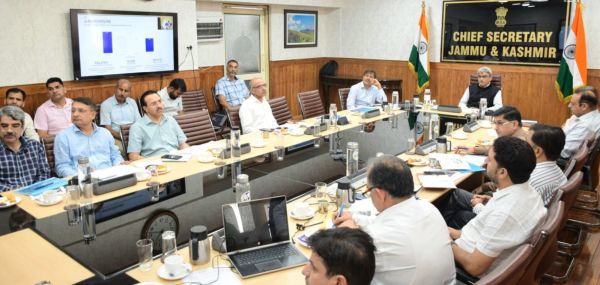
Srinagar: Chief Secretary Atal Dulloo on Thursday reviewed the proposed Comprehensive Minor Mining Policy-2026 and called for a legally robust, technology-driven and sustainable framework to regulate minor mineral extraction in Jammu and Kashmir.
Chairing a high-level meeting, Dulloo said the proposed policy should address existing regulatory gaps, strengthen enforcement and ensure scientific management of minor mineral resources while remaining consistent with the provisions of central legislation.
According to an official statement, the meeting reviewed a presentation by the Centre for Innovation, Technology Assessment and Good Governance (CITaG), which outlined key reforms proposed in the draft policy, including measures to improve transparency, streamline approvals and strengthen monitoring of mining operations.
The Chief Secretary directed officials to incorporate best practices adopted by other states while adapting them to local requirements. He also called for the development of a transparent digital ecosystem to facilitate the participation of traditional miners without allowing mining rights to be transferred or sublet.
Expressing concern over illegal mining, Dulloo asked departments to explore stronger legal deterrents against repeat offenders and ensure that enforcement provisions, including penalties and seizure of vehicles or machinery, are firmly rooted in law.
The meeting also discussed the introduction of a single-window clearance mechanism, a digital “mine-to-market” tracking system, geo-fencing, e-challan generation, real-time monitoring of mineral transportation and periodic revision of penalties to strengthen regulation.
Officials proposed measures including priority allocation of minor minerals for government infrastructure projects, scientific replenishment assessments, advance processing of environmental clearances, greater involvement of traditional miners in dredging and desilting works, and stronger protection for whistleblowers reporting illegal mining.
The meeting decided that CITaG would incorporate the suggestions received from stakeholder departments into the draft policy. It also proposed associating the Bhaskaracharya National Institute for Space Applications and Geo-informatics (BISAG-N) in developing the proposed digital monitoring platform.