
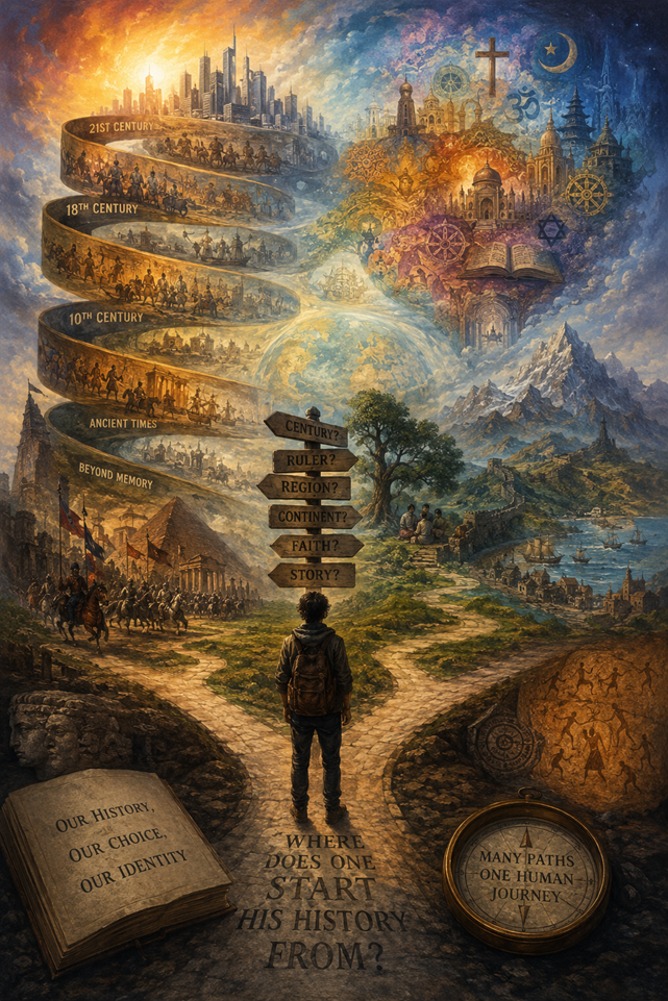
Identity is often built upon history, but history itself is rarely a single, clear story. Every individual, community, nation, religion, and culture looks to the past to explain who they are, where they came from, and why they belong. Yet this raises a difficult question: Where does one begin their history?
Should a person begin with the century in which their ancestors first settled in a region? Should they begin with a great ruler who shaped their culture? Should they trace their origins to a kingdom, a nation, a continent, a faith, or a sacred narrative? The answer is rarely simple, because history offers countless starting points, each leading to a different understanding of identity.
A person born today can claim many histories at once. One may identify with a modern nation-state that is only decades or centuries old. At the same time, they may belong to an ethnic group whose roots stretch back thousands of years. They may follow a religion that traces its origins to ancient prophets, saints, or scriptures. They may also share a common human ancestry that reaches far beyond any kingdom, border, or belief system. Which of these histories is the “real” one?
The challenge is that every starting point is, to some extent, a choice. A nation may celebrate a particular ruler as its founder while overlooking earlier civilizations that occupied the same land. A religious community may begin its story with a sacred event while paying less attention to what came before it. Ethnic groups often remember victories, heroes, and moments of glory, while periods of defeat or coexistence with others may receive less attention. In this sense, history is not merely discovered; it is often selected.
This selective nature of history can become a powerful force. People become emotionally attached to the period they choose as their beginning. If their chosen starting point represents a golden age, they may seek to revive it. If it represents a period of suffering, they may carry a sense of historical grievance. If it represents a sacred origin, they may defend it with deep conviction. Entire political movements have been built upon competing claims about where history should begin.
The problem becomes more complex when different groups living in the same place choose different starting points. One community may look to an ancient empire, another to a medieval kingdom, another to a religious tradition, and another to a modern constitution. Each group sees itself as the rightful heir to history, yet each is drawing from a different chapter of the same human story. Conflicts often emerge not because people disagree about facts alone, but because they disagree about where the story begins.
History also reveals that identities are rarely pure or fixed. Languages, cultures, religions, and populations have constantly interacted, mixed, migrated, and evolved. The boundaries that seem permanent today were often fluid in the past. The ruler celebrated by one group may have governed a diverse population. The faith seen as central to one identity may itself have absorbed influences from many cultures. The region regarded as ancestral homeland may have been home to numerous peoples over centuries. The deeper one looks into history, the harder it becomes to find a single point of origin.
Modern genetics, archaeology, and anthropology reinforce this reality. Human populations have moved across continents for tens of thousands of years. Trade routes connected distant civilizations. Ideas crossed borders long before modern states existed. The story of humanity is not one of isolated groups but of continuous interaction and exchange. If one traces history back far enough, all identities eventually merge into a shared human journey.
This does not mean that local histories, religious traditions, or cultural memories are unimportant. They provide meaning, belonging, and continuity. The danger arises when one chosen chapter of history is treated as the entire book. When people believe that their preferred starting point is the only legitimate beginning, history becomes a tool of exclusion rather than understanding.
Perhaps the most important question is not where history begins, but why we choose a particular beginning. What are we seeking in the past; truth, belonging, pride, justice, or certainty? The answer often reveals more about the present than about the past itself.
In the end, identity may be less about finding a single origin and more about recognizing the many layers that shape us. We are the descendants of countless generations, influenced by numerous cultures, beliefs, migrations, and experiences. History is not a straight line leading to a single identity; it is a vast web of interconnected stories.
The question, therefore, remains open: When we say “our history,” are we uncovering an objective past, or are we choosing the chapter that best explains who we wish to be today?