
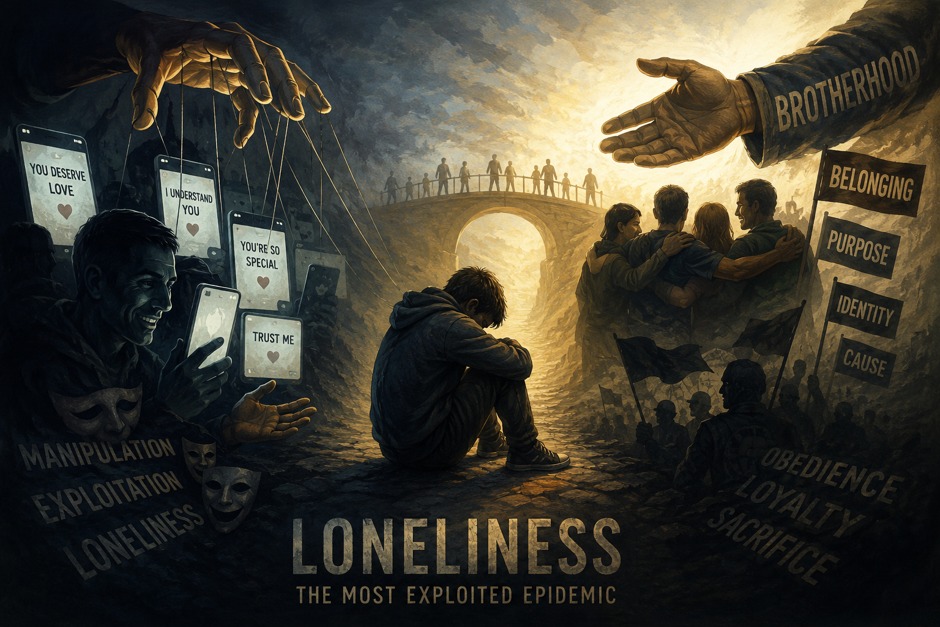
In an age where billions of people are connected through smartphones, social media platforms, and instant communication, loneliness has emerged as one of the defining paradoxes of modern society. Despite unprecedented connectivity, millions of people feel isolated, disconnected, and without purpose. What makes this crisis particularly concerning is that loneliness is not merely a personal struggle, it has become one of the most exploited human vulnerabilities.
Throughout history, people have sought belonging, identity, and purpose through family, community, religion, and social institutions. These structures helped individuals understand who they were and where they fit within society. However, as traditional social bonds weaken and many people find themselves increasingly disconnected, a growing number are searching for alternative sources of meaning and acceptance.
Those searching for belonging often become targets for exploitation.
Recent investigations into online criminal networks have revealed how scammers carefully identify lonely individuals and build emotional relationships with them before exploiting them financially. Romance scams and friendship scams, including those linked to organized criminal groups operating in various parts of the world, rely on a simple understanding of human psychology: people who crave connection are often willing to trust those who offer attention, affection, and companionship.
Yet financial exploitation is only one part of a much larger phenomenon.
Political movements, extremist organizations, cults, gangs, and radical ideological groups have long understood the power of loneliness. Many recruitment efforts begin not with ideology but with friendship. A vulnerable person is approached by someone who appears caring and understanding. They are offered support, recognition, and a sense of community. An arm around the shoulder can be far more persuasive than any political speech or religious sermon.
This pattern has been observed repeatedly in studies of radicalization. Researchers have found that many recruits initially join groups not because they are deeply committed to an ideology, but because they are searching for friendship, identity, and purpose. The emotional connection often comes first; the doctrine follows later.
The concept of brotherhood plays a particularly powerful role in this process. Across different cultures, religions, and political movements, the language of brotherhood creates a sense of loyalty and shared destiny. For individuals struggling with loneliness, rejection, or frustration, such communities can feel like a lifeline.
The problem arises when belonging becomes conditional upon obedience.
Manipulative groups often create a worldview that divides society into “us” and “them.” Members are encouraged to see themselves as part of a special community that possesses unique knowledge, moral superiority, or a historic mission. Gradually, independent thought can be replaced by group loyalty. Doubts are discouraged, criticism is viewed as betrayal, and personal identity becomes inseparable from the cause.
At the heart of many recruitment strategies lies a combination of loneliness and identity crisis. Individuals who feel ignored, humiliated, socially excluded, or uncertain about their future are often searching for explanations. Manipulative movements provide simple answers to complex problems. They offer a narrative that transforms personal frustrations into collective grievances and promises meaning through participation in a larger struggle.
This dynamic is not confined to any single religion, culture, or ideology. Similar patterns have been observed among extremist religious organizations, political cults, nationalist movements, violent gangs, and revolutionary groups throughout history. While some Islamist extremist organizations have used concepts of brotherhood and shared identity in recruitment, the underlying mechanism is universal. The exploitation of loneliness transcends religious and political boundaries.
History offers numerous examples of movements that converted feelings of isolation and resentment into powerful collective forces. Individuals who once felt invisible were made to feel important. Those who lacked purpose were given a mission. Those who felt alone were welcomed into a brotherhood. In some cases, this transformation led people to support violence, sacrifice personal freedoms, or dedicate their lives to causes they might never have embraced under different circumstances.
The challenge for modern societies is not to discourage community or brotherhood. Quite the opposite. Healthy communities, strong social, and meaningful relationships are among the most effective protections against manipulation. The answer to loneliness is not greater isolation but genuine connection.
As governments, educators, and policymakers increasingly recognize loneliness as a public health issue, they must also acknowledge its broader social and political consequences. A society that fails to address loneliness creates opportunities for those who seek to exploit it. Every isolated individual searching for belonging represents not only a human tragedy but also a potential target for manipulation.
Loneliness may be invisible, but its consequences are not. It can influence politics, fuel extremism, empower criminal networks, and reshape societies. In the twenty-first century, loneliness is no longer merely an emotional condition. It has become a strategic vulnerability, one that others have learned to exploit with remarkable effectiveness.
The question facing modern societies is whether we will continue to treat loneliness as a private problem or finally recognize it as one of the most important social challenges of our time.