
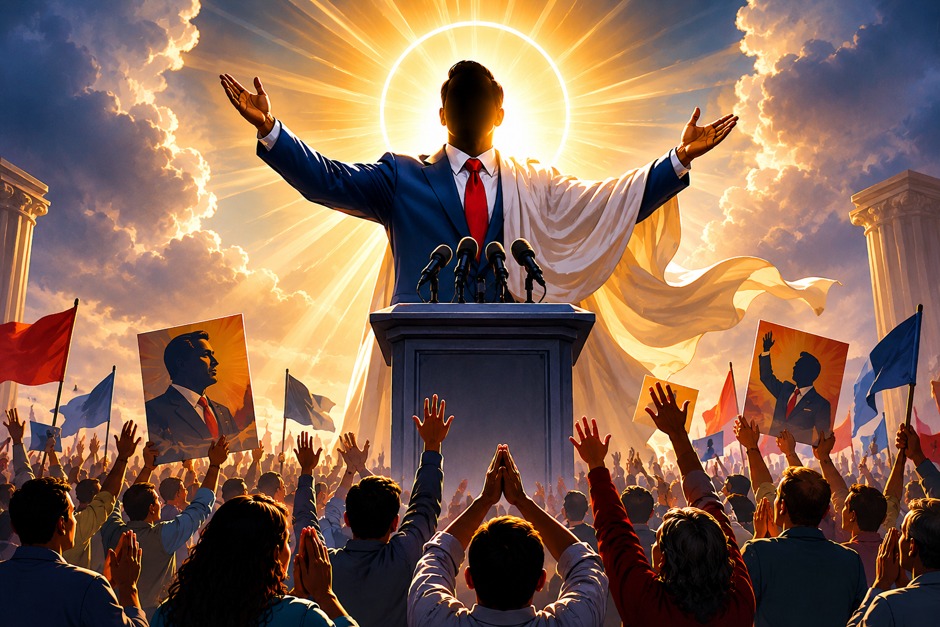
One of the most puzzling features of human history is how often societies place extraordinary faith in ordinary politicians. Despite centuries of experience, education, scientific progress, and countless historical warnings, people continue to elevate political leaders into figures of destiny, treating them as if they possess special wisdom, divine protection, or a unique mission to save the nation.
Throughout history, rulers have understood a simple truth about human psychology: people are often more willing to follow a myth than examine reality. As a result, many leaders have sought legitimacy not only through laws, policies, or public service, but through claims of divine favour, spiritual authority, or historical destiny.
The pattern is ancient. Egyptian pharaohs were regarded as gods. Emperors claimed heavenly mandates. European kings ruled under the doctrine of divine right. The message was always similar: the ruler was not merely another human being but someone chosen by forces greater than ordinary people. Such claims were politically useful because they discouraged criticism. If a ruler’s authority came from heaven, questioning the ruler could be portrayed as questioning heaven itself.
One might expect that modern societies would be less vulnerable to such thinking. After all, humanity has accumulated thousands of years of historical experience. Yet the tendency remains remarkably strong. The names and symbols may change, but the underlying behaviour often remains the same.
Political movements continue to wrap themselves in myths, prophecies, sacred symbols, and stories of national rebirth. Leaders are presented as unique individuals who alone can rescue the nation from decline. Supporters are encouraged to see them not as public servants but as saviours. Rational political debate is gradually replaced by emotional devotion.
This raises an uncomfortable question: if human beings are as rational as they often claim to be, why do they repeatedly seek political messiahs?
Perhaps the answer lies in the fact that uncertainty is difficult to live with. Complex problems rarely have simple solutions. Economic challenges, social tensions, and international conflicts require patience, compromise, and hard work. Yet many people prefer the comforting belief that a single extraordinary leader will solve everything. The myth of the saviour is emotionally appealing because it removes responsibility from society and places hope in one individual.
The twentieth century demonstrated the dangers of this mindset. Personality cults emerged across various political systems, portraying leaders as uniquely gifted and historically destined. Public criticism became disloyalty. Doubt became betrayal. Loyalty to the leader became more important than loyalty to facts.
Few examples illustrate this more clearly than Adolf Hitler. Hitler frequently referred to Providence as guiding his mission and pointed to his survival of assassination attempts as evidence that he was protected by a higher power. Many followers became convinced that he possessed a special historical destiny. Instead of critically examining his actions and policies, they increasingly placed faith in the myth that he was chosen to restore national greatness. The result was one of the greatest human catastrophes in history.
The troubling lesson is not merely about Hitler or any single leader. It is about humanity itself. Again and again, societies claim to have learned from history, yet they often repeat the same psychological mistakes. They exchange critical thinking for devotion, evidence for belief, and accountability for faith in a personality.
Religion, spirituality, and cultural traditions are not the problem. The problem begins when they are used to place political leaders beyond scrutiny. The moment a politician becomes a sacred figure, democracy begins to weaken. A leader who cannot be questioned is no longer a servant of the people but an object of worship.
Perhaps the greatest test of political maturity is the ability to resist the temptation of hero worship. Every leader, no matter how charismatic, remains a human being capable of error, ambition, and self-interest. History repeatedly demonstrates that the most dangerous words in politics are often those that suggest a leader is uniquely chosen, divinely protected, or destined to save the nation.
If humanity wishes to avoid repeating its worst mistakes, it must learn a lesson that history has been teaching for thousands of years: no politician is a messiah. The more a society believes otherwise, the more vulnerable it becomes to manipulation, authoritarianism, and tragedy.