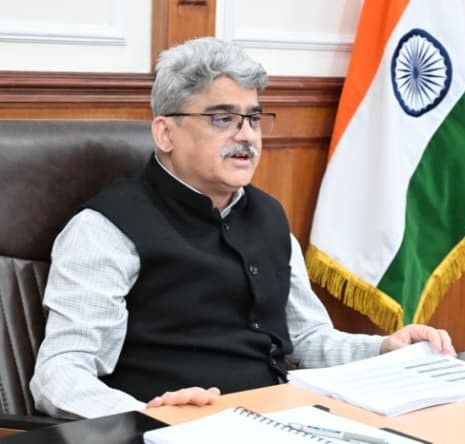
Srinagar: Chief Secretary Atal Dulloo on Monday directed the Health and Medical Education Department to accelerate NABH accreditation and ensure universal certification of healthcare institutions under the National Quality Assurance Standards (NQAS) framework across Jammu and Kashmir.
Chairing a comprehensive review meeting of the National Health Mission (NHM) and allied healthcare programmes, the Chief Secretary assessed the achievements, challenges and future roadmap for strengthening healthcare delivery in the Union Territory.
The meeting was attended by Commissioner Secretary Health and Medical Education M. Raju, Managing Director NHM, Director SKIMS, principals of Government Medical Colleges, Directors of Health Services Jammu and Kashmir and other senior officials.
During the meeting, Dulloo directed premier healthcare institutions in Jammu and Srinagar to immediately begin the process for securing NABH accreditation. He instructed each medical college to designate a nodal officer for institutional preparedness and said district hospitals and other medical colleges should subsequently follow the same model.
Stressing equitable healthcare access, the Chief Secretary directed the department to ensure posting of at least one medical officer in every Primary Health Centre and asserted that no healthcare institution in Jammu and Kashmir should remain without a doctor.
He also asked officials to expedite the tendering process for Tele-ICU, Tele-Radiology and BEMMP facilities, stating that these initiatives would strengthen tertiary healthcare services and reduce the need for patients to travel long distances for treatment.
Reviewing quality assurance measures, Dulloo directed health authorities to ensure certification of all healthcare institutions under the NQAS framework within the current year.
The Chief Secretary also reviewed the ongoing screening programme for Non-Communicable Diseases (NCDs) and called for intensified screening of people above 40 years of age. He described NCDs as “silent killers” and stressed the importance of preventive healthcare and lifestyle modifications.
He further directed the strengthening of the Drugs and Vaccine Distribution Management System (DVDMS) to ensure adequate availability of medicines under the Essential Drug List.
Commissioner Secretary Health and Medical Education M. Raju informed the meeting that Jammu and Kashmir had shown significant improvement in key healthcare indicators and had already achieved Sustainable Development Goal targets for Neonatal Mortality Rate and Under-Five Mortality Rate ahead of schedule.
Mission Director NHM Akriti Sagar informed the meeting that successful discharge rates in Neonatal Intensive Care Units and Sick Newborn Care Units had increased from 76 per cent in 2024-25 to 83 per cent in 2025-26, while neonatal deaths and referrals had declined.
Officials said more than 18.84 lakh children had been screened under the Rashtriya Bal Swasthya Karyakram during the current financial year, while over 1.51 lakh children requiring treatment were referred to higher healthcare institutions.
The review also highlighted that nearly 99.82 per cent deliveries in Jammu and Kashmir during 2025-26 took place in health institutions, indicating improved maternal healthcare outreach.
Under the TB Mukt Bharat Abhiyaan 2.0 campaign, Jammu and Kashmir was reported to be the top-performing region in X-ray utilisation for TB screening. Officials informed the meeting that five districts, Anantnag, Budgam, Kulgam, Pulwama and Shopian, had been declared TB-free.
The meeting was also informed that over 5.60 lakh beneficiaries had availed services under the 102 and 108 ambulance network, while the 104 Medical Helpline had catered to over 12.82 lakh people during 2025-26.
Officials further informed that 87 per cent of Ayushman Arogya Mandirs in the UT had become operational and OPD attendance at these facilities had crossed 3.33 crore cumulatively during the last three financial years.
The meeting also reviewed progress under telemedicine services, Hospital Management Information Systems, Tele-MANAS mental health support services and dialysis facilities established under the Pradhan Mantri National Dialysis Programme.