The fight against drugs has ramped up with massive campaigns gaining momentum under 100-Day Nasha Mukt Bharat Abhiyaan (NMBA) (Drug-Free India Campaign), an intensive, time-bound initiative launched in April 2026, primarily within the Union Territory of Jammu and Kashmir, aimed at combating the rising menace of drug abuse and trafficking. This 100-day campaign is a subset of the broader Nasha Mukt Bharat Abhiyaan (NMBA), which was launched nationally by the Ministry of Social Justice and Empowerment on 15th August 2020.
Across the country, campaigns like NMBA have amplified the urgency of building a drug-free society. Schools, as the most accessible public institutions, have naturally become key platforms for spreading this message. Yet, from the ground, a different story is beginning to surface—one that asks an uncomfortable question: Are we, in our enthusiasm to create awareness, unintentionally exposing children to ideas they are not ready to process? The awareness messages ignite curiosity in innocent minds, turning caution into risk.
While the intent of the campaigns is noble, emerging ground-level experiences suggest troubling paradox- awareness, when delivered without age sensitivity, may inadvertently create curiosity and risk among young children.
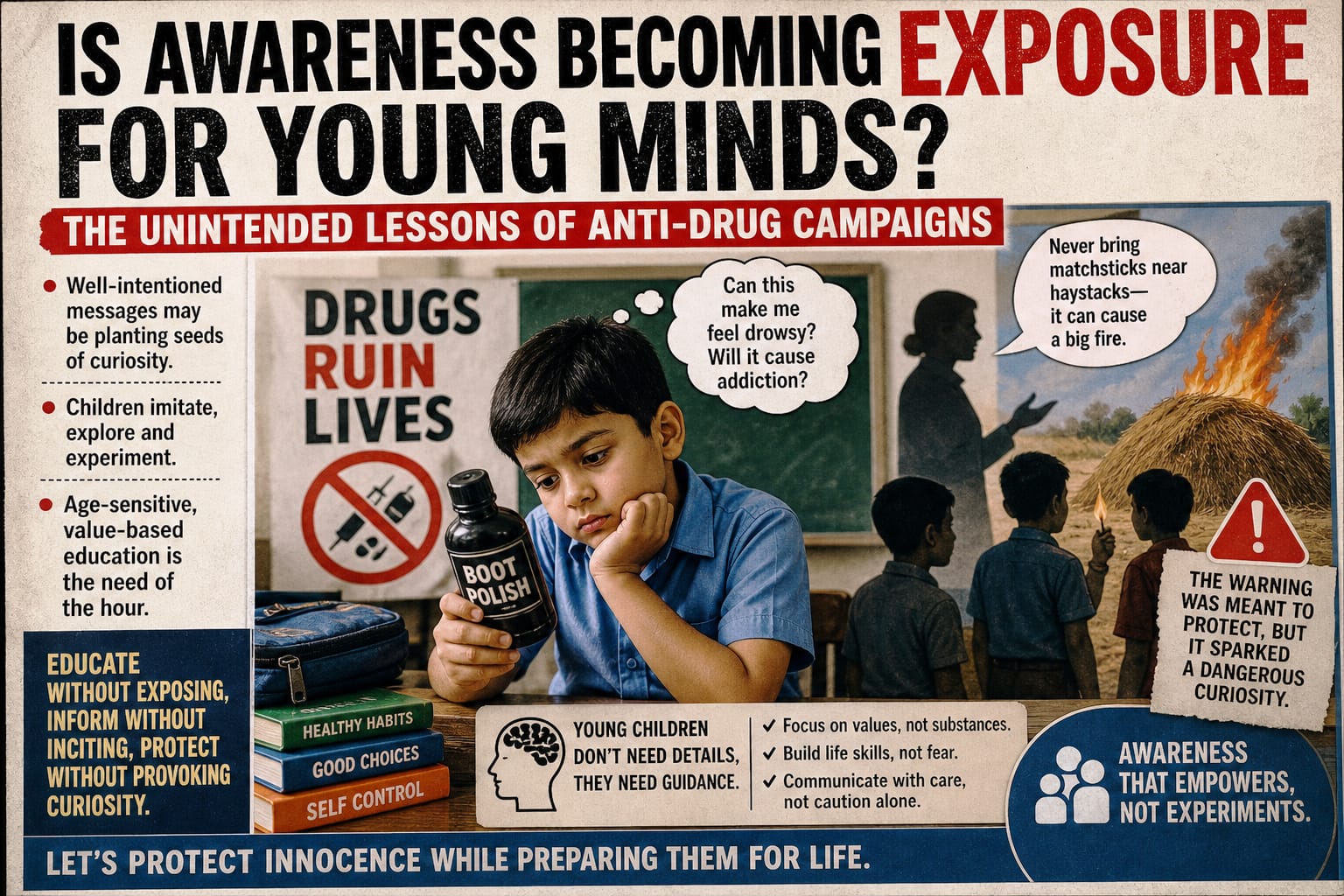
A frontline health worker, serving as an FMHW under Rashtriya Bal Swasthya Karyakram-a government program screening kids for health issues, so she visits schools regularly, recently shared an experience that deserves serious reflection. One morning, while polishing her young child’s school shoes, she was stopped by her 8-year-old, who insisted on doing it himself. When asked why, the child replied that he had learned in school that even boot polish could cause drowsiness and lead to addiction and he wanted to check its reality.
For the mother, the moment was jarring. The child, previously unaware of such notions, had now begun to associate everyday objects with addiction. What was meant to inform had, instead, introduced a new and unnecessary curiosity.
How did an everyday object become a temptation? The worker, with three years of school outreach, sees this pattern. “Kids this age can’t grasp abstract dangers like addiction, “she says. “We plant the seed of curiosity. They might sniff glue, socks or polish at home, thinking, “What’s this high like?” It’s not education—it’s exposure. Kids attempt to “test” what they’ve learned,” she maintained.
A primary school teacher narrated another telling episode. For years, haystacks stored outside a rented school building remained untouched by children. One day, in a well-intentioned warning during morning assembly, the teacher cautioned, ‘Never bring matchsticks near the haystacks—it could spark a massive fire.” After explaining the risk of fire, the very next day, some children brought matches from home and set the haystack ablaze. Firefighters had to rush in. The teacher reflected, “They had zero interest before. My words put the idea in their heads like reverse psychology.
The teacher was left questioning whether the warning had, in fact, planted the idea. Psychologists call this the “forbidden fruit effect.” Studies, like those from the American Psychological Association, show kids under 10 fixate on what is banned, not why. In India, a 2023 NCERT survey found 15% of primary students recalled “drug talks” sparking home experiments with household items.
These are not isolated anecdotes; the teachers and health educators point to a deeper pedagogical challenge. Children, especially in their early years, learn as much from what we say as from how we say it. Their cognitive world is driven by curiosity, imitation, and exploration. When complex or sensitive concepts like addiction, intoxication, or risk behaviours are introduced without age-appropriate framing, they may not deter behaviour; they may provoke it.
The distinction between awareness and exposure is subtle but critical. Awareness empowers when it is contextual, gradual, and developmentally appropriate. Exposure, on the other hand, can overwhelm, confuse, or even entice. In the case of younger children, naming substances, describing their effects, or linking them to everyday items may inadvertently normalize or sensationalize what should ideally remain outside their experiential frame.
This is not an argument against awareness campaigns. However, their success depends not just on intent, but on methodology. One-size-fits-all approaches to awareness especially in diverse classroom settings can do more harm than good.
For primary to middle level students, messaging must shift from substance-specific warnings to value-based education. Instead of detailing what addiction is or what causes it, educators can focus on building self-control and decision-making skills, encouraging healthy routines and habits, teaching the difference between safe and unsafe choices in general terms.
For older students, awareness can be gradually layered with accurate, guided information. But even then, it must be accompanied by counseling, dialogue, and critical thinking not only fear-based messaging.
Equally important is teacher preparedness. Educators need orientation and training to understand how children interpret information. A well-meaning sentence in an assembly can sometimes have unintended consequences, as the haystack incident shows. Communication in classrooms must be as carefully designed as the curriculum itself.
We must also recognize that innocence is not ignorance, it is a stage of development. Protecting that stage while gently guiding children towards informed adulthood is the true challenge of education.
If awareness campaigns are to succeed, they must be age-sensitive, psychologically informed, and pedagogically sound. Otherwise, we risk creating a generation that is not protected from harm, but prematurely introduced to it. The goal should be clear, educate without exposing, inform without inciting and protect without provoking curiosity. Only then can awareness truly become a tool of prevention, not an unintended pathway to risk.