
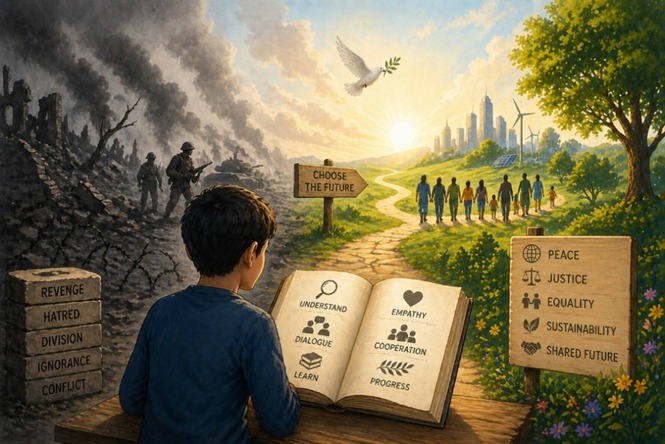
“History is to nationalism what the poppy is to the opium addict,” said Eric Hobsbawm. It is a warning, but it can also be seen as an opportunity. If history has the power to influence emotions so deeply, it also has the power to guide societies toward something better.
Today, many nations turn to history for identity and strength. That is not necessarily a problem. When used wisely, history can inspire confidence, resilience, and a sense of shared purpose. Even in a world where we sometimes see conflicts driven by expansionist ideas of “greatness,” history can instead remind us that true greatness comes from cooperation, stability, and progress, not domination.
The key lies in how we engage with the past. Rather than using history as a tool to divide, societies can use it to understand complexity. Every nation’s story includes both achievements and mistakes. Recognizing both does not weaken a country; it makes it more grounded and credible.
Education plays an important role here. When students are encouraged to explore multiple perspectives, they develop the ability to think critically and empathize with others. Institutions like UNESCO promote preserving authentic history, but the real impact comes when societies themselves choose openness over selective memory.
Nationalism, too, can be a positive force when it is forward-looking. Instead of focusing only on past glory, a healthy nationalism is built on shared values, civic responsibility, and common goals. It creates pride not just in what a nation was, but in what it is becoming.
There are inspiring examples. After World War II, Germany chose to confront its past honestly. By doing so, it rebuilt its identity on responsibility, democracy, and human rights. This shows that acknowledging history can strengthen, not weaken, a nation.
For societies carrying deep historical wounds, the path forward lies in acknowledgment and healing. Processes like the Truth and Reconciliation Commission demonstrate that facing difficult truths can build trust and unity over time. Honest dialogue creates space for reconciliation and shared progress.
In today’s interconnected world, history can also remind us of how much we share. Cultures have always influenced one another, and no nation has developed in isolation. Global challenges, from climate change to inequality, require collective solutions. Institutions like the United Nations reflect the idea that nations are part of a larger human community.
Leaders and citizens alike have a role to play. Instead of using history to evoke fear or nostalgia, it can be used to inspire responsibility and action. People can choose to value governance based on present outcomes, fairness, opportunity, and stability, rather than rhetoric about the past.
At its best, history is a guide. It shows what works, what fails, and what consequences follow our choices. Its purpose is not to trap societies in old narratives, but to help them make wiser decisions.
Pride in culture and heritage still has an important place. Celebrating art, literature, and achievements builds confidence. When combined with honesty about shortcomings, it creates a balanced and mature identity.
The past cannot be changed, but it can be understood and used constructively. It is not a burden or a weapon, but a resource.
Hobsbawm’s insight reminds us of history’s power. The real challenge is to use that power wisely. When history is approached with curiosity rather than emotion alone, and nationalism is shaped by values rather than myths, both can become forces for unity.
In that shift lies hope, the possibility of a world where nations are confident yet cooperative, proud yet open, and guided not just by where they come from, but by where they choose to goUntil then, the uncomfortable question will remain: is journalism informing the public, or merely shaping the narrative?