
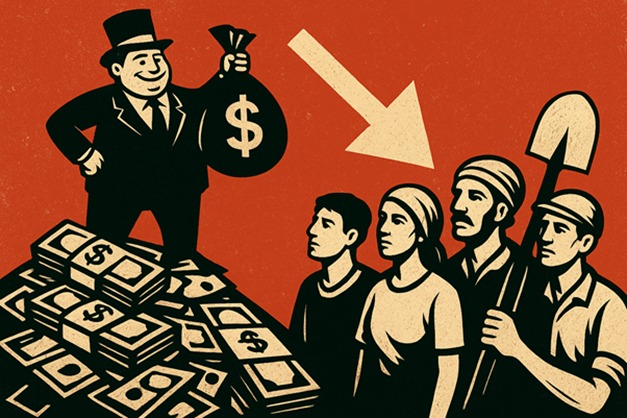
Across human history, one pattern repeats itself: societies may differ in language, culture, or religion, but the mechanisms of exploitation remain remarkably similar. Whether in ancient kingdoms or modern democracies, the greatest benefits most often flow to a small group that controls capital, land, factories, technology, or today’s global corporations. These systems are frequently presented as noble, wrapped in the language of community, justice, identity, or national pride, but the structures beneath them tend to protect the interests of the powerful. Constitutions, legal amendments, and the enormous cost of elections all help maintain this imbalance. Sustaining political power requires not only money but also constant narrative-building to keep the public engaged, distracted, or divided in ways that support existing hierarchies.
Capitalism itself is not inherently negative; it has driven innovation, efficiency, economic growth, and improved living standards across the world. However, when development opportunities and major investments are concentrated among a select few, capitalism’s weaknesses become clear. Wealth inequality widens, markets become unstable, and social or environmental concerns are often sidelined in the pursuit of profit. This dynamic is captured in the familiar phrase “the rich get richer and the poor get poorer,” reflecting how those with existing resources have far more opportunities to grow their wealth, while those with less struggle to catch up.
This pattern is known as the Matthew Effect or the “effect of accumulated advantage.” Those who have more, whether wealth, education, or influence, tend to gain more over time, while those who start with less face greater barriers. The effect can be seen in everyday economic life: wealthy families can invest in property, while poorer families struggle to save for a down payment; affluent children receive better education and support, while others are pushed toward unstable gig-economy jobs with low pay and few protections. Globally, studies show that a disproportionate share of wealth remains concentrated at the top. Even in fast-growing economies like India, new wealth is often captured by a narrow segment of society.
Sociological theories such as conflict theory argue that such inequality is not accidental but built into the structure of society, enabling those with power to accumulate more at the expense of those without. Others caution that not all inequality is due to exploitation, pointing out that education, skill differences, and market demand also shape income differences. Yet even these factors are influenced by early access, privilege, and structural advantage.
One area where inequality becomes highly visible is in wage practices, especially in the unorganised sector. India does have minimum wage laws under the Minimum Wages Act of 1948, but domestic workers are not universally covered, and protections vary significantly by state. While parts of the private and public sectors see regular salary revisions and bonuses, domestic workers rarely experience similar increments. Their wages stagnate not only due to weak regulations but also because of social attitudes that undervalue household labour.
Improving this situation requires more than legal reform, it calls for collective action, stronger worker organisations, and accessible legal support. But it also demands a shift in public ethics. Individuals who employ domestic workers, drivers, gardeners, or daily labourers must recognise their own role in perpetuating wage inequality. Fair pay, reasonable increments, and humane working conditions are not acts of charity; they are moral responsibilities that help correct a long-standing imbalance.
As societies debate inequality, it is essential to remember that systems do not change on their own. They change when citizens question them, demand fairness, and act with conscience in their own spheres of influence. Structural reform and personal responsibility must go hand in hand if we want an economy that allows everyone, not just a privileged few, to move forward.
Author has over 25 years of experience in leadership roles with major global Semiconductor companies working on AI. Visit LinkedIn to know more about the author: https://www.linkedin.com/in/aijazqaisar/