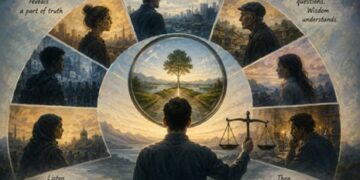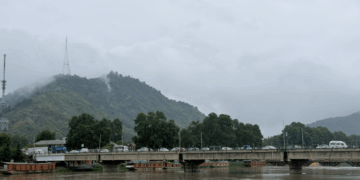

Once, Kashmir thought. It did not just speak. It argued, contemplated, doubted, prayed, painted, sang, and rebelled – with reason as its lamp. It was a land where thought was worship, not war; where the Sufi whispered to the Shaiva, and both found God in silence. Today that lamp trembles in the wind of noise.
The Kashmiri mind is disappearing.
Not because people have become stupid – but because they have become scared. Scared to imagine. Scared to differ. Scared to think without permission. Our ancestors debated existence on the banks of the Vitasta; we now forward memes on WhatsApp and call it opinion. The land that produced Abhinavagupta, Lalleshwari, Habba Khatoon and Mahjoor now trades in borrowed words, recycled thoughts, and imported faith.
There was a time when conversation in Kashmir meant communion – when even a cup of noon-chai carried an argument about God or destiny. Today, our dialogue has been replaced by declarations. We do not listen; we merely wait to reply. We speak in hashtags, think in algorithms, and mistake echo for agreement.
The younger generation, growing up amid curated certainties, has inherited neither doubt nor dialectic. Their world is algorithmically arranged: a stream of slogans, outrage, and advertisements of borrowed conviction. They are fluent in everything but truth.
Once, we read poetry to find ourselves; now we scroll reels to forget ourselves.
The great civilizations thrived because they tolerated discomfort – the pain of reflection, the ache of contradiction. Kashmir has lost that gift. We now seek comfort in conformity. The poet who questions is told to stay quiet; the teacher who provokes thought is labelled arrogant; the child who wonders is advised to “be practical.”
The easiest way to destroy a people is not by killing their bodies but by sedating their minds. Our sedation is complete – through gossip, religion-as-routine, politics-as-spectacle, and entertainment as anesthesia. We have mistaken motion for progress and performance for peace.
Walk into most classrooms and you will not find curiosity – only compliance. Education has become a transaction: a degree for a job, a syllabus for survival. We produce literates without literacy of the soul.
Our universities no longer birth thinkers; they breed clerks of ideology. We no longer ask “why,” only “how much.”
Abhinavagupta wrote about Pratyabhijna – self-recognition as liberation. But who among us remembers the self anymore? Our children can code apps but cannot decode the silence in their ancestors’ eyes.
Both religion and modernity have conspired in this disappearance. One sells fear in the name of faith; the other sells distraction in the name of freedom. Between the mullah’s megaphone and the influencer’s microphone, the Kashmiri soul has lost its original sound.
We shout “peace” louder than we practice it, “truth” more often than we live it.
Our shrines and schools, both once temples of reflection, now compete for relevance by numbers, not by nobility. We have turned our saints into slogans and our history into hashtags.
A society without self-reflection soon stops recognizing itself. We talk about Kashmir’s “identity” as if it were a lost photograph. But identity is not a relic – it is a rhythm. It must be renewed by consciousness, not claimed by memory. The disappearing Kashmiri mind is not just a loss for Kashmir; it is a loss for civilization itself. For when the valley that once taught the world to think forgets how to think, humanity becomes a little poorer.
To resurrect the Kashmiri mind, we do not need slogans or subsidies. We need solitude, sincerity, and study.
We must re-open the conversations between Lalla and Lalitaditya, between Mahjoor’s longing and Gani’s grief, between the saffron flower and the snow.
We must teach our children to wonder again – to question without fear, to read without agenda, to pray without prejudice.
Kashmir will survive its politics, its power cuts, its curfews. But it will not survive the death of thought.
The true Azadi – the only one that matters – is the freedom to think without fear.
When that returns, perhaps the lamp will steady again. And once more, the mind of Kashmir will begin to dream.
Box Item
The Forgotten Lineage of Light
We once belonged to a civilization of astonishing thinkers – minds that glowed like oil lamps in Himalayan snow. Yet ask today’s Kashmiri youth about them, and most will blink in silence. Our collective amnesia is not just ignorance; it is erasure. Here are some names we must whisper back into our classrooms, our shrines, our living rooms – before they vanish entirely.
Philosophers and Mystic Thinkers
- Abhinavagupta (10th century CE): The supreme philosopher of Kashmir Shaivism, whose Tantraloka unified metaphysics, aesthetics, and psychology long before the West dreamt of such synthesis.
- Utpaladeva (9th century CE): Founder of the Pratyabhijna (“self-recognition”) school – who taught that realization lies not in escape from the world but in recognizing oneself as divine consciousness.
- Vasugupta (8th–9th century CE): The revealer of the Śiva Sūtras, said to have appeared to him on a stone at Mahadeva hill – the seed from which Kashmir Shaivism blossomed.
- Kṣhemarāja (11th century CE): The lucid expositor of Abhinavagupta’s thought, whose works like Pratyabhijñāhṛdayam remain timeless meditations on awareness.
Poets, Saints, and Sages
- Lalleshwari (Lal Ded): The wandering mystic who stripped herself of every veil except truth. Her vaakhs remain Kashmir’s purest literature – bridges between Shaivism and Sufism.
- Sheikh Noor-ud-Din Noorani (Nund Rishi): The Rishi saint who carried forward Lalla’s vision of divine unity, reminding a divided people that holiness needs no label.
- Habba Khatoon: The Nightingale of Kashmir, whose songs of longing still tremble between Zoon and the Zabarwan hills.
- Arnimal and Rupa Bhawani: The poetesses who spoke of feminine strength and metaphysical yearning centuries before feminism had a name.
Scholars and Historians
- Kalhaṇa (12th century CE): Author of Rājataraṅgiṇī, the first continuous historical chronicle of any Indian region – combining fact, fable, and moral philosophy.
- Jonarāja and Śrīvara: His successors who continued Kashmir’s historical tradition – proof that memory, not might, is what sustains civilizations.
Modern Minds of Vision and Science
- Zain-ul-Abidin (Budshah, 15th century): The polymath king who revived art, literature, and secular ethics – a ruler who governed by intellect, not intolerance.
- Prem Nath Bazaz: Political thinker and reformer who envisioned a plural Kashmir where ideas mattered more than identities.
- G.M. Sufi & Pandit Madan Mohan Kaul: Scholars of history and economics who gave modern shape to Kashmir’s intellectual discourse.
Agha Shahid Ali: The poet of exile and elegance – whose English verses brought Kashmir’s anguish to the conscience of the world.