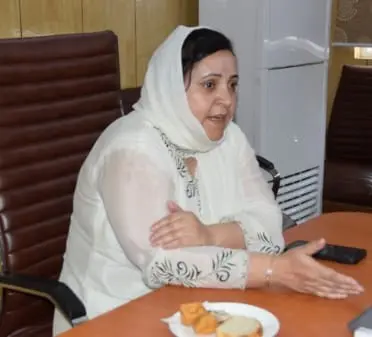
By: Ms. Jyoti Vij
With the world fast moving towards automation, the Government of India’s recently approved Employment Linked Incentive (ELI) scheme, comes as a very timely and measured step. With an outlay of nearly Rs 1 lakh crore, it is a bold policy intervention in India’s evolving employment landscape especially in manufacturing sector. Designed to support the creation of more than 3.5 crore jobs over the next two years, the ELI Scheme is not just an economic measure—it is a strategic investment in the future of India’s workforce, directly supporting the Government’s Viksit Bharat@2047 vision. ELI is going to be a major catalyst of job creation in the country.
Unlike many other countries where population would soon start reducing or have started reducing, India still has a large working-age population which needs to be supported by more job opportunities. The ELI Scheme seeks to bridge the persistent gap between job seekers and job creators, and more importantly, between informal work and formal employment.
Beyond the immediate employment outcomes, it is important to note that the ELI Scheme also strengthens India’s progress towards several Sustainable Development Goals (SDGs) particularly in SDG 8 (Decent Work and Economic Growth), by incentivising formal, long-term employment; in SDG 1 (No Poverty) and SDG 10 (Reduced Inequalities), by offering targeted financial support to low-wage earners and first-time jobseekers.
The linkage of the scheme to EPFO registration and disbursal through Aadhaar-enabled DBT systems ensures that it not only generates jobs but also expands social protection coverage, which is critical for building a just and inclusive economy. Recognising such efforts by India, ILO recently acknowledged India’s achievement and officially published on its dashboard that 64.3% of India’s population (as against 19% earlier in 2015), i.e. over 94 crore people, are now covered under at least one social protection benefit.
The emphasis on manufacturing is particularly welcome. As global value chains undergo realignment, India is fast emerging as a trusted alternative in sectors such as textiles, electronics, automobiles, consumer goods, and pharmaceuticals. By supporting long-term employment generation in these sectors, the ELI Scheme complements existing initiatives like PLI schemes, Make in India, and Skill India, and would accelerate industrial growth in both urban and semi-urban clusters.
For MSMEs, which often face constraints in scaling up formal hiring due to cost concerns, the scheme offers critical relief. The employer-side incentives reduce the marginal cost of new hiring, thereby encouraging expansion, formalisation, and workforce upgradation.
Globally, wage-linked incentive schemes have proven effective in promoting employment. Countries like Germany offer employer subsidies for apprenticeships and long-term hiring; South Korea provides targeted wage support to employers of young and older workers; and Singapore ties financial assistance to upskilling and employment retention. The United States has the Work Opportunity Tax Credit (WOTC), which rewards employers hiring individuals from disadvantaged groups. India’s ELI Scheme incorporates global best practices while customising for local needs—such as our large informal labour market, demographic dividend, and expanding digital infrastructure.
The ELI Scheme reflects a maturing of India’s employment policy—shifting from short-term relief to long-term labour market development. In the face of global megatrends like ageing populations as well as the digital and green transitions, such effective policies are crucial to grant more people access to quality jobs. We at FICCI urge our members to come forward to use this scheme. Employers—especially in the MSME segment—must recognise this as more than a financial benefit. It is a tool for scaling operations, tapping into young talent, formalising payrolls, and creating lasting economic value. As the apex industry chamber, FICCI stands committed to support this cause.
The writer is Director General, FICCI
Courtesy PIB, Srinagar