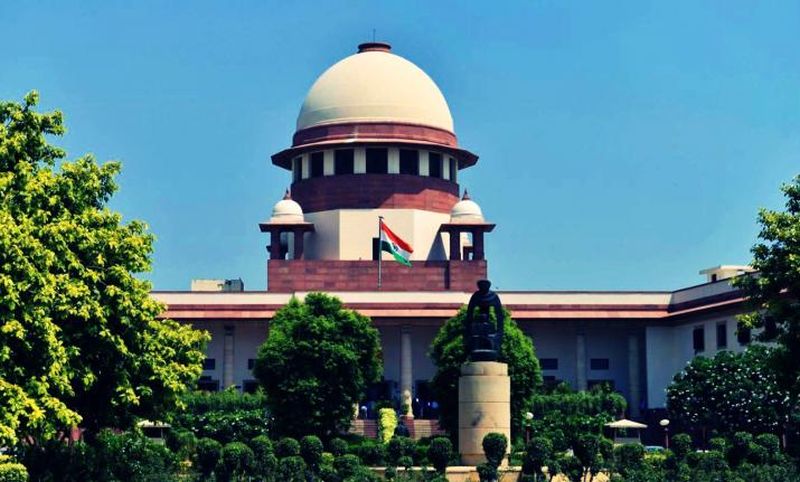
New Delhi: Religious rights of every person are subject to “public order”, the Supreme Court said on Monday while dismissing the plea of a man seeking to exhume the body of his son, who was dubbed a terrorist and killed in an encounter in Kashmir in November 2021, so the family could conduct his last rites in the same graveyard.
Observing that the exercise of fundamental rights is not absolute but must give way to the maintenance of public order, morality and health, the top court said the right to live a dignified life as enshrined under Article 21 of the Constitution is not only available to a living person but also to the “dead”.
“Religious rights of every person and every religion are, however, subject to the public order, the maintenance whereof is paramount in the larger interest of the society. Both these fundamental rights have been expressly made ‘subject to public order, morality and health’.
“The exercise of these fundamental rights is not absolute but must yield or give way to the maintenance of public order, morality and health,” a bench of Justice Surya Kant and J B Pardiwala said.
The apex court’s judgement came on a plea filed by Mohammad Latief Magrey seeking exhumation of the body of his son Aamir Magrey.
Refusing to disinter the body of the deceased for the purpose of religious rituals, the top court said almost nine months have passed post burial which is suggestive that the body may not be in a deliverable state.
The top court said it will be too much at this stage to disinter the body and that “the dead” should not be disturbed and some sanctity should be attached to the grave.
“It goes without saying that the right to live a dignified life as enshrined under Article 21 of the Constitution is not only available to a living person but also to the dead…..
“These rights are not only for the deceased but his family members also have a right to perform the last rites in accordance with the religious traditions. We are of the view that it would have been appropriate and in the fitness of things to hand over the dead body of the deceased to the family members, more particularly, when a fervent request was made for the same,” the bench said.
The apex court said for any compelling reasons or circumstances or issues relating to public order etc. more particularly in cases of encounter with the militants the agency concerned may decline to part with the body.
“These are all very sensitive matters involving the security of the nation and as far as possible the court should not interfere unless substantial & grave injustice has been done.
“Although, for some reason or the other, the body of the deceased was not handed over to the family members yet the same was buried with respect & dignity, with the help of the Auqaf Committee at the Wadder Payeen Graveyard,” the court said.
The top court said after a body has been buried, it is considered to be in the custody of the law, therefore, disinterment is not a matter of right.
“The disturbance or removal of an interred body is subject to the control and direction of the court. The law does not favour disinterment, based on the public policy that the sanctity of the grave should be maintained.
“Once buried, a body should not be disturbed. A court will not ordinarily order or permit a body to be disinterred unless there is a strong showing of necessity that disinterment is within the interests of justice,” the bench said.
The top court noted that the respondents have stated on oath that the body of the deceased was buried with all honour.
“The body was first washed and thereafter wrapped in fresh white cloth. The prayers were also performed at the time of the burial. There is nothing to indicate that the deceased was not given a decent burial as enshrined under Article 21 of the Constitution.
“The right to dignity and fair treatment under Article 21 of the Constitution is not only available to a living man but also to his body after his death. We, as a court of law, respect the emotions and sentiments expressed by the appellant as the father of the deceased. However, the court of law should not decide the rights of the parties considering their sentiments,” the bench said.
On June 03, a division bench of the High Court of Jammu and Kashmir and Ladakh stayed the single bench order for exhuming the body of Aamir Magrey and handing it to his family for last rites.
On May 27, the single judge bench had directed the Jammu and Kashmir authorities to make arrangements for exhuming the remains of the deceased from the Wadder Payeen graveyard in the presence of Latief Magrey.
The high court, however, had said if the body is “highly putrefied and is not in deliverable state or is likely to pose risk to public health and hygiene, the petitioner and his close relatives shall be allowed to perform last rites as per their tradition and religious beliefs in the graveyard itself”.
In that situation, the state shall pay petitioner Mohammad Latief Magrey a compensation of Rs five lakh for deprivation of his right to have the dead body of his son and give him a decent burial as per the family traditions, religious obligations, and faith which the deceased professed when he was alive, the single judge bench order had said.
Bodies of two more civilians, Altaf Ahmad Bhat and Dr. Mudasir Gul, who was killed in the Hyderpora encounter, were exhumed and returned to the families following an outcry days after the gunfight.
Four people, including Magrey, were killed in the encounter on the outskirts of Srinagar on November 15, 2021.
While police claimed all of them were terrorists and buried their bodies in Kupawara in north Kashmir, the families of the deceased insisted they were innocent civilians.