
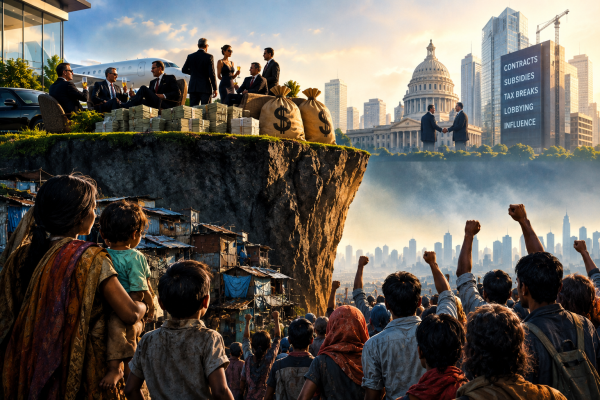
Throughout history, social inequality, economic disparity, and the high-handedness of those in power have often created the conditions for revolution. When wealth and power become concentrated in the hands of a few while large sections of society struggle to meet basic needs, a dangerous question eventually emerges: How long can such an imbalance survive?
Today, the world has thousands of billionaires, but they represent an almost invisible fraction of humanity. With a global population of more than 8.2 billion, only around 3,400 people have billionaire status, meaning billionaires make up roughly 0.000042% of the human population. That means at the other end of the spectrum, hundreds of millions live in extreme poverty.
The estimated 2026 populations against the number of billionaires for the top countries from the Forbes Billionaires List:
United States: 349.0 million – 989 Billionaires
China: 1.41 billion – 539 Billionaires
India: 1.47 billion – 229 Billionaires
Germany: 83.6 million – 212 Billionaires
Russia: 143.4 Million – 147 Billionaires
Italy: 58.9 million – 89 Billionaires
Canada: 41.8 million – 82 Billionaires
Hong Kong: 7.5 million – 71 Billionaires
Such a gap cannot be explained simply by individual talent or hard work. Governments and public institutions often play an important role in creating the environment in which enormous fortunes are built. Access to public contracts, licences, natural resources, land, subsidies, tax policies and infrastructure can dramatically increase private wealth. In some countries, close relationships between business and political power create what is commonly called crony capitalism.
The relationship, however, can work both ways. Once great fortunes are created, immense wealth can influence governments through political donations, lobbying, media ownership, and policy-making. Some billionaires have entered politics directly, while others use their economic influence to shape regulations and taxation. The danger is not wealth itself, but the concentration of wealth and political influence in the same hands.
History shows that revolutions rarely begin simply because people are poor. They usually emerge when economic hardship combines with a sense of injustice, political exclusion and loss of trust in institutions. The American and French Revolutions were shaped by taxation and economic crisis; the Russian Revolution was fuelled by inequality, war and political repression. Similar patterns can be seen in other upheavals: long-standing grievances create the pressure, while a crisis provides the spark.
Revolutions also require organization. Intellectuals and political leaders give grievances a language and a direction. Emerging middle classes may demand political power to match their economic influence. Workers can organize strikes and mass protests, while peasants can provide numbers and sustained support. In many historical revolutions, divisions within the military have also proved decisive when soldiers refuse to defend an unpopular regime.
The question today is therefore not simply whether the poor can revolt against the rich. The deeper question is whether societies can correct extreme inequalities before frustration turns into confrontation. In an age of unprecedented wealth and technology, governments face a fundamental challenge: to ensure that economic growth creates opportunity for the many, rather than concentrating wealth and power among the few.
History offers a warning. When people believe that the system protects the powerful but ignores everyone else, reform becomes harder, and revolt becomes more imaginable. The real test of modern governance is not merely how much wealth a society can create, but whether its people believe that the wealth, opportunities and institutions of that society are fairly shared.