

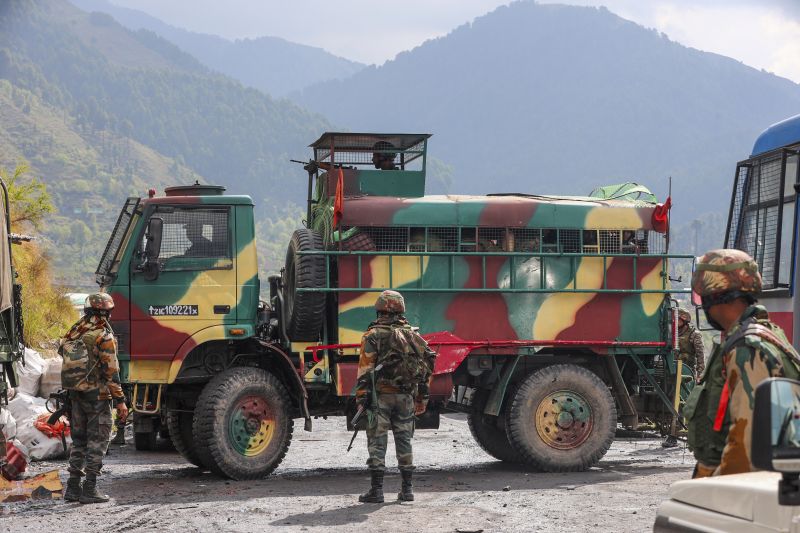
For over a decade the current government has been operating with a zero-tolerance policy towards terrorism. This radical shift in the policy framework is not mere rhetorical but has been adopted by the state institutions which includes legislative and diplomacy.
Since 2014, authorities have dealt with terrorism beyond the law-and-order paradigm, making it a security policy that needs a systemic transformation.
As per the official figures, the menace of terrorism have had immense human cost, as many as 7,217 terrorist-related attacks took place across the country between 2004 to 2014 in which at least 92,000 individuals were killed. In the same period, the terror networks operations caused devastation in India’s hinterland notably the key incidents are Parliament attack (2001), the Mumbai train bombings (2006), the Hyderabad blasts (2007), and the 26/11 attacks.
If we take the example of the UT of Jammu and Kashmir, the bordering state the region had for decades experienced the concern of terror infiltration from across the Line of Control (LoC). Within its urban setting, there was major concern of youngsters indulging in the stone-pelting incidents that have completely been eradicated by the PM Modi-led government. Previously the stonepelting related incidents were averaged to be around 2,654 per year between 2010 to 2014.
The first area of reform was legislation
In 2019, Parliament amended the Unlawful Activities (Prevention) Act to allow the government to designate individuals, not just organisations, as “terrorists”.
This closed a gap that had long irritated investigators.
The amendment increased the jurisdiction of the National Investigation Agency’s (NIA) to cover offences committed outside India against Indian interests, and widened its mandate to include cyber terrorism and human trafficking.
Since that amendment, more than 57 individuals have been designated as terrorists under this Act. The list includes Masood Azhar of Jaish-e-Mohammed, Hafiz Saeed and Zaki-ur-Rehman Lakhvi of Lashkar-e-Taiba, Dawood Ibrahim, and several Khalistani operatives.
The Bharatiya Nyaya Sanhita, which came into force in July 2024, went further.
For the first time, Indian penal law defined “terrorism and organised crime explicitly”, and prescribed punishments ranging from five years to life imprisonment, with the death penalty where a terrorist act results in death.
The law also criminalised conspiracy, recruitment, training, and harbouring of terrorists.
Legislation without capacity means little
As per official records, the NIA’s budget has grown from INR 91 crore in 2014-2015 to INR 394 crore in 2024-2025. Its branch offices expanded to 21 across the country.
A network of Special NIA Courts was established in states and union territories to speed up trials. The agency’s conviction rate today stands at 92.70 percent.
Authorities have given equal attention to intelligence coordination.
The Multi-Agency Centre, functioning under the Intelligence Bureau, was upgraded with a INR 500 crore investment in hardware and analytical tools, including artificial intelligence and machine learning capabilities. It now connects 28 central and state agencies in real time.
The National Intelligence Grid links immigration, banking, telecom, and travel records with authorised agencies. The Crime and Criminal Tracking Network now connects all 17,798 police stations across India through a system launched in 2024.
In January 2025, the government established the Cyber Multi-Agency Centre — CyMAC — to coordinate responses to cyber threats, espionage, and misuse of technology for terrorism.
Shift in operational doctrine
Previously the governments used to respond to cross-border terrorism with diplomatic protests and strategic restraint. However the approach of the incumbent government shifted in September 2016, when the army conducted precision strikes across the LoC following the Uri attack.
It changed again in February 2019, when the air force struck a Jaish-e-Mohammed facility in Balakot following the Pulwama attack. And it changed again in May 2025, when India launched Operation Sindoor in response to the Pahalgam attack, targeting terrorist infrastructure in mainland Pakistan and PoK.
The New Norm
The strict policy of the government has yielded positive results, the terrorist-related incidents declined from 7,217 (between 2004 to 2014) to 2,242 (between 2014 and 2024). Especially the terrorist-initiated incidents in the state dropped from 228 in 2018 to mere 12 in 2025.
Civilian casualties too fell from 55 (in 2018) to 28 (in 2025). Security force fatalities dropped from 91 in 2018 to 16 in 2025 — a decline of over 82 percent.
The infamous stone-pelting incidents, which once numbered over 2,600 annually, have been near-zero since 2022. Organised strikes and shutdowns in Jammu and Kashmir fell from 52 in 2018 to zero from 2023 onward.
Tourist arrivals in the region reached 2.3 crore in 2024.
These positive parameters did not happen by themselves but are an outcome of legislation that gave agencies sharper tools, institutions that were built and funded. And a doctrine that imposed costs on those sponsoring terrorism, and diplomacy that raised India’s standing in global counter-terror forums.
Courtesy: PIB Srinagar


