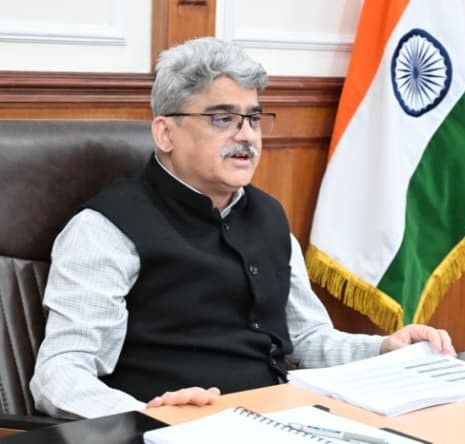
Srinagar: Chief Secretary Atal Dulloo on Monday reviewed a roadmap prepared by the Agriculture Production Department (APD) for promoting the commercial cultivation of medicinal and aromatic plants (MAPs) in Jammu and Kashmir.
The meeting was attended by senior officers of the Agriculture Production and Forest departments, Vice Chancellors of SKUAST-Kashmir and SKUAST-Jammu, representatives of CSIR-IIIM Jammu and other officials.
According to an official statement, the roadmap seeks to tap the Union Territory’s biodiversity and climatic advantages to develop a high-value medicinal plant sector, diversify agriculture, enhance farmers’ incomes and generate employment.
Dulloo directed the department to implement the roadmap with defined timelines and measurable outcomes, while ensuring coordination with the Forest Department, AYUSH, research institutions and the private sector to develop the entire value chain from cultivation to marketing.
He also stressed the need to attract private investment in cultivation, processing and value addition, adopt cluster-based cultivation models and strengthen market linkages to improve returns for farmers.
Additional Chief Secretary, Agriculture Production Department, Ashish Chandra Verma, presented a proposed ₹150-crore mission to be implemented over six years for conservation, scientific cultivation, research, processing, branding, marketing and export of medicinal and aromatic plants.
Managing Director, Holistic Agriculture Development Programme (HADP), Sagar Doifode Dattatray, said the mission envisages interventions in conservation and cultivation, processing infrastructure, branding and marketing, research, monitoring and capacity building.
The proposed roadmap includes geo-spatial mapping of medicinal plant-rich areas, restoration of 1,500 hectares of degraded forest land, establishment of 51 specialised nurseries, expansion of cultivation outside forest areas, strengthening of 225 Biodiversity Management Committees and financial support to 500 farmers for Good Agricultural and Collection Practices (GACP) and organic certification.
The meeting was informed that the mission also proposes setting up six primary processing centres and two advanced extraction units in the private sector to strengthen value addition and reduce post-harvest losses.
Officials said around 40 per cent of the project cost has been earmarked for branding and marketing initiatives, including the establishment of two FPO/MFP parks, two mega MAP clusters under the public-private partnership model, two model MAP villages, an Export Promotion Cell, a digital marketing platform and a Herbal Innovation Fund to support 80 start-ups.
The department said successful implementation of the roadmap is expected to expand medicinal and aromatic plant cultivation to more than 1,700 hectares, support 80 start-ups and 25 export-oriented enterprises, and directly benefit more than 5,000 farmers and entrepreneurs while generating indirect employment across the value chain.