During the assembly elections held recently in in four states of the country, the war of words and emotional polarization that emerged in politics and society has not diminished; rather, its intensity appears to be increasing. Its heat is no longer confined to those states alone, but can also be felt in other parts of the country. Needless to say, this atmosphere of hostility and hatred serves neither the interests of individuals, nor of any group, community, or the nation as a whole. Those who fuel animosity and division for personal or political gains should read the writing on the wall before it is too late. Likewise, the public must also firmly understand that in any democratic society, education and awareness alone are the true keys to progress and security. The path of confrontation and violence leads only to the destruction of nations and communities. The sooner we realize this truth, the better it will be for all of us.
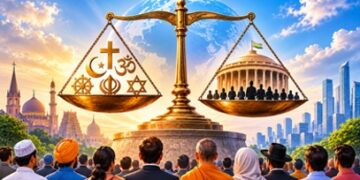
India is a land of extraordinary diversity. It is home to multiple religions, numerous languages, cultures, ethnicities, and traditions. Undoubtedly, this diversity is both its beauty and its strength, but it also brings challenges. Social tensions, communal conflicts, disputes driven by emotions and vested interests, intolerance, misinformation, and political polarization often threaten the harmony of society. In such an environment, knowledge and wisdom are not merely virtues or marks of superiority; rather, they become essential requirements for peaceful coexistence and collective progress. The Holy Qur’an states that Allah grants wisdom to whomsoever He wills, and whoever is granted wisdom has indeed been blessed with abundant goodness (Al-Baqarah: 269).
The teachings of the Holy Qur’an and the Prophet Muhammad emphasize that true knowledge enlightens the mind, refines character, promotes justice, and nurtures compassion. Islam does not confine knowledge merely to religious instruction; rather, it encompasses an understanding of humanity, ethics, science, society, and the responsibilities of coexistence. A society guided by wisdom can overcome hatred, prejudice, and conflict.
Allah Almighty says: “Say, are those who know equal to those who do not know?” (Az-Zumar: 9). This verse establishes knowledge as the foundation of moral and intellectual distinction. Ignorance often gives rise to fear, hatred, and violence, whereas knowledge opens the doors to understanding and empathy. In a pluralistic society like India, ignorance about one another’s beliefs and traditions frequently breeds suspicion and division. Education and meaningful dialogue help remove these barriers.
The very first message of Islam was not about conflict or domination, but about learning and reflection. This demonstrates that the path to human progress begins with intellectual awakening. A society that values reading, inquiry, and critical thinking becomes capable of resolving conflicts peacefully and building bridges among communities.
The Qur’an instructs believers to engage with others through wisdom and respectful dialogue, rather than provoking disputes or hostility. Allah says: “Invite to the way of your Lord with wisdom and good counsel, and argue with them in the best manner.” (An-Nahl: 125). Yet today we witness even our youth along with many seasoned political players and self-styled religious leaders fueling hatred and misunderstanding through social media, political rhetoric, and communal propaganda, precisely at a time when society needs stronger voices for peace and harmony. The Qur’anic approach emphasizes wisdom, patience, and respect in dialogue. Wisdom means understanding context, speaking .with empathy, and striving for reconciliation rather than confrontation.
Democracy provides us with a vast opportunity to convey the message of faith and humanity to people. However, many so-called political, social, and religious leaders, through their lack of understanding, emotionalism, and irresponsible speech, are instead worsening the atmosphere.
The Prophet Muhammad himself presented the finest example of wisdom in dealing with people of different faiths and backgrounds. In Madinah, through the Charter of Madinah, he established a pluralistic social order in which Muslims, Jews, and other tribes were recognized as one community with mutual rights and responsibilities. Societies are damaged by emotional reactions, prejudice, and narrow-mindedness, whereas wisdom teaches patience, balance, and justice.
The Qur’an further warns: “O you who believe, if a wicked person comes to you with news, verify it, lest you harm people in ignorance and afterwards become regretful for what you have done.” (Al-Hujurat: 6). In this age of viral misinformation and rumors where false narratives and inflammatory rhetoric spread rapidly and inflame emotions this verse demands that believers remain vigilant and verify information before reacting. This Qur’anic principle is one of the fundamental conditions for preserving peace within society.
Furthermore, Islam emphasizes the unity of humanity despite diversity. Allah says: “O mankind, We created you from a male and a female and made you into nations and tribes so that you may know one another.” (Al- Hujurat: 13). Diversity, therefore, is not a curse but a divine design intended for mutual recognition and understanding. Religious, linguistic, and cultural differences should become opportunities for cooperation rather than causes of conflict and confrontation.
The future of the world depends not only on economic growth or political power, but also on nurturing enlightened minds that value justice, coexistence, and human dignity. Knowledge without wisdom can lead to arrogance, while wisdom without knowledge may remain ineffective. Both the Qur’an and the Prophetic teachings call for a harmonious balance between the two.
The message of Islam is clear; human prosperity, progress, and security lie in education and awareness. Knowledge and wisdom alone provide the true path for humanity. In a diverse and conflict-prone society like India, it is knowledge and wisdom that can transform suspicion into understanding, hostility into harmony, and division into unity. The teachings of the Qur’an and the Prophet Muhammad invite humanity to build a society founded upon justice, compassion, and broad¬mindedness. Only through knowledge and wisdom can India truly fulfill its promise as a peaceful and inclusive nation for\ its people, and contributing toward this noble goal, according to one’s ability and capacity, is the duty of every Indian citizen.