
Economic Prosperity, Religious Identity and Secularism Mean Little Without Freedom and Accountability.
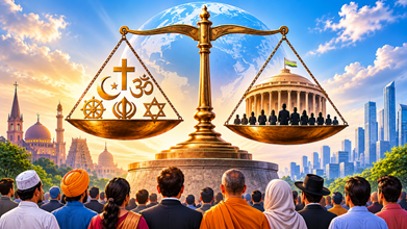
The relationship between religion and governance has been debated throughout human history. One school of thought believes they should remain closely connected, while another argues that they should operate independently. Both have their reasoning, but history offers an important lesson: whether rulers invoke God, nationalism, democracy or secularism, the temptation to misuse power remains the same.
Those who favour combining religion and governance argue that religion provides a moral foundation for society. The fear of God and accountability to a higher authority, they believe, can restrain rulers from becoming greedy, arrogant or corrupt. Religious teachings promote honesty, compassion, charity and justice while preserving cultural identity and traditions. Islam emphasises justice and charity; Hindu philosophy speaks of dharma; Buddhism advocates compassion; Sikhism promotes equality and service; and Christianity emphasises forgiveness and human dignity.
There is merit in these values. However, a fundamental question arises: who decides which interpretation of religion should govern everyone? What happens to citizens who follow another faith, interpret the same religion differently, or do not believe in religion at all?
The opposing school of thought argues that the state belongs equally to all citizens, regardless of their beliefs. Laws should be based on reason, constitutional principles, equality, and justice rather than religious doctrine. Separation of religion and state does not mean removing religion from society. It means preventing the state from becoming an instrument of religious dominance. Individuals should remain free to practise their faith, but no religious authority should impose its beliefs upon others.
Religion may guide an individual’s conscience, but should it govern everybody else’s conscience?
When Ideology Becomes an Instrument of Power
The experiences of countries that have adopted theocratic systems raise serious questions about religious authority and individual freedom.
Iran, following the 1979 Islamic Revolution, established an Islamic Republic in which elected institutions coexist with powerful unelected religious authorities. The Supreme Leader and institutions such as the Guardian Council exercise considerable influence over political decisions and electoral participation. Pakistan, despite its Islamic constitutional identity, has struggled with military interventions, political instability, and weak democratic institutions. Afghanistan under Taliban rule demonstrates how a particular religious interpretation can be used to restrict women’s education, employment, and participation in public life.
These examples do not prove that religion is incompatible with democracy. They demonstrate the dangers of allowing political establishments to claim exclusive authority to interpret religious principles.
When rulers claim to represent God’s will, questioning their decisions can become dangerous. Opposition to government policies can be portrayed as opposition to religion itself.
When a ruler claims to speak on behalf of God, who is left with the authority to question the ruler?
However, secularism is no automatic guarantee of democracy either. France, Germany, and the Nordic countries demonstrate how constitutional governance, individual freedoms, and different relationships with religion can coexist. Yet China, a secular and officially atheist state, demonstrates that secular governance can also become authoritarian.
The lesson is clear: a religious ruler can misuse power, just as a secular ruler can. The real dividing line is not between religious and secular governments, but between accountable and unaccountable power.
Prosperity Without Political Freedom?
Gulf monarchies such as Qatar, the UAE, Saudi Arabia, and Kuwait have achieved remarkable economic development through oil and gas revenues, strategic investments, and modern infrastructure. Yet economic prosperity and political freedom are different measures of development. In several of these countries, political authority remains concentrated within ruling families, while opportunities for political opposition and participation in national decision-making remain limited.
The Arab Spring of 2011 exposed this contradiction. Popular protests across Tunisia, Egypt, Libya, Yemen, Bahrain, and other countries demanded dignity, freedom, political accountability, and an end to corruption. People wanted more than economic benefits; they wanted a voice in determining their future.
The aftermath also demonstrated that removing an authoritarian ruler does not automatically establish democracy. Libya and Yemen descended into prolonged conflict, Egypt returned to authoritarian rule, and Tunisia’s democratic transition suffered a serious reversal.
Interestingly, constitutional monarchies such as Norway, Sweden, Denmark, and the United Kingdom function as established democracies. This demonstrates that the important question is not whether a country is a monarchy or republic, but where political power resides and how accountable it is.
The Hypocrisy of Political Ideologies
Perhaps the most disturbing aspect of this debate is how selectively political leaders use ideology to retain power.
Some invoke religion to establish moral authority but ignore its teachings when confronted with corruption and injustice. Others speak of secularism, democracy, nationalism and freedom while weakening institutions, restricting individual rights and suppressing dissent.
Even elections do not automatically make a government democratic. A majority cannot claim unlimited authority to undermine minority rights, silence the media or weaken the judiciary. Democracy requires more than voting; it requires the freedom to question leaders, express disagreement, and peacefully change governments.
We must stop judging governments by the ideologies they advertise and start judging them by how they treat their people.
What Should Be the Ideal Model of Governance?
No political label can independently guarantee good governance. Religion can provide moral direction, but should not become an unquestionable source of political authority. Secularism can protect equal citizenship, but cannot guarantee ethical leadership. Democracy can provide representation, but requires strong institutions and constitutional safeguards. Economic prosperity can improve living standards, but cannot replace individual freedom and political participation.
The ideal system should allow religion to enrich society without imposing religious conformity. It should protect secular principles without becoming hostile to religious expression. Every citizen, irrespective of faith, gender, ethnicity, or political belief, must enjoy equal rights and protection under the law.
Ultimately, the purpose of government is not to promote a particular ideology or preserve the dominance of a ruling establishment. It is to create conditions in which people can live with dignity, freedom, security and equal opportunity.
Perhaps the real test of any political or religious ideology is not how loudly it claims to represent God, morality, democracy or national identity, but how fairly it treats those who disagree with it.
We need morality without religious coercion, secularism without hostility towards faith, democracy without majority domination, prosperity without political subjugation, and governance without authoritarianism.
That is the real measure of a civilised society.

