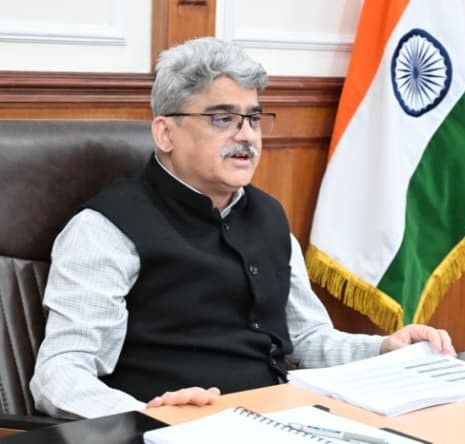
Srinagar: Atal Dulloo on Monday chaired a high-level review meeting with Administrative Secretaries to assess implementation of reform initiatives emerging from the Prime Minister’s interaction with Secretaries to the Government of India, with focus on integrated governance, ease of living and end-to-end digitization of public services across Jammu and Kashmir.
The Chief Secretary emphasized that the reforms are aimed at establishing citizen-centric, technology-driven and accountable governance systems for efficient delivery of public services.
He said departments must move beyond conventional silo-based functioning and work in close coordination to achieve larger developmental goals envisioned under Viksit Bharat 2047.
A detailed presentation on Action Taken Reports (ATRs) related to various reform initiatives was made by the Planning Development and Monitoring Department.
The meeting was informed that several departments including Finance, School Education, Skill Development, Health & Medical Education, Housing & Urban Development, Agriculture Production, Social Welfare, Public Works, Tourism and Higher Education have already adopted convergence-based governance models involving inter-departmental coordination, digital integration and collaborative implementation mechanisms.
Reviewing the School Education sector, the meeting was informed that vocational education has been expanded to more than 1,350 schools across Jammu and Kashmir with enrolment of over 1.41 lakh students.
It was also informed that digital platforms, ICT laboratories and smart classrooms have been integrated under the framework of National Education Policy 2020.
Regarding the Skill Development Department, officials informed the meeting that flagship initiatives including Mission YUVA and PM Vishwakarma are being implemented through coordinated institutional mechanisms involving multiple departments, financial institutions and academic organisations.
The Health & Medical Education Department proposed integrated planning with allied departments for convergence of health, sanitation, nutrition, education and livelihood initiatives.
The Housing & Urban Development Department highlighted its focus on technology-driven governance, sustainable urban planning and citizen-centric reforms aimed at improving urban living standards.
The meeting was also informed that departments including Food, Civil Supplies & Consumer Affairs, ARI & Trainings, Disaster Management, Labour & Employment and Information Department have introduced integrated digital governance systems, interoperable platforms and real-time monitoring mechanisms to improve transparency and accountability.
Reviewing reforms under the J&K Jan Vishwas initiative, the meeting was informed that around 32 criminal provisions across 20 Acts have been decriminalized to reduce compliance burden and improve ease of doing business, while 19 obsolete laws have been repealed.
The Chief Secretary also reviewed progress on achieving 100 percent end-to-end digitization of Government-to-Citizen services across the Union Territory.
Officials informed the meeting that 1,548 G2C services have already been digitized under the E-Unnat Platform, while nearly 300 additional services are under development.
In the first phase, 302 services across key departments including Agriculture, Higher Education, Housing & Urban Development, Revenue, Health and Power Development have been identified for elimination of offline processes and complete digital transformation.
The roadmap includes phased implementation involving policy notification, digitization audit, workflow re-engineering, system integration, capacity building, real-time monitoring and third-party audits.
Stressing the need for process reforms before digitization, Atal Dulloo directed departments to simplify existing Government-to-Government, Government-to-Business and Government-to-Citizen procedures to eliminate bottlenecks and ensure faster and citizen-friendly governance.
The meeting also reviewed progress under Vision 2030 and Vision 2047 targets.
Officials informed the meeting that several departments have already submitted quantifiable targets, achievements, gap analysis and timelines for bridging developmental gaps, while remaining departments have been asked to furnish inputs for preparation of a comprehensive vision document for Jammu and Kashmir.