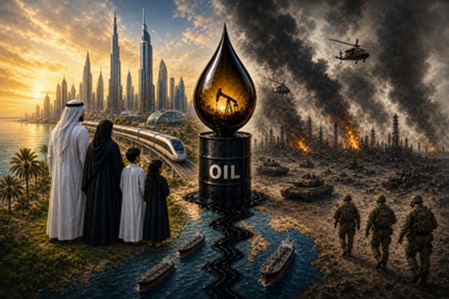
The discovery and control of energy resources, especially oil and gas, have shaped the modern world in profound ways. For many countries, these resources have brought wealth, development, and global importance. At the same time, they have also made these nations targets of foreign influence, conflict, and geopolitical struggles. This pattern is not limited to the Gulf region but can be seen across the world, both in the past and in the present.
In the early 20th century, the discovery of oil transformed regions that were once economically modest into centers of global importance. Countries in the Middle East, such as Saudi Arabia, Iraq, and Iran, experienced rapid economic growth due to oil exports. Similarly, Venezuela in South America and Russia became major energy powers. These resources allowed governments to invest in infrastructure, education, and modernization, improving the quality of life for millions.
However, the importance of energy resources also attracted external interest and intervention. During the colonial era, Western powers sought control over oil-rich regions to fuel their industries and militaries. This was evident in the Middle East, where foreign companies and governments played a dominant role in oil production and pricing. In Africa, countries like Nigeria and Libya became focal points of global energy politics.
The Cold War further intensified competition for energy control. The United States and the Soviet Union both sought influence over oil-rich regions. This rivalry often led to political instability and conflicts. For example, the Iranian Revolution significantly changed global energy dynamics, while the Iran-Iraq War caused widespread destruction and disrupted oil supplies.
In many cases, conflicts were directly or indirectly linked to energy resources. The Gulf War began when Iraq invaded Kuwait, highlighting how control over oil could trigger international military intervention. In Africa, struggles over oil wealth have contributed to internal conflicts in Nigeria. In South America, Venezuela’s vast oil reserves have made it both influential and vulnerable to economic and political pressures from global powers.
A particularly striking example is Libya under Muammar Gaddafi. His efforts to maintain independent control over Libya’s oil and challenge global power structures coincided with increasing international tensions. During the Libyan Civil War, external intervention played a major role in his removal. While the situation was complex, energy interests were widely seen as an important underlying factor.
In recent years, new regions have also become important in global energy politics. The discovery of oil in Brazil’s offshore fields, natural gas in Qatar, and energy reserves in the Eastern Mediterranean involving countries like Turkey and Israel have increased geopolitical competition. Even regions like the Arctic are now being explored, leading to new strategic rivalries.
At the same time, major global powers continue to play a significant role. The United States maintains a strong presence in key energy regions, while China has expanded its influence through investments and infrastructure projects to secure energy supplies. This ongoing competition ensures that energy-rich regions remain central to global politics.
Despite these challenges, many countries are now trying to reduce their dependence on oil and gas. Investments in renewable energy, economic diversification, and regional cooperation are becoming more common. However, the global demand for energy remains high, and fossil fuels continue to play a crucial role in the world economy.
In conclusion, energy resources have been both a blessing and a curse for many countries around the world. They have brought wealth, development, and global significance, but they have also attracted foreign intervention, conflict, and instability. From the Middle East to Africa, South America, and beyond, the struggle for control over energy continues to shape international relations. The challenge for the future lies in managing these resources in a way that promotes peace, stability, and shared prosperity rather than conflict and competition.