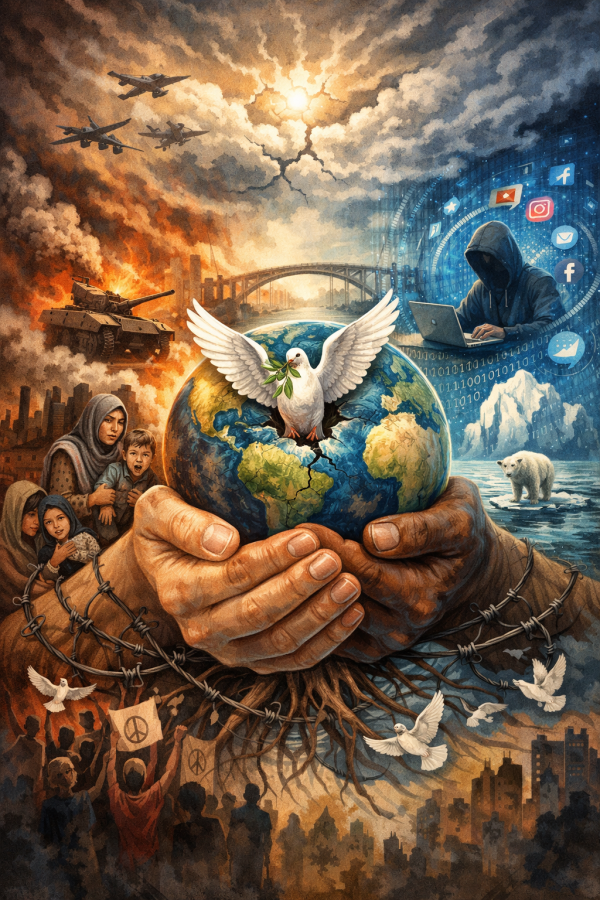
We are living in uneasy times. Tensions are rising around the world. Nations speak the language of self-defence, deterrence, nationalism, and progress. Some concerns are real and rooted in national interest. Every country has the right to protect its people. But when fear and greed begin to shape decisions, humanity pays the price.
The greatest challenges of our time do not stop at borders. Climate change does not need a visa. Artificial Intelligence does not carry a passport. Pandemics do not respect political boundaries. Economic shocks ripple across continents within hours. In such a world, zero-sum thinking, the idea that one nation’s gain must be another’s loss, is not only outdated, it is also dangerous.
We can compete and still cooperate. We can protect national priorities and still build bridges. Strength and dialogue are not opposites. In fact, true strength lies in choosing peace when conflict seems easier.
Today, courage does not always mean fighting. Courage means choosing common ground when division is fashionable. It means refusing to be swept away by anger when every voice around us demands that we pick a side. When events make it seem as though we are living in a jungle where only the “survival of the fittest” matters, we must remember something important: human beings are not ruled only by instinct. We have the ability to think, to reflect, and to choose peace over destruction.
In times of fear and uncertainty, opportunists emerge. They use insecurity and identity as powerful tools. They exploit emotions. They turn communities against one another for personal or political gain. History shows us how quickly hatred can be manufactured, and how costly it becomes.
A painful reminder is the 2017 persecution of the Rohingya in Myanmar. Thousands of Rohingya were killed, tortured, raped, or displaced in what has widely been described as ethnic cleansing. Investigations later revealed how hate speech and misinformation spread rapidly on Facebook, where algorithms amplified divisive and inflammatory content. What began as online hostility contributed to real-world violence. It showed the world that technology without responsibility can become a weapon.
In today’s digital age, news, both true and false, travels faster than ever. A careless post, an emotional message, or a misleading headline can inflame tensions within minutes. Each of us now carries a broadcasting tool in our hands. That means each of us also carries responsibility.
Peace is not built only in international summits. It begins in homes, neighbourhoods, classrooms, and online conversations. In a global economy where people work across borders and cultures, harmony and safety are not luxuries, they are necessities for growth and progress. No society can truly prosper in an atmosphere of hate and fear.
If humanity is to survive and flourish, the effort must start at the personal level. Individuals must resist the temptation to spread anger. Communities must promote dialogue. Institutions and digital platforms must correct the systems that reward outrage over understanding.
Wars, conflicts, and hatred are enemies of humanity. But so is silence in the face of division. These are testing times. The real test is not of military strength or economic power. It is a test of our moral courage, our ability to choose cooperation over confrontation, responsibility over recklessness, and humanity over hostility.
Because in the end, humanity must survive, and that survival depends on the choices we make today.