

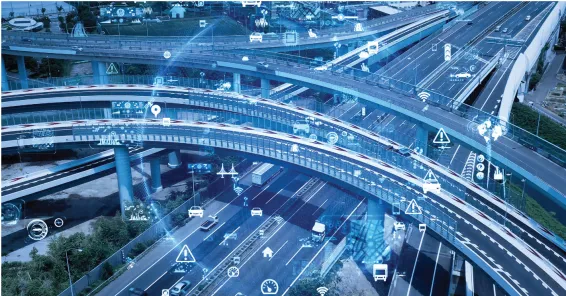
Transportation and logistics are the growth engines of economic growth. Every product we consume, every journey we undertake, and every city we inhabit depends on the smooth movement of people, goods and services. Yet, across the world and particularly in rapidly developing economies like India, transportation systems face mounting challenges such as urban congestion, rising accident rates, escalating fuel costs, carbon emissions, and increasingly complex supply chains. Traditional planning and operational methods are no longer sufficient to manage this scale and complexity. It is in this context that Artificial Intelligence (AI) and Data Science have emerged as transformative forces, redefining how transportation and logistics systems are designed, operated, and optimized.
AI & Data Science in Transportation: A Paradigm Shift
Transportation systems today generate unprecedented volumes of data from traffic sensors, GPS-enabled vehicles, and electronic tolling systems to ticketing platforms, surveillance cameras, weather feeds, and logistics management networks. Artificial Intelligence (AI) and Data Science transform this raw, high-velocity high-volume data into actionable intelligence, enabling transportation systems to become predictive, adaptive, and resilient. This shift is especially visible in India, where large-scale digital platforms and new infrastructure projects are redefining how mobility and logistics are planned and operated.
In urban and highway mobility, Intelligent Transportation Systems (ITS) powered by machine learning are increasingly central to traffic and toll operations. A prominent example is FASTag, which has digitized toll collection across national highways, generating real-time data on vehicle movement, traffic density, and corridor utilization. This data enables congestion analysis, dynamic traffic management, and evidence-based infrastructure planning. Similarly, AI-enabled traffic signal control systems deployed in several Indian cities analyse live camera feeds and sensor data to optimize signal timings, reduce idling time, and improve intersection safety.
In logistics, data integration platforms such as the Unified Logistics Interface Platform (ULIP) represent a significant step toward AI-driven decision-making. By integrating datasets from railways, ports, road transport, and customs, ULIP creates a unified digital backbone for India’s logistics ecosystem. AI and advanced analytics applied to such platforms support demand forecasting, route optimization, and bottleneck identification across multimodal networks. These capabilities are particularly important as India develops multimodal logistics parks, gati shakti cargo terminals and expands dedicated freight corridors to reduce logistics costs and improve supply chain reliability.
New infrastructure developments further amplify the role of AI and Data Science. Landmark projects such as the Chenab Rail Bridge: the world’s highest railway arch bridge—rely extensively on sensor data, structural health monitoring, and predictive analytics to ensure safety and long-term reliability in challenging terrain. Similarly, the deployment of Vande Bharat trains introduces high-frequency, data-rich operations where AI can optimize scheduling, energy consumption, passenger flow, and maintenance planning. As India moves toward high-speed rail corridors, data-driven control, real-time monitoring, and predictive maintenance will be indispensable for ensuring safety, punctuality, and operational efficiency at high velocities.
Predictive maintenance remains one of the most impactful applications of AI across railways, aviation, and highways. By analysing data from tracks, rolling stock, signalling systems, bridges, and aircraft components, AI models detect early signs of degradation and failure. This proactive approach enhances safety, minimizes service disruptions, and significantly reduces lifecycle costs of infrastructure assets.
Complementing these applications are enabling technologies such as computer vision for automated inspection, digital twins for simulating complex transportation systems, Internet of Things (IoT) for continuous monitoring, and real-time analytics platforms. Together, they signal a fundamental transition from reactive and fragmented operations to predictive, integrated, and intelligence-driven transportation systems. This paradigm shift is central to India’s ambition of building a safe, efficient, and globally competitive transportation and logistics ecosystem.
Why Transportation & Logistics Need Specialized AI Professionals
India’s massive investments in railways, expressways, ports, airports, and multimodal logistics parks demand professionals who understand both AI techniques and domain-specific constraints. At the core of this transformation is the demand for a new class of engineers, professionals who not only understand algorithms and data, but also grasp the unique dynamics of transportation networks, logistics flows, and infrastructure systems.
To address this critical national and global requirement, Gati Shakti Vishwavidyalaya was established with a singular academic mission of creating future-ready talent for India’s transportation and logistics ecosystem. As the country’s first university dedicated exclusively to this domain, Gati Shakti Vishwavidyalaya is intrinsically aligned with India’s infrastructure expansion and integrated mobility vision. Its academic approach extends beyond conventional engineering education, emphasizing applied technologies, multimodal transportation, logistics efficiency, and data-driven decision-making at scale.
A defining strength of the university lies in its deep industry–academia integration. Continuous engagement with railways, highways, ports, aviation, and logistics sectors ensures that learning remains rooted in real operational challenges. This close alignment exposes students to live datasets, contemporary systems, and emerging technologies—enabling them to translate theory into impact and contribute meaningfully from the outset of their professional careers.
Shaping the Future of Mobility and Logistics
AI and Data Science are no longer optional enhancements; they are foundational to the future of transportation and logistics. As India advances toward integrated, efficient, and sustainable mobility systems, the demand for skilled professionals who can harness these technologies will only intensify. By offering a specialized, forward-looking academic programs rooted in national priorities, Gati Shakti Vishwavidyalaya stands at the forefront of this transformation—educating engineers who will design, optimize, and lead the transportation systems of tomorrow. Cutting-edge research that enhances operational efficiencies through optimized route planning, revenue management and predictive/assistive technologies for maintenance and safety shall be the foundation stones of our country becoming Viksit Bharat by 2047.
Courtesy PIB, Srinagar
Prof. Manoj Choudhary is Vice-Chancellor, Gati Shakti Vishwavidyalaya.
Dr. Vipul Mishra is Associate Professor, Gati Shakti Vishwavidyalaya.


