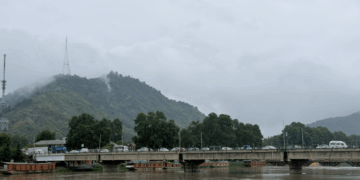
Wular Lake has always been a symbol of infinity. To the people of the valley, it was the Great Water, a source of fish, water chestnuts, and legends. But as I stood on the muddy shore, the infinity felt fragile. The air here didn’t smell of fresh water and mountain breeze; it smelled of stagnation and decay.
I met Gul Kak, a young fisherman whose family had worked these waters for generations. Gul Kak was sitting by his wooden boat, his nets spread out on the ground. But he wasn’t mending them. He was picking through them, his face set in a mask of frustration.
Look at this, Beta, Gul Kak said, holding up a handful of his catch. It wasn’t fish. It was a tangled mess of plastic bags, a shredded piece of a tarp, and several plastic bottle caps. In the centre of the mess was a single, small fish, gasping for air amidst the synthetic debris.
The plastic is everywhere now, Gul Kak continued, his voice trembling with anger. “It is at the bottom of the lake. It is floating on the surface. It gets into the engines of the motor boats. It kills the weeds where the fish spawn. Some days, I spend more time cleaning my nets of trash than I do catching anything to sell.”
I looked out over the water. From a distance, the lake still looked magnificent, reflecting the clouds and the mountains. But near the shore, the reality was undeniable. The water was choked with islands of floating waste. These were not just a few stray bottles; they were massive, matted rafts of plastic that had been pushed together by the wind and the currents. I saw a group of water birds landing on one of these islands, thinking it was solid ground. They pecked at the colourful fragments, mistaking the bright plastic for food. I knew the science, these birds would fill their stomachs with indigestible waste and slowly starve to death, their bodies becoming small, feathered tombs for the plastic they had consumed.
“They say the lake is dying” I said quietly.
“It is not saying, it is doing” Gul Kak replied. “The water is getting shallower every year. The silt is building up, and the plastic is holding the silt in place. The lake is shrinking. The land is reclaiming it, but it is a land made of garbage.”
They walked along the shore, passing areas where the plastic had been piled up by the waves. It was a graveyard of human consumption. I saw items from every part of life; sandals, toys, crates, and thousands upon thousands of those thin, translucent bags. I saw the remains of the festivals I had feared the heavy-duty bags from the meat shops, the colourful boxes from the sweet sellers, all bleached by the sun but otherwise unchanged.
The academic in me recalled the statistics. Wular Lake was crucial for the region’s ecology, acting as a natural flood reservoir and a habitat for countless species. Its degradation was not just a local problem; it was a regional catastrophe. If the lake died, the water table would drop, the floods would become more frequent and more violent, and the climate of the entire valley would shift.
“We are treating the lake like a toilet” Gul Kak said, spitting into the water. “We throw things into the streams in the Mohalla and think they are gone. But they all come here. This is where the world ends, my son. This is where our waste comes to rest.:
I knelt by the water and reached in. The surface was covered in a thin, oily film. Beneath it, I could see the layers of plastic settled on the lakebed. It was a geological stratum of the Anthropocene, a layer of human-made material that would mark this era in the earth’s history forever.
I thought about the ‘simple practice’ I had started at home. It felt small, almost pathetic, in the face of this vast, drowning giant. How could counting five bags a day make a difference when millions were already floating in the Wullar? But then I looked at Gul Kak, and I saw the desperation in the young man’s eyes.
“We have to stop the flow, Gul Kak” I said, my voice gaining a new strength. “We can’t clean the lake until we stop the villages from feeding it. It starts in the Mohalla. It starts at the bakery and the grocery store.”
Gul Kak looked sceptical. “The people won’t change” my son. They like the bags. They like the convenience. “They won’t like the hunger when the fish are gone” I countered. “They won’t like the thirst when the water is poison. I am counting the waste in my own house. I am seeing the monster for what it is. If I can show them the numbers, maybe they will see it too.”
As the sun began to set., the lake took on a golden hue. For a moment, the beauty returned, masking the rot beneath. But I was no longer fooled. I knew that the giant was gasping for breath, its lungs filled with the very things they used once and threw away.
I walked away from the shore, the sound of the plastic lapping against the mud echoing in my ears. I had seen the end of the line. Now, I had to go back to the beginning. I had to understand the chemistry of the poison, to know exactly why it was so resilient, and why it was so deadly to the world I loved.
The tragic degradation of Wular Lake becomes a visceral reality for me as I see the plastic-choked nets of local fishermen. A deep dive into the chemical resilience of polythene will soon explain why this poison is so hard to kill.
The Author hailing from a Wular Fringe Village of Bandipora, is a writer and can be reached at saltafrasool@yahoo.com