By: Husain Haqqani
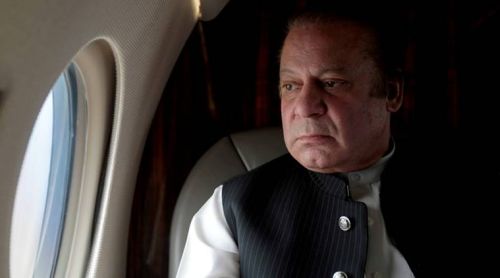
For the first 23 years after independence in 1947, Pakistanis were denied the right to vote. Since 1970, they have been allowed to vote intermittently but they are still denied the right to vote freely. The upcoming July 25 election in Pakistan has been marred by a series of attacks, some by the judiciary and others by the country’s ubiquitous military-intelligence machinery, aimed at politically decapitating former Prime Minister Nawaz Sharif and his Pakistan Muslim League (PML-N).
Sharif was disqualified a few months ago by the Supreme Court for not fulfilling the constitutional criteria for honesty and sagacity. Few, if any, prominent Pakistani politicians fulfill that vague requirement. It was inserted into the constitution by Sharif’s original mentor, General Zia ul Haq, precisely because its vagueness enabled unelected branches of government to choose who could or could not run for elected office.
Ironically, Sharif refused to support other political parties in deleting the articles of the constitution that were used to disqualify him just a few years ago. His trial, and conviction last week for possessing assets beyond his means, seems like poetic justice to those who hate the fact that he started his career as a military protege, amassed considerable wealth while in office, and went on to build an independent political base in the Punjab province with the help of that wealth. But those who can rise above their pique at Sharif or other individual politicians realise that no politician in Pakistan is ever punished for corruption and Sharif is no exception. Sharif’s career affirms the unwritten law of Pakistani politics: A politician can be corrupt or he/she can oppose the military-led Pakistani establishment but he cannot be corrupt and anti-military at the same time.
In the 1990s, when Sharif and the PML-N were backed by the military, the institutions of state (including the judiciary) found nothing wrong with their acquisition of wealth. The focus then was on the alleged corruption of Benazir Bhutto’s husband Asif Zardari. Sharif supported selective accountability against Bhutto and Zardari and the latter spent 11 years in prison without being convicted.
But General Musharraf’s 1999 coup transformed Sharif. He was now anti-establishment and critical of the military and that is what seems to have cooked his goose. Since his return from exile after Musharraf’s downfall, Sharif made no effort to partner with the Pakistan Peoples Party of Bhutto and Zardari to undo the legal regime that allows the judiciary to intervene in political matters.
Sharif himself took petitions to the Supreme Court against the Zardari government, including the so-called Memogate case that affected me personally. I was accused of writing a memo inviting US support against an impending coup. There was no coup in the works at the time and I wrote no memo of the sort that was alleged. But I was supposed to rebut the story woven by a Pakistani-origin businessman living in Monaco to “clear” my name. This inverted the normal system of criminal law, which requires prosecutors to prove guilt beyond doubt at trial. Instead of being the court of final appeal, the Supreme Court acted as the court of first instance.
Sharif himself became a victim of this perverted system of justice when, after the appearance of his name in the Panama Papers, the Court insisted that he prove the provenance of his properties in London. The former PM was disqualified before he was tried. Even at trial, the judge concluded that the ownership of the London properties in question could not be ascertained. He still went on to convict Sharif for failing to prove where he got the money to buy these properties. One need not be convinced of Sharif’s innocence to observe that he was a victim of less than transparent legal proceedings. His downfall started when the military got upset with an article in Dawn suggesting that the civilian government wanted to act against the jihadis but the military did not.
Corruption is a painful reality of Pakistani politics but so is the fact that it is Pakistan’s military that decides who remains in politics and who is ousted through court judgments. After 60 years of direct and indirect meddling in politics, the military has not been able to create its ideal polity and Pakistan remains unstable and mired in corruption.
For the last three years, Sharif has been the target of a relentless propaganda war and the shenanigans of Pakistan’s invisible government. Just as Sharif was the beneficiary of similar manoeuvres against Bhutto in the 1988 and 1990 elections, cricketer-turned-politician Imran Khan is the intended beneficiary of the campaign against Sharif. Apart from judicial rulings, Khan is being aided through coerced changes in loyalty of locally influential politicians and pressure on the media to black out anything that disfavours the preferred candidate in the coming election.
A civilian leader must deliver a measure of prosperity and economic development to maintain political support. Contrary to the military’s narrative, the major reason for Pakistan’s economic difficulties is not just corruption; it is lack of investment and expansion of productivity resulting from the country being seen as a jihadi safe haven.
Even in this election, several groups of jihadis and assorted extremists have been allowed to participate. One of them — Khadim Husain Rizvi of Tehrik Labbaik Ya Rasool Allah — told an election rally recently that he would nuke the Netherlands if someone there ever published a cartoon of Prophet Muhammad. Tolerance for and mainstreaming of such dangerous individuals is unlikely to bolster Pakistan’s image or economic prospects.
Civil-military tension is built in into Pakistan’s current structure of state. If civilians defer to the military leadership without any questions, they lose popular support and have to face all the blame that comes with supporting the military’s monochromatic policies. If, however, they dare to disagree like Nawaz Sharif did, they would lose the institution’s backing just as Sharif lost it over the years. Then we would see them becoming targets of similar viciousness and possibly adverse judicial verdicts.
Unfortunately, the election on July 25 will not rid Pakistan of that tension.
Courtesy Indian Express