

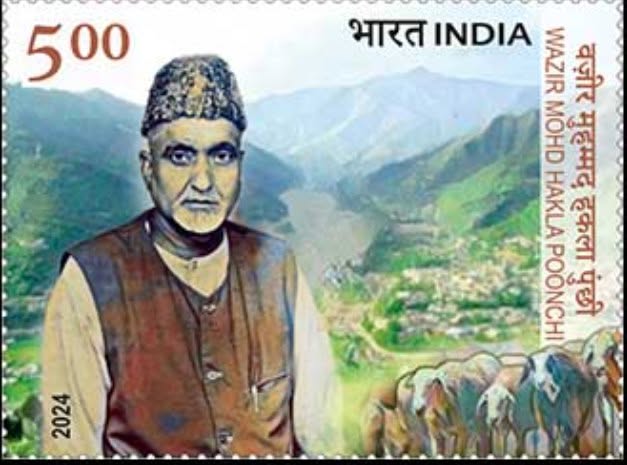
The history of Jammu and Kashmir is incomplete without remembering the individuals who dedicated their lives to social reform, national unity, and the upliftment of marginalized communities. Among such personalities, Late Choudhary Wazir Mohd Hakla Poonchi holds a place of immense respect and admiration. He was not merely a tribal leader but a visionary reformer whose lifelong struggle transformed the social and political consciousness of the Gujjar-Bakarwal community in Jammu and Kashmir.
Long before tribal rights, constitutional safeguards, and social inclusion became part of mainstream discourse, Choudhary Wazir Mohd Hakla had already devoted himself to these causes. Through his leadership, activism, scholarship, and patriotism, he emerged as one of the earliest voices of marginalized tribal communities in the region.
- Birth, Family Background, and Early Life
Choudhary Wazir Mohd Hakla Poonchi was born on 14th March 1915 in the village of Bandi Chechian in Tehsil Haveli of District Poonch, Jammu and Kashmir. The remote mountainous region lacked even basic facilities during that period, and life was marked by hardship and isolation.
He belonged to the respected Hakla family of the Gujjar community. His father, Choudhary Fateh Mohammad Hakla, was a respected landowner and pastoralist, while his mother, Makhni Bi, was known for her resilience and moral strength. After the early demise of his father, he was raised by his widowed mother and paternal uncle Noor Mohammad. These difficult circumstances shaped his character and developed within him a deep understanding of the struggles faced by ordinary people.
- Education and Intellectual Awakening
Despite limited educational facilities in the region, Choudhary Wazir Mohd Hakla pursued his studies with determination. He acquired knowledge of Urdu, Persian, and Arabic, but his real education came through his observation of society and the hardships surrounding him.
From a young age, he witnessed poverty, illiteracy, exploitation, and social neglect faced by backward and tribal communities. These experiences gradually transformed him into a socially conscious reformer who believed education was not merely a means of personal advancement but a tool for social awakening and empowerment.
- Influence of the Freedom Movement
The freedom movement deeply influenced Choudhary Wazir Mohd Hakla during his youth. Inspired by the ideals of justice, equality, and nationalism, he dedicated himself to public service and social reform rather than personal ambition.
He travelled extensively across Poonch, Rajouri, and other parts of Jammu and Kashmir, educating people about their rights, social awareness, and the importance of unity and education. He consistently raised his voice against injustice, discrimination, and exploitation while encouraging backward communities to overcome fear and social isolation through collective awareness.
- Commitment Towards Communal Harmony
One of the most remarkable aspects of Choudhary Wazir Mohd Hakla’s personality was his unwavering commitment towards communal harmony. At a time when divisions based on religion and caste frequently dominated society, he worked tirelessly to strengthen unity among Hindus, Muslims, Sikhs, Jains, and other communities.
He believed that social peace and national unity could survive only through coexistence, mutual respect, and brotherhood. His secular outlook and inclusive leadership earned him admiration across social and religious boundaries.
- Champion of the Gujjar-Bakarwal Community
The defining mission of Choudhary Wazir Mohd Hakla’s life was the upliftment of the Gujjar-Bakarwal community of Jammu and Kashmir. During the mid-twentieth century, the community remained socially, educationally, economically, and politically marginalized. Most families lived in isolated mountainous and forest areas without roads, schools, healthcare facilities, electricity, or political representation.
Recognizing these realities, he devoted his life to changing the condition of his people. He travelled through remote tribal regions creating awareness regarding education, social reform, and political participation. He repeatedly approached state and national leadership demanding developmental initiatives for tribal populations.
He strongly advocated the establishment of schools, hostels, roads, healthcare facilities, scholarships, and welfare schemes for tribal communities. His efforts towards promoting education among Gujjar-Bakarwals proved particularly historic, as he encouraged families to educate their children despite poverty and social hardships.
- Pioneer of the Scheduled Tribe Movement
One of the greatest achievements of Choudhary Wazir Mohd Hakla Poonchi was his pioneering role in the movement demanding Scheduled Tribe status for the Gujjar-Bakarwal community of Jammu and Kashmir.
Long before tribal rights became a political issue, he understood the importance of constitutional safeguards for marginalized communities. In 1958, he formally initiated organized efforts demanding Scheduled Tribe recognition for Gujjar-Bakarwals.
He represented tribal concerns at major conferences held across India, including in Delhi, Himachal Pradesh, Rajasthan, and Madhya Pradesh. At the historic All India Gujjar Conference held at Badarpur, Delhi, on 11 June 1965, he strongly raised the demand for Scheduled Tribe status for the community.
In 1975, he led a delegation to meet Prime Minister Smt. Indira Gandhi and submitted a memorandum demanding constitutional recognition and safeguards for tribal populations.
Although he did not live to witness the outcome, history eventually validated his vision when the Gujjar-Bakarwal community of Jammu and Kashmir was granted Scheduled Tribe status on 19th April 1991. This remains one of the greatest legacies of his lifelong struggle.
- Contribution Towards Education and Development
Choudhary Wazir Mohd Hakla firmly believed that education was the foundation of social progress. He continuously worked to promote literacy and educational opportunities among tribal populations.
Due to his advocacy, scholarships for tribal students received governmental attention, Gujjar-Bakarwal hostels were established, and mobile schools for nomadic children were introduced. He also strongly advocated road connectivity, healthcare services, electricity, drinking water facilities, and welfare schemes for remote tribal areas. His efforts significantly contributed towards bringing the concerns of tribal communities into governmental planning and public policy discussions.
- Scholar, Writer, and Preserver of Tribal Culture
Apart from being a social reformer, Choudhary Wazir Mohd Hakla was also a respected scholar, researcher, and writer. He conducted extensive research on Gujjar history, folklore, traditions, and the Gojri language.
Through articles and public writings, he highlighted both the cultural richness and social struggles of the Gujjar-Bakarwal community. He played a major role in promoting Gojri language and literature and contributed towards the introduction of Gojri programmes on All India Radio stations in Jammu and Srinagar. His intellectual work helped preserve an important part of the tribal cultural heritage of Jammu and Kashmir.
- Patriotism During the Wars of 1965 and 1971
Choudhary Wazir Mohd Hakla’s patriotism was active and deeply committed. During the Indo-Pak wars of 1965 and 1971, when the border districts of Poonch and Rajouri faced instability and fear, he stood firmly with the Indian army. He motivated border populations and Gujjar-Bakarwal communities to support the Indian Army and cooperate with national security forces. His efforts strengthened morale among local populations and reinforced the spirit of national unity during difficult times.
- National Recognition and Honours
The immense contribution of Choudhary Wazir Mohd Hakla received recognition both during his lifetime and after his death. In 1973, Gujjars belonging to different religions from across India honoured him with the prestigious title of “Wazir-ul-Qaum” at the All India Gujjar Conference held at Kotla Mubarakpur in New Delhi.
Several public institutions and landmarks in Jammu and Kashmir were later named in his honour, including “Ch. Wazir Mohd Hakla Road”– from Drungli bye pass to Noona Bandi Bridge of Block Nangali district Poonch J&K, “Ch. Wazir Mohd Hakla Govt. High School”, Bandi Chechian in district Poonch, J&K “Ch. Wazir Mohd Hakla Conference Hall & Library”, situated near the Govt. Gujjar-Bakarwal Boys Hostel, district Poonch, at Poonch city.
In a historic recognition, on 25th July 2022, the Govt. of India, Ministry of Communication, sanctioned a ₹5 commemorative postal stamp in the name of Ch. Wazir Mohd Hakla Poonchi and this Postal Stamp was released on 24th July 2024 by Hon’ble Lieutenant Governor of J&K – Shri Manoj Sinha at Raj Bhawan, Srinagar, Kashmir.
Moreover, in the year 2025, the Department of Higher Education and School Education, J&K Government, ordered the display of his portrait & postal stamp photo frame in all government Degree Colleges of Jammu Province and all the Higher Secondary and High Schools of Jammu Province. The postal stamp photo frame was placed at all Post Offices and Government offices in the Rajouri & Poonch districts, as well as hospitals of the Poonch district, Government Medical College, Rajouri, J&K, and at the Jammu University’s Central Library and waiting hall of Vice Chnacellor’s secretariat, Jammu University.
- Death and Enduring Legacy
Late Choudhary Wazir Mohd Hakla Poonchi passed away on 15th August 1977 after a brief illness. The date of his passing carries deep symbolism, as his life remained closely connected with the ideals of freedom, justice, and national service.
Even decades after his death, his influence continues to shape the educational, social, and political consciousness of Jammu and Kashmir. His contributions remain alive through the rights secured for tribal communities, the preservation of Gojri culture, and the awareness he created among generations of people.
- Continuing the Legacy Through Future Generations
An important part of Choudhary Wazir Mohd Hakla Poonchi’s enduring legacy can be seen through the continued social and intellectual contributions of his son, Shamsher Hakla Poonchi, and grandsons, Shahid Hakla Poonchi & Irfan Hakla Poonchi. Shamsher Hakla Poonchi has remained associated with tribal activism and advocacy for the educational, cultural, and political rights of the Gujjar-Bakarwal community in Jammu and Kashmir. Carrying this legacy forward, his grandson- Shahid Hakla Poonchi has emerged as a young writer, columnist, researcher, who has authored over sixty (60) published articles on society, culture, psychology, and public affairs. He has also contributed research work on the Gujjar-Bakarwal community and authored the book “What Shapes Us When No One Is Watching”.
Late Choudhary Wazir Mohd Hakla Poonchi belonged to a rare generation of leaders who believed that service to humanity was greater than personal ambition or political power. He was a patriot, reformer, scholar, and visionary who transformed the struggle of the Gujjar-Bakarwal community into a movement for dignity, justice, education, and constitutional recognition.
In today’s era of temporary visibility and superficial leadership, his life reminds us of a deeper tradition of public service rooted in sacrifice, honesty, compassion, and lifelong dedication towards society. His contributions deserve not only remembrance but a permanent place in the social and political history of Jammu and Kashmir and modern India.
The author is a columnist and an independent researcher who writes on public policy, social change, youth affairs and governance, and he is also the grandson of Late Choudhary Wazir Mohd Hakla Poonchi. He can be reached at shahidhakla360@gmail.com

