
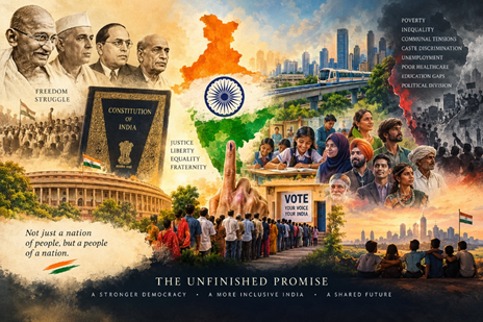
When India gained independence in 1947, it faced an extraordinary challenge. Partition had divided the country, millions had been displaced, poverty was widespread, and society was deeply unequal. India could have chosen authoritarian rule, a one-party system, or a political identity centred on a dominant religion. Instead, its founders entrusted the country’s future to democracy.
This was not simply a choice of government. It was a decision about who would own the nation: its rulers or its people.
Why did India choose democracy?
The freedom struggle had brought together people from different religions, castes, languages and regions. Democracy offered a framework in which these differences could coexist under a common Constitution. By granting every adult the right to vote, regardless of wealth, caste, religion, gender or education, India rejected the idea that political participation should be a privilege reserved for the powerful or educated.
Pakistan followed a different constitutional path, formally becoming an Islamic republic in 1956. India established a democratic republic based on constitutional government, equal citizenship and religious freedom.
The important distinction, however, lies not merely in how countries define themselves, but in how they treat their citizens. India’s constitutional commitments must be judged by their implementation, not simply by their declaration.
The challenges of independence:
India’s founders faced the difficult task of integrating princely states, managing Partition’s aftermath, protecting minorities, building institutions, and overcoming poverty. Caste discrimination, inadequate education, poor healthcare, and economic backwardness threatened the promise of equal citizenship.
The Constitution provided a framework of fundamental rights, parliamentary democracy, federalism, an independent judiciary and universal suffrage. Economic planning and industrial development were intended to improve living standards, while constitutional safeguards sought to address historical disadvantages.
The central challenge was to create a state strong enough to maintain unity and deliver development, yet restrained enough to prevent the misuse of power.
Was democracy a long-term solution?
Democracy was never intended as a temporary arrangement until India became wealthy or educated enough for self-government. It was a long-term commitment to public participation, accountability, and peaceful political change.
Authoritarian systems may promise faster decisions, but concentrated power can weaken scrutiny and suppress dissent. Democracy may require compromise and take longer to reach decisions, but it offers citizens peaceful ways to challenge governments and correct mistakes.
Yet elections alone cannot guarantee good governance. A government may win a majority while neglecting minorities, weakening institutions or treating criticism as disloyalty.
Democracy loses its purpose when winning elections becomes more important than governing fairly.
How far have we fulfilled the promise?
India has made substantial progress since independence. It has expanded infrastructure, developed industrial and technological capabilities, improved access to education and essential services, and maintained a constitutional framework through major political and economic changes.
Yet serious challenges remain. Unequal access to quality education, healthcare, employment, and wealth limits opportunities. Caste discrimination and religious tensions continue to affect social relations. Questions about institutional independence, media freedom, political accountability and the treatment of dissent remain central to debates about democratic governance.
Economic growth and national strength are important, but they do not automatically produce equality or justice.
A country must also ask who benefits from its progress, who remains excluded, and whether every citizen can question those who exercise power.
Are we united or divided?
India remains united by many shared aspirations: prosperity, security, dignity and a better future for the next generation. Elections, economic interdependence and everyday cooperation connect people across regions and communities.
At the same time, religion, caste, language, economic inequality and competing ideas of national identity create divisions. Political disagreement becomes dangerous when opponents are treated as enemies or when the rights of minorities are considered less important because they lack electoral strength.
The problem is not that Indians disagree. Disagreement is essential to democracy. The problem arises when political loyalty becomes more important than justice, constitutional principles and mutual respect.
We may be united in wanting economic growth but divided over who benefits from it. We may share a desire for national security but disagree over the limits of state power. We may celebrate India’s heritage while disagreeing over whose traditions and histories receive recognition.
National unity cannot be built by demanding uniformity. It must rest on equal citizenship and the assurance that every community belongs.
The danger of confusing the nation with its rulers:
A government is not the nation, a political party is not the people, and an electoral majority does not represent every citizen’s interests.
Governments change, but constitutional principles must endure. Criticism of a government is not necessarily criticism of the country. Equally, supporting a government does not exempt its actions from scrutiny.
When citizens excuse misconduct by their preferred leaders while condemning the same behaviour by their opponents, accountability becomes selective. Democracy suffers when people defend institutions according to who controls them rather than the principles they are meant to uphold.
Governments must respect constitutional limits, opposition parties must scrutinise power, the media must investigate, and citizens must question their own political loyalties as rigorously as those of their opponents.
The unfinished promise of 1947:
India’s freedom struggle was not fought merely to replace British rulers with Indian rulers. Its larger ambition was to give ordinary people control over their future and the opportunity to live with dignity, liberty and equality.
If access to justice depends on wealth or influence, the promise remains incomplete. If young people cannot find reasonable opportunities despite education and hard work, the promise remains incomplete. If minorities fear unequal treatment or institutions fail to hold those in power accountable, the promise of equal citizenship is weakened.
These shortcomings do not automatically mean that democracy has failed. They remind us that constitutional principles require constant protection, public scrutiny and practical implementation.
India’s founders entrusted the future to a system in which successive generations could debate, reform and improve the country. That responsibility now rests with us.
The measure of national success cannot be economic growth, military strength, technological achievement or electoral victory alone. It must also include fair institutions, equal opportunity, protected rights and public trust.
India’s independence gave its people the right to govern themselves. The enduring challenge is to ensure that self-government does not become merely the right of a majority to rule, but the shared right of every citizen to live with dignity, freedom and equal protection.
The real test of India’s independence is not simply whether Indians rule India, but whether India is governed in the interests of all Indians. That was the promise made to its people in 1947, and the responsibility of fulfilling that promise lies on the shoulders of every generation that inherits it.