
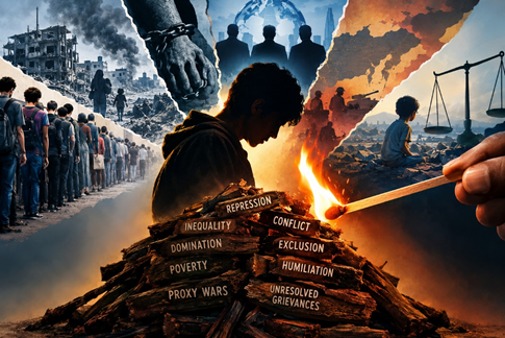
Is radicalisation really only a product of religious doctrine? Or does it emerge from a much larger mixture of political conflict, repression, economic inequality, foreign intervention, identity, humiliation and the frustration of people who believe that peaceful change is no longer possible?
Religion can certainly become a powerful vehicle for radicalisation. Extremist organisations can use religious language to justify violence, recruit followers and create a strong sense of identity and purpose. But to explain radicalisation only through religion is to risk missing the conditions in which extremist ideas become attractive.
Radicalisation is rarely a sudden transformation. It is often a process. A person may begin with unemployment, discrimination, political exclusion or personal humiliation. Prolonged conflict can deepen anger. Repression can create the belief that legitimate political channels have failed. Foreign intervention, occupation or proxy warfare can add another layer of resentment, particularly when people believe powerful states are determining the future of their region while ordinary citizens bear the cost.
Research by the UN Development Programme has illustrated this complexity. Its study of people who joined violent extremist organisations in several African countries found that economic opportunity and livelihoods were important motivations for many recruits. Among those who identified a specific event that pushed them towards extremism, many pointed to human-rights abuses, particularly those involving security forces. These findings do not justify terrorism; they demonstrate that extremist recruitment can flourish where people experience insecurity, exclusion and a lack of alternatives.
This distinction is essential. Understanding radicalisation is not the same as excusing violence. Nothing makes terrorism, murder or attacks on civilians legitimate. But if every extremist is viewed simply as a product of religious indoctrination, society may overlook the political, economic and social circumstances that helped make extremist propaganda convincing.
History repeatedly shows how political frustration can become radical politics. When people believe that institutions are corrupt, elections cannot deliver change, their community is permanently excluded, or powerful countries manipulate their region for strategic and economic interests, radical movements can present themselves as the only alternative. They offer simple answers to complicated problems: identify an enemy, blame that enemy for suffering and promise a complete transformation.
This is where ideology becomes particularly dangerous. It can take a genuine grievance and turn it into an absolutist worldview in which compromise becomes betrayal and violence becomes justified. A legitimate demand for justice can gradually become a demand for revenge.
The geopolitical environment can make this process even more destructive. Wars, occupation, state collapse and proxy conflicts create spaces in which armed groups can grow. External powers may support competing factions in pursuit of strategic interests, regional influence or access to resources. Local populations are then caught between forces much larger than themselves. Violence produces instability; instability produces fear and resentment; and resentment becomes material for further recruitment.
Economic inequality is another part of the picture. Poverty alone does not create extremists. Millions of people live in difficult circumstances without turning to violence. The danger increases when economic deprivation is combined with exclusion, discrimination, unemployment, and the perception that the system is fundamentally unfair.
Psychology and identity also matter. People searching for belonging, dignity, recognition or purpose can become vulnerable to movements that offer a powerful collective identity. Recruiters may not begin with theology or politics. They may begin with friendship, grievance, community or the promise of dignity. Ideology can come later, providing a framework through which personal frustration is interpreted.
There is therefore a warning here not only for vulnerable societies but also for the powerful.
History shows that political and economic domination can leave grievances that survive for generations. Colonialism is one of the clearest examples of how external control can shape political identities and historical memory long after formal rule has ended. But the lesson is broader than colonialism. Any system in which people feel that their political choices, resources, or future are being controlled without meaningful participation can produce resentment.
The same warning applies to contemporary geopolitics. When powerful states compete for strategic territory, energy, minerals, markets or regional influence, smaller societies can become arenas for proxy conflicts. The consequences; displacement, poverty, insecurity and political instability are experienced not by those making the strategic calculations but by ordinary people.
This does not mean that every grievance produces radicalisation. Nor does it mean that every political conflict is manufactured by powerful states. People retain agency, and extremist organisations deliberately exploit grievances for their own purposes. But ignoring genuine grievances can provide extremists with an opening.
The responsibility, therefore, is shared.
Governments must confront terrorism and extremist violence. Religious and community leaders must challenge interpretations that turn faith into hatred and make clear that no religious belief can justify attacks on civilians. Societies must resist discrimination and exclusion. And powerful states must recognise that security cannot be sustained indefinitely through military strength or political suppression alone.
A government may suppress a movement today, but if the grievances that helped produce it remain untouched, another movement may emerge tomorrow under a different name and perhaps an even more extreme ideology.
The fight against radicalisation must therefore go beyond policing and military action. It requires political participation, economic opportunity, accountable institutions, respect for human rights and credible avenues for peaceful change. It also requires confronting the conflicts and inequalities that allow extremist narratives to flourish.
The greatest mistake is to search for a single cause. Radicalisation is rarely born from one doctrine, one religion or one grievance. It is more often the point at which ideology meets accumulated frustration.
The more useful question is therefore not simply, “What religion does this extremist follow?” It is also: What happened before this person became an extremist? What conflict shaped him? What injustice did he experience? What opportunities were denied? What propaganda reached him? Who benefited from the conflict? And why did peaceful alternatives appear to have failed?
None of these questions excuses violence. But asking them may help prevent the next generation of violence.
Ideology may light the match, but political repression, inequality, exclusion, conflict, domination and despair can provide the combustible material. If the world wants to prevent radicalisation, it must confront both the ideology and the conditions that allow it to take root.
Ultimately, the real test of power is not simply how effectively it can suppress dissent. It is whether it can build societies in which people have meaningful dignity, opportunity and peaceful ways to demand change.
Because peace imposed through fear may silence a grievance, but justice, inclusion, and human dignity are more likely to prevent that grievance from becoming radicalism.
– – Aijaz Qaisar Azad, the author, is a professional artist (painter) and has over 25 years of experience in managing global marketing communications for major semiconductor MNCs and can be reached at aijazqaisar@yahoo.com.