Book Review
By
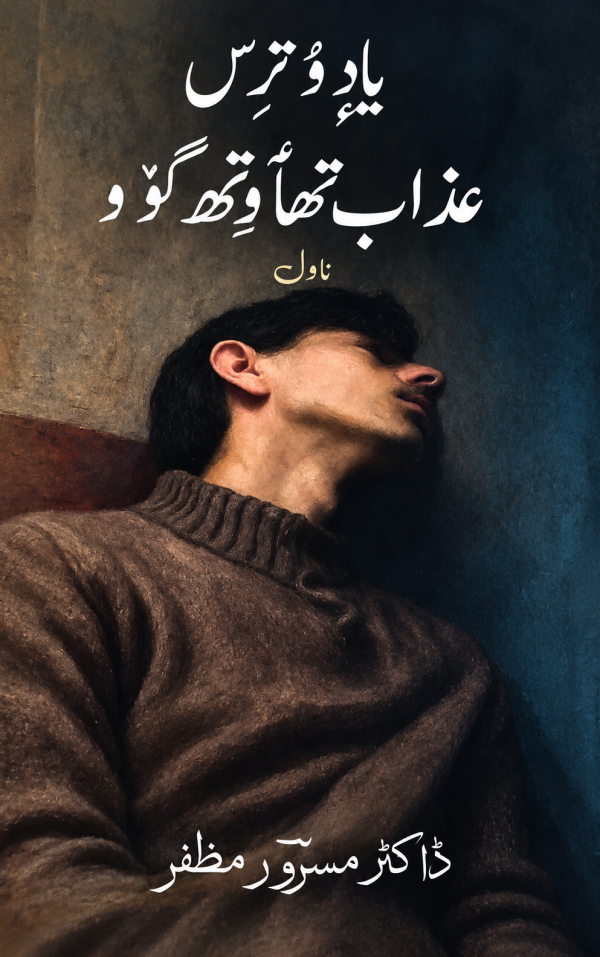
Dr Masroor Muzafar’s Kashmiri novel Yaad-e-Votris Azaab Thaveth Go (She Left Me the Torment of Memories) is not only a tragic love story of a poet, but it is also a fine attempt to portray the precarity of a generation trapped between education and employment.
The protagonist, Altaf, is a dedicated PhD scholar at Aligarh Muslim University, a responsible son from a middle-class village family, and a contractual college teacher. The personal journey of Altaf becomes a tool for the novelist to talk extensively about some burning issues like corruption and institutional exploitation faced by the educated youth of the country.
The novel is not a conventional love story rather it carries social realism within a narrative of romance. In this matter it is dandy addition to the Kashmiri fiction. University life, PhD research, contractual employment, academic uncertainty and the social prestige attached to government jobs occupy considerable space in the narrative. There are also autobiographical undertones: like the novelist, Altaf studies at the University of Kashmir before pursuing a PhD in Kashmiri at Aligarh Muslim University.
The novel’s opening is powerful. It begins in the lawn of Altaf’s house, where people are waiting for his dead body. The novelist initially withholds both the circumstances of his death and the complete story of his life, before taking the reader into the past through flashback. This creates an immediate sense of curiosity. The reader wants to know who Altaf is and what has led him to such an end. However, the narrative momentum generated by the opening is not maintained consistently. Once the flashback begins, some portions feel more explanatory than dramatic, and the story occasionally appears to be developing through deliberate narration rather than through the natural progression of events. The initial narrative momentum gradually gives way to a rather forced progression of the plot.
Altaf’s relationship with Sadiya forms the novel’s emotional centre. They meet unexpectedly on a flight to Delhi and gradually develop a relationship while pursuing their academic careers. The romance is important not simply as a love story but because it eventually becomes intertwined with many thought-provoking issues.
The Aligarh episodes are among the novel’s most interesting episodes. Masroor Muzaffar portrays the academic environment, hostel life, administration and experiences of research scholars while also drawing attention to wider problems in higher education, such as delayed PhD submissions, exploitation of women research scholars by supervisors, uncertainty and the psychological difficulties faced by researchers.
At the same time, the novel engages with corruption and institutional failure in a broader sense. Corrupt Politics in Kashmir, educational institutions and recruitment systems become subjects of criticism. Muzafar also depicts contemporary relationships with a degree of openness relatively uncommon in Kashmiri fiction. His willingness to enter uncomfortable social spaces is one of the novel’s notable qualities.
Sadiya’s betrayal shatters Altaf from within, leaving a wound far deeper than he can ever express. What begins as heartbreak gradually turns into despair, as Altaf finds himself unable to see a way out of the failures that have accumulated around him. In the end, overwhelmed by rejection and a profound sense of defeat, he takes the tragic step of ending his life by plunging into the waters of Dal Lake.
Altaf’s fate gives the novel its larger social significance. His tragedy raises questions about a society in which academic qualifications and intellectual ability do not necessarily translate into employment, social recognition or personal security. The novel does not offer easy answers; instead, it places the educated unemployed at the centre of a difficult social conversation.
The novel nevertheless has its limitations. Altaf is sometimes idealised to the point that he appears almost superhuman. The novelist repeatedly exaggerates Altaf’s character, creating the impression that he already knows everything and has little left to learn, whether about his academic subject, research, or even administrative matters. This excessive idealisation sometimes makes him appear less like a realistically drawn character and more like an exceptionally gifted figure whose knowledge and abilities are almost limitless. Such incidents are present in the novel in abundance. The protagonist is more effective when presented through his vulnerabilities, anxieties and contradictions. A more restrained characterisation could have made his eventual collapse more affecting. The narrative also contains a few minor language and typographical errors, suggesting that more careful proofreading would have benefited the published text.
These limitations do not diminish the significance of Muzafar’s attempt. Yaad Votris Azaab Thavith Goom brings together romance, academic life, unemployment and social criticism in a narrative rooted in contemporary Kashmiri experience. Its greatest strength lies in the questions it raises about education, employment, dignity and human relationships. It is neither a flawless novel nor merely a story of failed love; it is an earnest attempt to represent a generation whose dreams are often larger than the opportunities available to it.
Dr. Waseem Majazi is a writer, book reviewer, researcher, and Lecturer in English with the School Education Department, Jammu and Kashmir. His wider interests include Kashmiri literature, translation, comparative literary studies, and the relationship between literature, history, and society.